

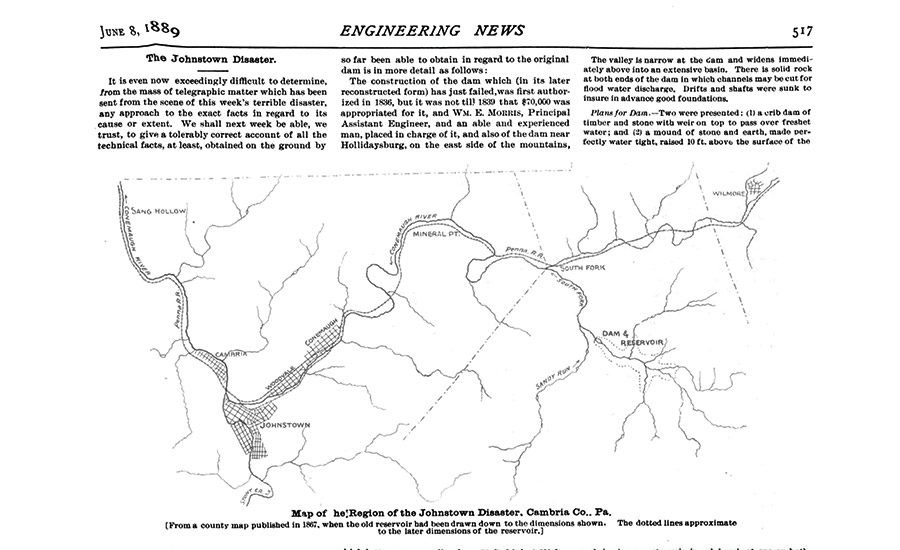

The small headline of the Engineering News article shown here belies the severity of the disaster: the deadliest dam failure in US history. The South Fork Dam in Pennsylvania was an earth and rock structure 72 feet high and 931 feet long. After a construction process halted for a dozen years, it was completed in 1853. The dam went through several changes of ownership and was inadequately repaired. Fish screens were installed that clogged the spillway and caused the water to burn and erode the structure. This body of water uprooted trees, rocks, houses, wagons and animals as it thundered down the valley before crashing into a stone railroad embankment. The fires lit by the wrecked locomotives burned for three days. The death toll was 2,208.
Journalists of that time worked in different conditions. The first weekly issue of Engineering News to carry news of the catastrophe was probably printed only three or four days later. The information came by telegraph, with telephones not yet widely used and no telephone number mentioned in the magazine header. It had an article describing the structure of the dam and two previous non-fatal failures in 1847 and 1862. There was also an editorial blaming the public for not having an official state government engineer overseeing the safety of the dam .
The following week’s issue contained first-hand reports. The flood damaged rail lines in the Johnstown region, but once rail service resumed four days later, “Two [unnamed] members of that magazine’s editorial staff, equipped with compass, hand level, tape, and camera, left New York.” The ENR staff traveled by train to Rockwood, Pa., and “slept in the clean hay of a dirty barn.” After reaching Johnstown the next day, they proceeded to walk 14 miles through “the bleak valley” to the broken dam.
“What they saw on the road, and the general state of the valley, we cannot attempt to describe and illustrate in this issue,” the publication continued. “The greatest point of interest to engineers about the disaster is the dam which caused it, and space and time are sufficiently engraved to present the facts about that structure as fully as we do in this issue.” There is a plan and elevation of the ruined dam taken from surveys made by journalists, as well as half a dozen engravings of the remains of the dam and the obstructed spillway. The engravings were made from photographs taken by journalists. At the time, printing technology, the halftone process, was not advanced enough to reliably print photographs.
His paper noted that a major factor in the dam’s failure was the collapse of its crest, due to expected settlement over time, which had not been corrected. This made the landfill less effective. Had there been no crestfall, “the dam would have had an excellent ‘fighting chance’ to survive intact, as it would have delivered an additional 1.5 to 2.5 feet of water into the spillway, despite the obstructions…”
Discussing the repairs made to the dam in 1879, the newspaper stated: “Indeed, the rebuilders, who received no engineering advice or supervision. …were much less careful about the dump area instead of more,” (emphasis in original text).
An editorial warned of the danger posed to the water supply of numerous towns and villages downstream by the presence of corpses, dead animals and broken sewer systems. He urged public officials to clear the debris quickly. Another article talked about one state, Rhode Island, as having the most effective dam safety laws in the US, and criticized Connecticut for having a toothless law. The publication went on to advocate that all states institute robust public oversight of dam safety.
