

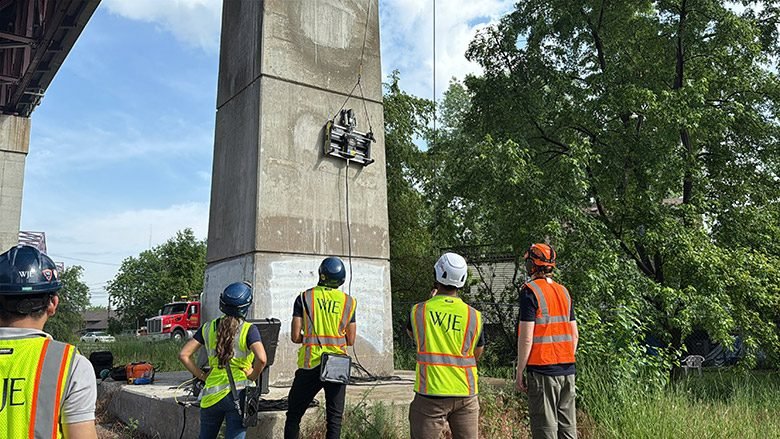
A wall-climbing robot powered by technology inspired by Formula 1 racing is helping engineers inspect hard-to-reach places such as bridges, dams, cooling towers and other massive, vertical structures.
Called HB2, the crawler-style robot was developed by UK-based HausBots. Engineering consulting firm Wiss, Janney, Elstner Associates is deploying it to help engineers inspect infrastructure more efficiently, quickly and safely than traditional methods involving lifts, scaffolding or rope equipment, the firm says.
The 29-inch-wide machine includes a PCI camera and is controlled via a joystick. It is able to adhere to concrete and other flat surfaces using a combination of airflow and suction technology. Engineers say it can scale tall structures while carrying inspection equipment that scans concrete, steel and other materials for deterioration.
For WJE, which handles structural assessment and non-destructive testing, the technology represents a change in the way these inspections are performed.
“It’s a means of access for us,” says WJE associate director and unit director Mohamed ElBatanouny. “The non-destructive [testing] equipment that works there, we are experts. We understand what the data is and can interpret it, but the robot can help our team collect data more efficiently and, in some cases, more safely.”
The HB2 can carry up to 6 kg of equipment, traverse rough surfaces and overcome obstacles like cables and screws, according to Jack Cornes, co-founder and CEO of HausBots. It can also operate in less than perfect weather conditions.
“If the wind is above a certain speed you [humans] you can’t even go up in an elevator,” says ElBatanouny. “You could have a team already mobilized to a place, but you won’t be able to do anything because of the strong winds. So, in a way, you’ve wasted your time. You have to tether the robot, of course, but you can make it go up and down. Conditions that are not safe for humans are safe for the robot.”
ElBatanouny first encountered the robot at a bridge preservation conference in 2024 when he saw it climb up the side of a truck and was intrigued.
“I said ‘OK. That sounds great,'” he says.
After graduating from university, Cornes and his colleagues built the first crawler prototype in 2017. The company currently has 40 to 50 robots operating in the field inspecting hard-to-reach places.
Cornes says other manufacturers make robots that use magnetic wheels to climb, but they only work on ferrous metal surfaces. Other systems that use vacuum pumps to create suction have been studied and tested, but these require almost perfectly flat surfaces for the machines to work.
“Our system has a fan, so it uses the airflow to make aerodynamics so the surface doesn’t have to be perfect,” he says.
WJE invited HausBots to demonstrate the tracker in June 2024 under both laboratory and field conditions. The pilot project involved inspecting damage to piers on the Chicago Skyway, a 68-year-old tollway on Chicago’s South Side. The challenge was to see if he could carry a series of non-destructive testing tools while climbing vertically on concrete surfaces up to 160 feet high.
The robot carried equipment for a half-cell potential measurement test, which detects the likelihood of corrosion in steel reinforcement within concrete, and for a MIRA ultrasonic shear wave tomography test, which uses multiple ultrasonic sensors placed against a pressurized surface. It sends sound waves through the concrete and creates a 3D image of what’s inside the structure.
“At first, I didn’t think a robot could perform this test because the device needs pressure against the surface,” says ElBatanouny. “But Jack explained that the robot was designed to handle that, and in the end it worked successfully.”
ElBatanouny says there are still cases where practical inspections are needed.
“If the data collected by the robot indicates that, and we want to go back and look at some specific areas more closely, we can have people do that,” he says.
A bridge inspection in Louisiana in rainy weather was faster, safer and more reliable with the robot, he says.
“The bridge is over water, so inspectors usually had to use a spike truck to get underneath. They still used the truck for close-up inspections, but they used the robot to scan the bridge and collect data continuously.”

The HB2 robot was used to evaluate a bridge in Louisiana in wet and slippery conditions.
Photo courtesy of WJE
WJE already has other ideas from teams they want the robot to carry, such as an impact echo or sounding, which involves touching a structure and using a sensor to measure how it responds.
“We’re actually doing internal research to develop a system like this that can work with the robot,” says ElBatanouny. “Jack has been very supportive – he immediately said he could help and it would be a good idea.”
Cornes describes the robot, which has a patent pending, as a tractor that transports different payloads. HausBot is also working on allowing the machine to carry equipment for core sampling on concrete that would require some type of drilling equipment.
“We want to encourage the diversification of this tractor as much as we can,” he says. “Our intellectual property is the tractor piece — how it attaches to the wall and how it climbs. But then, of course, we have to partner with experts like the WJE team to [look at] how to make this tractor even more useful. We’ll support almost any kind of new attachment or adaptation we can.”
After piloting the robot, WJE purchased the technology in late 2025 because, according to ElBatanouny, it “makes us better.”
