

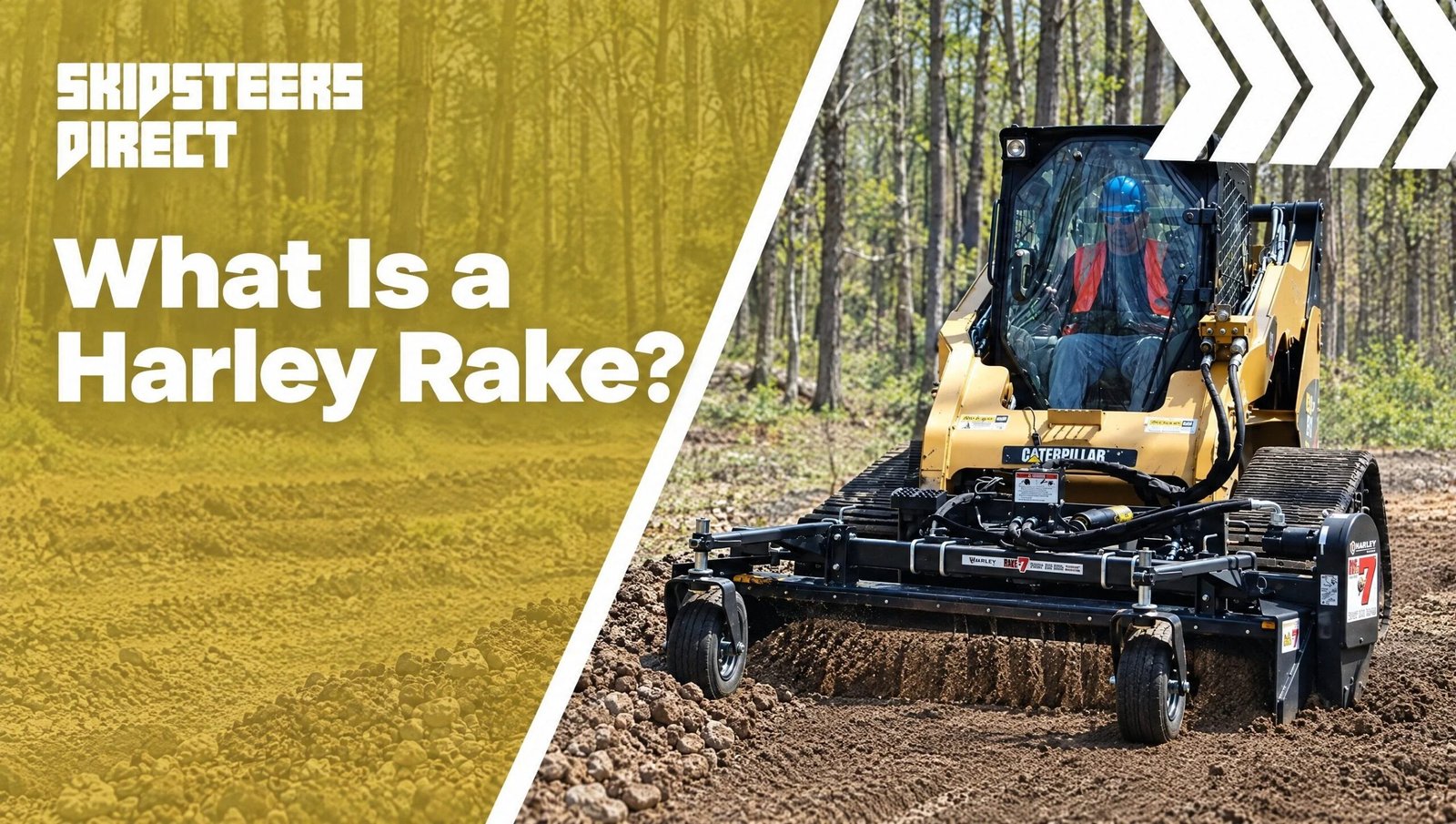
If you’ve ever seen a skid steer smooth out rough terrain into a seedbed-ready surface in a single pass, there’s a good chance it was running a Harley rake. It is one of the most useful attachments in landscaping and leveling work, and also one of the least explained. Here’s what a Harley rake actually is, what it does on the ground, and how it differs from a flat landscape rake.
FAST RESPONSE
A Harley rake, also called a power rake, is a rotary drum attachment that combines rock removal, soil leveling and seed bed preparation in one pass. Spring-loaded tines remove debris and stones on the surface while a rear roller bar smooths and grades the soil, replacing multiple hand tools for finish grading before turf or seed.
How a Harley Rake Really Works
The business end of a Harley rake is a rotating drum lined with spring-loaded teeth. As the drum rotates, the tines dig into the top few inches of soil, pulling rocks, roots and debris to the surface where they can be collected or swept to the side. A roller bar located behind the drum smooths and hardens the ground that has just been worked, leaving a flat and even surface behind the machine.
This combination, cultivation and finish grading in one pass, is what separates it from a simple drag or landscape rake. A landscape rake removes debris and levels loose material, but does not plow the soil or pull up buried rock like the rotating drum of a Harley rake does.
The drum itself is hydraulically operated from the miniature’s auxiliary circuit, and most models allow the operator to control both the direction of rotation and the depth of the tines from the cab. Rotating the drum in reverse to the direction of travel is what gives the tines their digging action, rather than simply skimming the surface as a drag rake would.
Rock removal, leveling and seedbed preparation in one pass
Most Harley rakes offer a windrow feature, which allows the operator to tilt a side deflector so that the collected rock and debris piles up along one edge of the pass instead of being scattered across the ground. In a second pass, the same machine can pick up this platform and remove it, or an operator can drag it by hand into a bucket.
- Cultivation: the teeth break through the topsoil and lift the buried rock to the surface.
- Threaded: a side deflector piled the debris to a rim instead of spreading it.
- Finish grading: the roller bar sickens and levels the worked soil behind the drum.
- Depth control: most models adjust the depth of the teeth to suit how aggressive a pass needs to be.
Width matters as much as depth in this attachment. A narrower Harley rake, in the 48- to 60-inch range, maneuvers well in narrow residential yards and around obstacles like trees and beds. Wider models, 72 inches and larger, cover ground faster on open commercial sites, but require more turning space and more hydraulic flow to effectively turn the longer drum.
Speed and depth settings for different ground conditions
Harley rakes are not a set-it-and-forget-it accessory. The depth and speed of the terrain must match the terrain conditions. Rocky, compacted soil requires a shallower depth and slower pass for the tines to work through, while already loose soil can usually be graded into a faster pass in a shallower environment.
Running too deep, too fast is the most common new operator mistake. It clogs the drum, stops forward progress, and leaves an uneven surface because the teeth cannot completely clear the material they have just removed before the machine has already moved forward. Slowing down and making a shallower second pass almost always beats forcing an aggressive pass.
A rough sequence for a typical job
- First pass, deeper environment. Work the soil and remove the rock to the surface, pushing the debris to the side as you go.
- Clean the spinner. Collect or remove the collected rock and debris.
- Second pass, shallow assembly. Finish leveling the now clean soil to a flat, seed-ready surface.
On larger jobs, a third pass of light in a very shallow setting can knock off the remaining high points from the first two passes, especially along the edges where the drum overlaps the least on each run.
More suitable jobs: lawn preparation, seeding and final grading
A Harley rake comes in handy on any job where the finished surface needs to be smooth and clean before anything falls on it, new sod, grass seed or a paver base coat or small patio pad. It is a common choice ahead of both residential lawn installations and larger commercial landscaping jobs where consistent quality is important.
- New construction lawn: the leveling and scrapping of the raw subsoil left behind after the leveling crew finishes rough forming.
- Turf Replacement: preparing an even, debris-free base so that the new turf makes full contact with the ground rather than bridging over high spots.
- Sports and municipal turf: maintain a consistent level in fields and park space where an uneven surface becomes a safety issue.
- Preparation before the hard landscape: level a base layer before pavers, a small patio or a shed pad.
Most Harley rakes fall into the standard accessory category rather than requiring high-flow hydraulics, although larger and wider models can push into high-flow territory. Please check the specific model flow requirement with your machine before ordering one.
When a simple level blade is the simplest and cheapest option
A Harley rake is not the right tool for all grading jobs. If the ground is already reasonably level and just needs a final smoothing pass, rather than tilling, removing rocks or preparing the seed bed, a grader attachment does the job for less money and less installation. Reach for the Harley rake specifically when soil needs to be worked, not just moved.
A helpful rule of thumb: If you can get an acceptable result by dragging a chain link section or box blade across the area a couple of times, you probably don’t need a Harley rake. If your soil has buried rock, uneven compaction, or needs to go from dirt to seed-ready in one operation, the Harley rake is worth the extra cost and setup time.
Keep tines and drum in working order
The tines take the brunt of the wear on this attachment, especially in rocky ground, and a worn or bent tine loses its ability to dig and lift material the way a straight, sharp one does. Most manufacturers sell tines as a replaceable wear part rather than requiring a complete drum replacement, so a quick visual check before a job, looking for tines that are bent, cracked or worn noticeably shorter than the rest, catches the problem before it shows up as an uneven finish on the floor.
The hydraulic drum motor and drive chain or belt, depending on the model, also deserve a periodic look. A drum that spins slower than it used to, or that sags in conditions it used to handle well, is often a sign that the drive’s components need attention before they completely fail mid-job.
Explore Power Rake models
Frequently asked questions
Is a Harley rake the same as an electric rake?
yes Harley Rake and Power Rake refer to the same accessory. Harley Manufacturing was an early and well-known brand of the tool, and the name stuck as a generic term as some brands do.
Do I need a high flow hydraulic system for a Harley rake?
Most standard Harley rakes run on standard flow. Larger and wider models sometimes require a large flow. Check the spec sheet for the specific model with your machine’s hydraulic output before purchasing.
Can a Harley rake remove rocks from a yard?
Yes, this is one of his main jobs. The rotating tines dig into the top of the soil and bring the buried rock to the surface, where it can be dragged to the side and dragged away.
How wide of a Harley rake do I need?
For narrow residential yards, a 48- to 60-inch model maneuvers more easily around obstacles. For open commercial sites, a 72-inch or wider model covers the ground faster, as long as the machine has enough hydraulic flow to turn the longer drum effectively.
