

Plans are moving forward in southern Indiana for a $280 million riverfront redevelopment planned to transform 430 acres along the Ohio River into a linear park. Caliber Engineering, based in Highlands Ranch, Colo., was recently selected to design and oversee the construction of a whitewater facility, intended as a distinctive feature of the project.
The Origin Park development, located in Clarksville, Ind., aims to repurpose former landfills, scrap yards and riverfront industrial areas into public spaces. The park, which is currently partially open, is expected to draw visitors from the Louisville metro area as well as Indiana, Ohio and other nearby states.
“We’ve acquired 80 percent of 430 acres and we’re in the process of clearing it,” said Dennis Schnurbusch, CEO of the nonprofit River Heritage Conservancy, which is leading the project to redevelop the area.
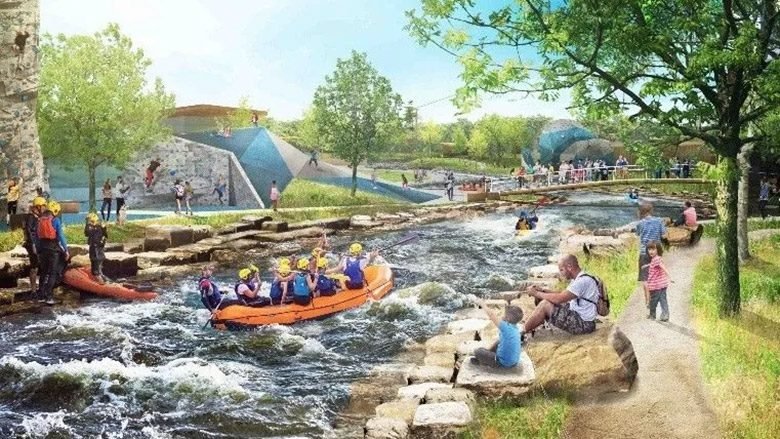
Wildwater at Origin Park, the wild water feature, is planned as the gateway and main attraction of the park. It is planned to have more than 3,300 linear feet of simulated whitewater river system, including a 2,000 linear foot recreational channel, a 1,000 linear foot competition channel and a 92 linear foot surf wave, offering whitewater experiences for beginners through elite athletes.
Caliber leads all aspects of the whitewater system, including channel design, hydraulic engineering, structural systems and physical modeling, as well as civil engineering and integration with the broader park infrastructure. “We build these projects for adventurers, beginners and experts, who are looking for a unique whitewater experience that looks and feels like real whitewater,” Scott Shipley, Caliber’s whitewater division manager, said in a press release. “Our approach is rooted in designing from the user’s perspective, to understand how people will use the park and then design for those needs.”
The whitewater system itself represents a feat of engineering and environmental transformation, according to Caliber, which will build the whitewater course through two former landfills. Plans also include a high-capacity pump system capable of delivering flows of 900 to 1,200 cubic feet per second that will power adjustable whitewater features, including surf breaks and training areas, allowing for year-round operation.
The park is expected to ultimately include more than 22 miles of trails, paddling access points, and a host of other amenities, including zip lines, hiking trails, climbing walls, ropes courses, picnic areas, boardwalks, and retail space.
Construction of the $20 million, 14,000-square-foot event center that can accommodate up to 360 people was completed in May. The contractor was Dean Builds, which has offices in Lexington and Louisville, Kentucky.
Other remaining work includes restoration of 1.5 miles of creek trails, log removal and gully bridge construction.
Project team members include Perkins & Will (architect); Construct Solutions (Owner’s Representative); Cloward H2O (water treatment); WSP (structural engineering and MEP); ERI (feature design); JTL (surveyor); and PIME (geotechnical and environmental services).
Noting that plans for the park have been in the works for ten years, Schnurbusch said the whitewater feature is in the design phase and a construction date has not yet been set. He said he would like to open it in 2029 and envisions it being the site of Olympic whitewater rafting trials.
