

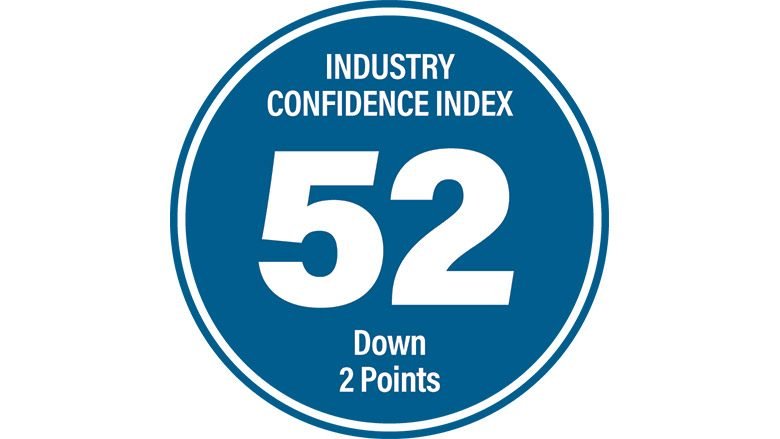
ENR’s construction industry confidence index fell marginally between the second and third quarters, down two points, but still rated slightly positive at 52. Sentiment has barely changed over the past four quarters, ranging from 52 to 54.
The confidence index measures executives’ sentiment about where the current market will be in the next three to six months and over a period of 12 to 18 months, on a scale of 0 to 100. A rating above 50 shows a growing market. The measure is based on responses from US executives at major general contractors, subcontractors and design firms on ENR’s top lists to surveys sent between Aug. 3 and Sept. 14.
The slight drop in confidence this quarter reflects growing pessimism about the near or average health of the construction market. Last quarter, 31% saw the market improve in three to six months, but that number dropped to 22% this quarter. In the period of 12 to 18 months, 18% of companies see a decline, compared to 11% last quarter.
Businesses are more pessimistic about the economic outlook, with the percentage expecting a declining economy in three to six months rising to 33% in Q3 from 23% in Q2. The proportion of companies expecting a decline in the typically optimistic 12-18 month period more than doubled from 11% to 26%. Overall, the economic index fell three points, to a somewhat pessimistic score of 45.

Design firms are the least confident of the ENR group, with a score of 47. Designers have the least confidence in both the current market and the market three to six months from now, but ever-optimistic, they are the most confident in the market 12 to 18 months from now. General contractors and construction managers are the most trusted, with a score of 59. Subcontractors come in at 49, but have much less confidence in the market 12 to 18 months out than designers or GC/CMs, with a confidence score of 55 for that time frame, compared to 66 and 70 for GC/CMs and designers, respectively.

Larger companies report much higher short- and long-term confidence levels than smaller companies. Business executives who self-reported that their companies earned $250 million or more in revenue scored a robust 63 on the Confidence Index and 54 on the Economic Index. Companies that reported revenues of $50 million or less posted scores of 41 and 37, respectively.
The results of the Confindex survey released by the Construction Financial Management Association, based in Princeton, NJ, tell a slightly different story than the ENR survey. Each quarter, the group consults with CFOs of general and civil contractors and subcontractors about markets and business conditions. The resulting Confindex is based on four separate financial and market components, each rated on a scale of 1 to 200. A rating of 100 indicates a stable market; higher ratings indicate market growth.
All the indexes the group tracks rose between 2 and 3, except for the “current confidence” index, which remained stable. The global Confindex rose 1.9% to a rating of 109. The “business conditions” index rose 2.9% to a rating of 112, while the “financial conditions” index rose 0.9% to 107. The biggest increase was in the “outlook for the year” index, which rose 4.5% to 115.
“It would have been expected, given the costs borne by construction companies and the significantly higher interest rates recently, that [industry] Financial professionals will be less bullish than they were a year ago,” says Anirban Basu, CEO of Sage Policy Group and CFMA advisor. “In contrast, the Confindex is up 4.8% year-on-year.”
Association respondents report that they have remained busy, despite the headwinds. Only 18% of respondents cited construction demand as a concern, while 67% cited skills shortages, up 18% from the second quarter.
Sage’s CEO reports that construction costs have actually decreased for some companies he’s spoken to. “They said, ‘Look, three or four years ago, the contractors we were working with were enjoying incredible margins. Now, because there’s more competition for projects, they’re reducing those margins to something more historic and that’s helped lower construction costs.”
Money being pushed into the economy by federal deficit spending and the data center boom is another factor, Basu says. “These hyperscalers are now leveraging their balance sheets. They’re borrowing money and then pouring it back into the economy,” he says. “That’s good for construction. It may be an uneven construction expansion, but it’s broad enough for our general measures to be general.”
Basu also sees the dampening of project delivery keeping delays higher than they would have been otherwise. “Projects take longer because project owners need to manage cash flow. If I own the project, it will take longer to generate income for my other properties to help pay for those construction costs,” he notes. “So instead of having a four- or six-month project, it’s eight or twelve months.” Meanwhile, contractors don’t have enough workers to speed up schedules, Basu says. “The industry seems to have found a happy balance.”
Looking for quick answers on construction and engineering topics?
Try Ask ENR, our new intelligent AI search tool.
Ask ENR →
