

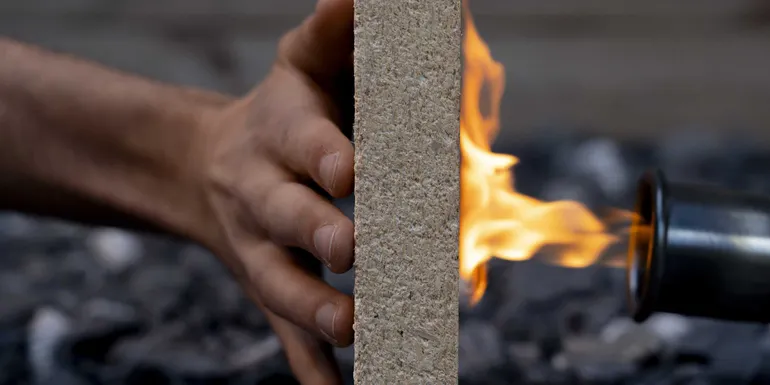
Researchers have found a way to turn sawdust into a durable and sustainable interior wall panel, but whether it is marketed as a product depends on how cost-effectively manufacturers can access a mineral that is key to the production process.
The key ingredient is struvite, a crystalline ammonium magnesium phosphate that builds up in the pipes of water treatment plants.
In pipes, ore is a problem. It creates obstructions that can cause backups. But because it has fire-resistant properties, it may have utility in construction applications, including panel boards, researchers at the Swiss university ETH Zurich. say in an article they published on the institution’s website.
“Struvite sawdust panels essentially protect themselves,” says Ronny Kürsteiner, PhD candidate and research assistant at the university, who developed the process as part of his doctoral thesis.
“Struvite is not only non-combustible, but also helps to actively increase fire resistance,” the article says. “When heated, the mineral breaks down, releasing water vapor and ammonia. This process absorbs heat from the surroundings, producing a cooling effect. The non-combustible gases that are released also displace the air, preventing the fire from spreading further.”
By itself, struvite is brittle, so the researchers mixed it with an enzyme extracted from watermelon seeds. This strengthened the ore to the point where it could be used as a filler for sawdust.
The enzyme works by enlarging the struvite crystals so that they fill the cavities between the sawdust particles, binding them together. When the compound is poured into a mold, heated and then cooled, it creates a panel that can be used as a building material.
“The material is stronger … than the original spruce wood” from which the sawdust is derived, Kürsteiner said.
The panels are also sustainable, the article says. When crushed and heated, the components separate and can be reconstituted into new panels.
“This new material could therefore be an important contributor to the circular economy,” he says.
Using struvite as a building material would not be cheap. Compared to polymer binders or cement, mineral is relatively expensive, the article says. But if manufacturers can find a way to cost-effectively access it from wastewater treatment plants, they’d get a source for the mineral while helping to keep pipes from clogging.
“We could use these deposits as raw material for our building material,” says Kürsteiner.
