

When Maryland state officials gathered May 7 for the installation of the final light rail segment on the Purple Line, it marked the end of a decades-long journey for the 21-station, 16.2-mile project intended to connect two well-developed suburban counties of Washington, D.C. in one of the largest public-private transit partnerships in the United States. Plagued for years by lawsuits and rebid in 2021 after the original design team left, the project is back in the works, and will begin passenger service next year. With track construction complete, “We are trying to complete it [overhead catenary system] they’re working right behind,” says Hugo Fontirroig, project executive for Maryland Transit Solutions, a joint venture led by the North American subsidiaries of Dragados and OHLA USA. Crews are now finishing up the installation of 1,000 catenary poles, landscaping, paving and testing of the 28 light rail vehicles. “We have good momentum to finish the civil construction year.”
The alignment connects the cities of Bethesda, Silver Spring, College Park, and New Carrollton and links them to the Maryland branches of the Red, Green, Yellow, Silver, and Orange lines of the Washington Metro, to three lines of the Maryland MARC commuter rail system, and to Amtrak’s interstate rail service. The concessionaire, Purple Line Transit Partners, led by Meridiam and Star America, will operate and maintain the line for 30 years after service begins, estimated at the end of 2027.

Designed to connect major centers of activity in Montgomery and Prince George’s counties without the need to travel through downtown Washington, DC, the line extends from Bethesda to New Carrollton.
Map courtesy of the Maryland Dept. of Transportation
difficult times
The vision for the system took at least that long to take shape, with planning and studies dating back to the late 1980s. A team led by Fluor Corp. won a $3 billion contract in 2016 for the estimated $5.6 billion project to open in 2022. But it opted not to in 2020, citing disputes with state transportation agencies over delays and cost overruns, fueled in part by stakeholder demands and the pandemic liquidation250. The current cost of the project is now estimated at over $9 billion.
“Looking back to 2020, the line was 30 to 40 percent built and we had no contractors. This was unprecedented in American history,” James Mitchell, Purple Line project manager at AECOM, which is the Maryland Transit Administration’s program director, said in a post on the company’s website. “When the contractor dropped the tools, the [agency] he took over the day-to-day management of the project and suddenly had about 150 subcontracts,” he noted. “As program managers for the project, we stepped in to pick up the pieces and take on all the subcontracts on his behalf. Our project team went from 50 full-time employees to about 130 overnight.”
“This is the most integrated P3 job I’ve ever experienced.”
—Hugo Fontirroig, project executive, Maryland Transit Solutions
The agency and Meridiam built on the lessons learned. The new design-build contract included “a revised dispute process with faster timelines and a third-party dispute resolution board as a mandatory step in the process,” Jane Garvey, chairman of Meridiam’s supervisory board, told ENR in 2022, adding that the management approach will also focus on improving skills such as coordination and communication.
The new financing package increased the original $2 billion total construction cost by 75% and included a $1.76 billion Transportation Infrastructure Innovation and Financing Act (TIFIA) loan to replace the original $875 million loan to finance up to 33% of the $5.9 billion in eligible project costs. Other items include $643 million in private activity bonds issued to Purple Line Transit Partners and $293 million in equity. The project reached 80 percent completion in the three years since then, notes Ray Biggs, senior project manager for the Maryland Transit Administration. Adds Fontirroig: “This is the most integrated P3 job I’ve ever experienced. Everyone says it at every job. Here, it’s a reality.”

Testing of the light rail line was underway long before the last rail track was laid on May 8 at the future 16th Street-Woodside station in Silver Spring.
Photos courtesy of MDOT/MTA’s Purple Line Project

Measurement of challenges
Winding through busy streets and the large campus of the University of Maryland in College Park, turning sharp corners and adjacent roads and a golf course, the project was so complex and varied that the team has nine project managers, says Julio Velez, director of construction for Maryland Transit Solutions.
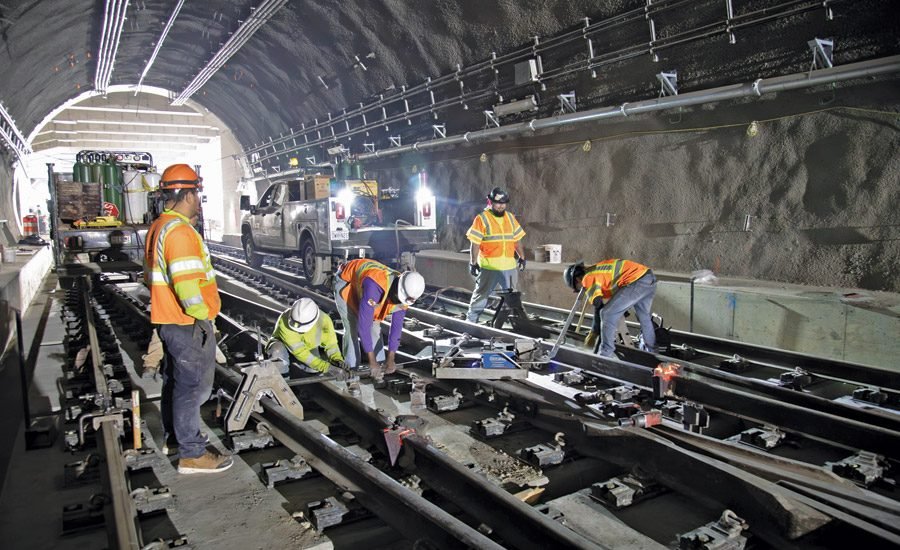
The alignment varies from level to elevated to a 1,000-foot-long tunnel; mixed traffic on dedicated track; and greenfield, brownfield, residential and commercial areas. Three types of railroads are used, depending on the area, Vélez says. Track embedded within concrete slabs or public streets is used in urban areas and on campus. Gravel ballasted track is used for dedicated ground-level rights-of-way. The direct-fixed track, with rail bolted directly to concrete foundations, is used in places that have small spaces that require greater structural durability, such as on elevated sites and on bridges.
Considering the large number of stakeholders, including those access roads affected by the construction, the team did additional work, including widening roads and sidewalks, improving drainage and reconstructing about 4 miles of the Capital Crescent Trail, as well as extending it about 1.5 miles as a concession in Montgomery County. Since the trail runs parallel to part of the road alignment, in this area “the entire structure [such as a bridge] it has to be built twice”, says Fontirroig.

The line-up runs through, over and under busy suburban streets and often alongside residences.
Photo courtesy of MDOT/MTA’s Purple Line Project
Other parts of the alignment parallel the CSX freight rail alignment, requiring the construction of a 2,000-foot-long impact wall. Proximity to a golf course and residential yards required the construction of eight 2-inch-thick, 500-foot-long vibration mats below the ballast rail and 4 miles of noise wall.
On the University of Maryland section, which includes five stations, crews installed a parallel underground power system so trains could run on a single overhead catenary cable, and it was necessary to mitigate electromagnetic interference with university labs, Fontirroig says. “On trains, there are strict requirements to measure the amount of energy emitted and keep it within a threshold,” he adds. The team also coordinated with the school so that major works took place over the summer.
In Bethesda, crews constructed a sheltered area between two new buildings for a 150-foot-deep shaft to create an elevator link to a Metro subway station. A 30-ton gantry crane excavated about 12,000 cubic meters of soil plus 20,000 cubic meters of blasting and drilling material, Velez says.
At the Silver Spring Transit Center, the alignment runs over a steel girder flyover bridge over CSX and WMATA tracks. Crews installed about 200 micropiles under the train platform to support the loft. “We had to remove the central part of the platform, leaving the outer edge available”, says Fontirroig.
Crews also cut the inside of the platform, digging down to allow for the installation of minipiles, topped off by a pile cap that supports the footbridge. The work was done in three-hour night shifts so as not to disrupt revenue service. The alignment crosses 53 level interchanges and works with three types of traffic management systems: pre-emption (less waiting time for trains), priority (no stops) and regular traffic lights, notes Fontirroig.
The communications systems, a “football field” of cameras, audio and other equipment, Vélez says, were pre-wired and tested in the lab, then reconnected and tested through the central train control center in a 170,000-square-foot LEED-certified facility at Glenridge in Prince George’s County, along with railcar maintenance activities. A second facility is located in Lyttonsville, near Silver Spring.

Embedded, ballasted and direct fixing tracks are used in the Purple Line project.
Photo courtesy of MDOT/MTA’s Purple Line Project
To address the impacts of construction on small businesses, the Maryland Department of Transportation created the 2024 Purple Line Small Business Grant Program. According to the agency’s website, it has awarded nearly 250 grants totaling $2.6 million to date in Montgomery and Prince George’s counties.
The team also has a dedicated business engagement team that has awarded more than $81,000 in Beyond the Rails grants to community groups such as youth centers, schools and job training programs. It has awarded at least $400 million in work to minority-owned and disadvantaged business enterprises.
The Purple Line’s 142-foot-long cars, which the team says are the longest of their kind in the U.S., each carrying 430 passengers, will run every 7.5 minutes at maximum, with an end-to-end travel time of 63 minutes. A team led by Alternate Concepts Inc. and CAF USA Inc. will be responsible for operations and maintenance of the line for the next three decades.
