

Harsh winter conditions with “extremely cold temperatures and significant snowfall” led to two incidents in two weeks in May involving spalling of concrete and metal on busy roads leading to New York City’s George Washington Bridge, says Kathryn Garcia, director of the Port Authority of New York and New Jersey.
The snow and ice mixture seeped into the bridge’s plate system through the bridge’s expansion joints, along with salt, which further corroded some of the concrete, Garcia says.
The 85-year-old GW Bridge, which carries about 300,000 vehicles a day on 14 lanes of traffic between Manhattan and the New Jersey Palisades, is one of the nation’s most critical transportation links, according to the Port Authority of New Jersey. It has been restored since 2015 as part of the Restoring George programme. Like many other roads and bridges in the region, the bridge suffers from aging infrastructure that is increasingly causing safety issues for motorists.
The 14-lane Trans-Manhattan Expressway connects the GW Bridge with a busy section of Interstate 95 called the Cross Bronx Expressway.
“We immediately went in and closed those lanes and started banging, which literally [means] tapping to make sure we don’t feel any voids in the concrete, and then cutting anything we discovered in those inspections,” Garcia said at a May 21 news conference after the authority’s board meeting following the second incident on May 13.
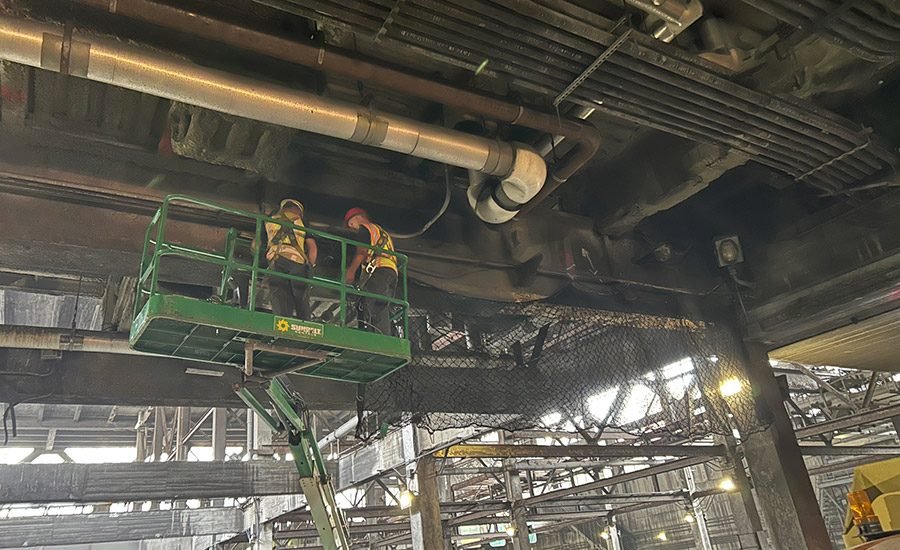
Additionally, crews installed construction-grade wire mesh as a precaution at all expansion joints to catch any additional debris that fell. “Crews installed webbing on all the expansion joints near the one that failed and now we’re redoing other areas,” says Garcia.

Quality wire mesh was installed outside the expansion joints at the lower level of the TransManhattan Expressway, located below the GW Bridge Bus Terminal near the George Washington Bridge.
Photo courtesy of NYNJ Port Authority
Port Authority crews installed 2,000 square feet of netting after inspecting 72,000 square feet of the overpass’ overhead structure, which included removing loose debris from overhead areas, the New York Times reported.
The most recent incident involved a passenger who was sent to the hospital after debris fell and hit his car as he approached the Trans Manhattan Expressway, according to the New York City Fire Department. The driver was taken to New York Presbyterian Hospital, but his condition was not available, the New York Times reported.
Another incident in which concrete fell on a car was captured on video over the previous weekend and appears to have happened near the same area, according to a report from New York’s ABC 7 News.
The first incident in early May involved material that was “almost like a shiny metal” with dust on it, Garcia said at the news conference. “The second one was a piece of concrete and so we’ve removed any concrete, like when we’ve hit it and we hear noise, we’ve had a few instances of it hitting it to make sure we can move passengers safely,” he added.
Before the recent spalling incidents, Garcia noted that the authority already had plans in place for “a long-term capital replacement on several of these flyovers and we will continue to work as we go forward in other areas out of an abundance of caution outside of the expansion joints,” he said.
A $250 million project to rehabilitate the overpasses in design builds on the Port Authority’s 10-year capital plan approved last year, the New York Times reported.
In other news, Garcia said authority personnel discovered a sinkhole May 21 at LaGuardia Airport as part of their routine inspections. “We continue to use ground-penetrating radar samples and core samples to find any additional voids,” he says.
