

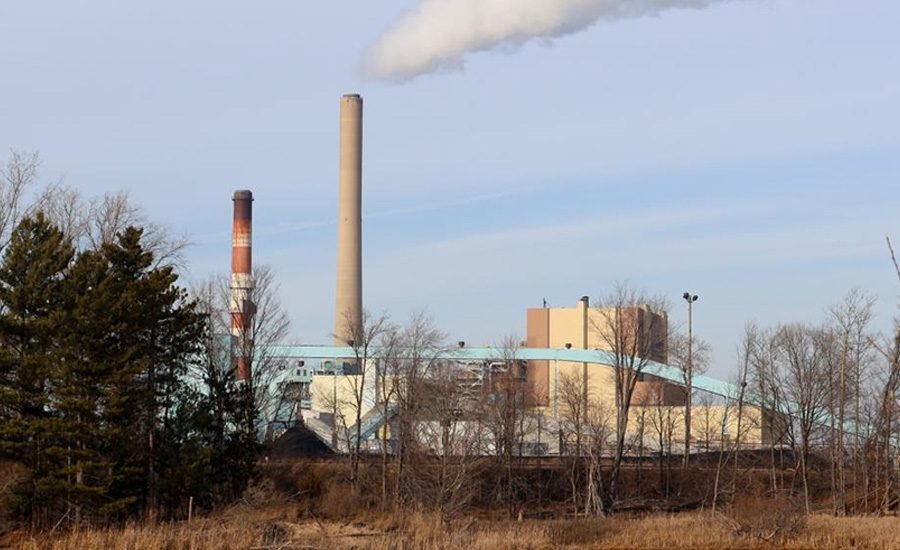
A federal appeals court has sharply limited the U.S. Department of Energy’s emergency authority to keep power plants available past planned retirement dates, vacating the agency’s original order that required Consumers Energy’s JH Campbell coal plant in Michigan to remain open.
The U.S. Court of Appeals for the D.C. Circuit ruled on September 11 that Section 202(c) of the Federal Power Act is a limited, last-resort authority available when a threat to grid reliability requires immediate federal intervention, not a mechanism to override state and regional resource planning.
The ruling vacates the agency’s May 23, 2025 order requiring Midcontinent Independent System Operator (MISO) and Consumers Energy to keep the 1,560 MW Campbell plant available beyond its planned retirement on May 31, 2025. The plant has remained available under successive agency orders since then and is currently required to remain available until November 14
The agency based the original order on adjusted potential reserve margins and an “elevated risk” of shortfalls during periods of high demand or low generation. But the order also acknowledged that MISO’s 2025-26 capacity auction had “demonstrated sufficient capacity”.
An assessment by North American Electric Reliability Corp. cited by Energy said MISO faced high risk, but also concluded the region had “adequate prior resources” under peak load conditions. The MISO auction produced a summer reserve margin of 9.8%, almost two percentage points above its target.
The court found that the agency never identified the severity, timing, location, or likelihood of a potential specific shortage requiring federal intervention. “The mere possibility of a shortfall in electric supply” was not enough to trigger Section 202(c), Judge Cornelia Pillard wrote for the unanimous three-judge panel.
Consumers Energy, which serves about 1.9 million electric customers in Michigan, had spent years preparing for a May 2025 retirement under a 2022 plan approved by the Michigan Public Service Commission that included replacement generation, solar development and battery storage. The commission found that the plan would “enhance the adequacy of resources,” while MISO separately determined that Campbell was not needed to meet its reliability criteria.
Looking for quick answers on construction and engineering topics?
Try Ask ENR, our new intelligent AI search tool.
Ask ENR →
At the administrative hearing, Energy argued that the secretary could act before a shortage became imminent and cited long-term concerns that most regions could face unacceptable reliability risks within five years.
The court rejected this rationale, saying that section 202(c) cannot be used as a “partial substitute for and disruption of states’ planning processes.” He called the federal intervention in Campbell’s “long and carefully planned retirement” and warned that such actions could distort the market signals used to determine when new generation capacity should enter or exit the system.
Later, the Campbell order remains in effect
The Sept. 11 decision applies to the agency’s original Campbell order. Challenges to several subsequent orders had been held in abeyance while the D.C. Circuit considered that directive; the court did not decide these later cases.

Key Events in the Planned Decommissioning and Continued Operation of the Michigan JH Campbell Coal Plant.
ENR chart
Consumers Energy has stopped decommissioning work at Campbell and continues to operate the plant under the current 90-day federal order, spokesman Brian Wheeler told ENR on Sept. 14. The company is reviewing the ruling and did not provide a new retirement timetable.
Wheeler said the orders totaled $259 million in net costs from May 23, 2025, to June 30, 2026. Consumers will work to ensure that “everyone who benefits from Campbell plant power throughout the Midwest pays their fair share,” he said.
The question of who pays ultimately remains before the Federal Energy Regulatory Commission. The DC Circuit noted that consumers intervened in the appellate case specifically to protect their ability to recover costs associated with Energy orders.
Michigan Attorney General Dana Nessel opposes shifting those costs to taxpayers. “Hundreds of millions of dollars in unnecessary costs are piling up and Michigan families will be forced to foot the bill to keep a plant online that should have been shut down more than a year ago,” he said in an Aug. 17 statement.
Energia defended its broader use of emergency authority after the ruling. “The Department of Energy’s emergency orders, including in Campbell, prevented blackouts and likely saved hundreds of lives during peak capacity events last year,” a department spokesperson told ENR on Sept. 14. The agency said Campbell operated at more than 650 MW each day from Jan. 21 to Feb. 1 during Winter Storm Fern.
Earthjustice, which represented challengers in the Campbell case and is involved in challenges to other Energy orders, said the ruling would not end its litigation. “We will continue to challenge the illegal orders if the DOE persists in issuing them,” attorney Michael Lenoff said in a statement.
ENR report
Follow-up of federal power plant interventions
ENR has followed the Department of Energy’s increasing use of emergency authority to delay planned retirements of generating plants and the legal challenges that followed.
May 2025
ENR reports the first federal order keeping Consumers Energy’s Michigan coal plant available beyond its planned May 31 retirement.
December 2025
Energy orders TransAlta to keep Washington’s last coal-fired generating unit available as it moves forward with a $600 million natural gas conversion.
March 2026
Washington state and public interest groups are challenging the federal order, arguing that no regional energy supply emergency warranted intervention.
June 2026
ENR tracks additional federal stay-open orders as Campbell litigation reaches the D.C. circuit and utilities report mounting costs.
The ruling extends to other plant withdrawal orders
The administration continued to use section 202(c) on the same day the D.C. Circuit issued its Campbell decision. Energy Secretary Chris Wright issued another order on Sept. 11 requiring TransAlta Centralia Generation LLC to keep the 700 MW Unit 2 of its Centralia Centralia plant in Washington available from Sept. 13 to Dec. 11, citing elevated Northwest reliability risks during extreme weather conditions.

TransAlta’s Centralia Generating Station in Washington remains under a federal order to remain open until Dec. 11 as the company moves forward with a roughly $600 million conversion from coal to natural gas.
Image courtesy of TransAlta
The directive extends a federal intervention that began in December 2025. TransAlta said in its July 31 quarterly results that Unit 2 did not generate electricity for the first six months of 2026 despite being subject to Energy’s stay orders. The company said it remained in compliance and was working with the state and federal governments.
ENR has followed the dispute since Energy first intervened in Centralia’s planned retirement. TransAlta has advanced a roughly $600 million conversion of the coal-fired plant to natural gas and previously told ENR the conversion remained a priority despite the federal directive.
Centralia d’Energia’s latest order requires TransAlta to notify the department within 15 days of receiving the necessary permits for the natural gas conversion.
TransAlta is not a petitioner in the Centralia challenges identified by ENR. Washington state and environmental groups have separately challenged the directives in the US Court of Appeals for the Ninth Circuit.
Energy has also used Section 202(c) to postpone retirement or closure plans at plants in Indiana, Pennsylvania and Florida. ENR previously reported that affected utilities cited added maintenance and operation costs, while some dispute the agency’s reliability findings.
The agency did not address ENR’s questions about whether the ruling affects its subsequent plant hold orders from Campbell and others or whether the department plans to seek further review.
The D.C. Circuit did not rule on Campbell’s subsequent orders, while challenges to Centralia d’Energia’s guidelines remain pending in the Ninth Circuit.
