


Chamberlin Roofing and Waterproofing is an established construction company that concentrates on new and repair projects. The company is headquartered in Houston, Texas with satellite offices in Austin, San Antonio, Dallas/Ft. Worth and Oklahoma City. They have a wide reach in the south-central Gulf states, doing business in Texas, Oklahoma, Louisiana, Arkansas and New Mexico.
Founded in 1897 in Detroit, Michigan as the Chamberlin Weatherstrip Company of America, the business has witnessed firsthand countless transformations, from a name change to advancements in the construction industry. More than 800 employees work at Chamberlin today, with its singular focus on “keeping water out of buildings.” To achieve this goal, Chamberlin has created and maintains a well-trained workforce and a well-thought-out training program.
The Village
Lyle Coston is the vice president and general manager of the Houston office and has been with Chamberlin since 2000. Prior to Chamberlin, Coston began his construction career in the field in 1997 as a waterproofer and caulker for another company in Austin. His career path is like that of most of his colleagues at Chamberlin: he worked his way up. The company develops its talent from within.
When Coston started working with Chamberlin, he wasn’t sure where he wanted to take his career. Coston said the CEO emphasized that co-workers would recognize his talent and help develop his skills to bring out the best in him.
“I asked our CEO ‘What are some ways I can move up within the company?'” Coston explained. “He gave me an idea and a piece of advice: ‘Your peers promote you. They’ll help you promote yourself.”
The CEO then added another piece of advice: Help develop others.
“Throughout my career, I’ve always tried to take the time to answer questions and have an open door policy,” Coston said.
It’s a philosophy that permeates the Chamberlin culture: they encourage and promote growth from within.

Image: Chamberlin Roofing & Waterproofing
“We build our teams [internally] and put them on a career path,” Coston said. “We’ve created a program where our employees can grow. We encourage and empower the workforce to grow through education. Training empowers employees to control their destiny.”
The Evolution of a Training Program: From Chamberlin ‘U’ to NCCER
The driving force behind the team approach is Chamberlin University (Chamberlin ‘U’), a training curriculum that has evolved and formalized since it was conceived in 2006.
Chamberlin ‘U’ is part of a broader company strategy to prepare its workforce through training and education for an ever-changing industry. Chamberlin ‘U’ has graduated hundreds of craftsmen and superintendents since its inception and invested thousands of hours in training and education.
Over the years, the company adjusted and modified the framework of courses at Chamberlin ‘U’, but a more formal program was not instituted until 2019, when the accession of Operations Management was pushed for more structured training.
“Once we got the commitment,” Coston said, “the program took off!” It was in 2019 that Chamberlin ‘U’ began incorporating NCCER training programs.
Operations management
Shane Hubbard is senior director of operations in the Houston market and oversees the waterproofing and roofing contractor divisions. Hubbard has been with Chamberlin for 34 years and, like Coston, also got his start on the field. Today he works with Coston and closely with Chamberlin’s training and development team.
Hubbard described the integration of NCCER into Chamberlin’s training curriculum and its importance.
“We’ve put more emphasis in the last two years on NCCER because of how formal they are and curriculum development compared to what we had with Chamberlin ‘U,'” Hubbard said. “We wanted to supplement Chamberlin ‘U’ with training that was available through NCCER certifications.”
Chamberlin has been using NCCER modules such as Thermoplastic Polyolefin (TPO) and Modified Bitumen, Level 1 and Level 2 roofing curriculum, along with safety, soft skills and technical skills classes that enable work crews to deliver quality, cost-effective projects that are completed safely and productively.
Leadership training
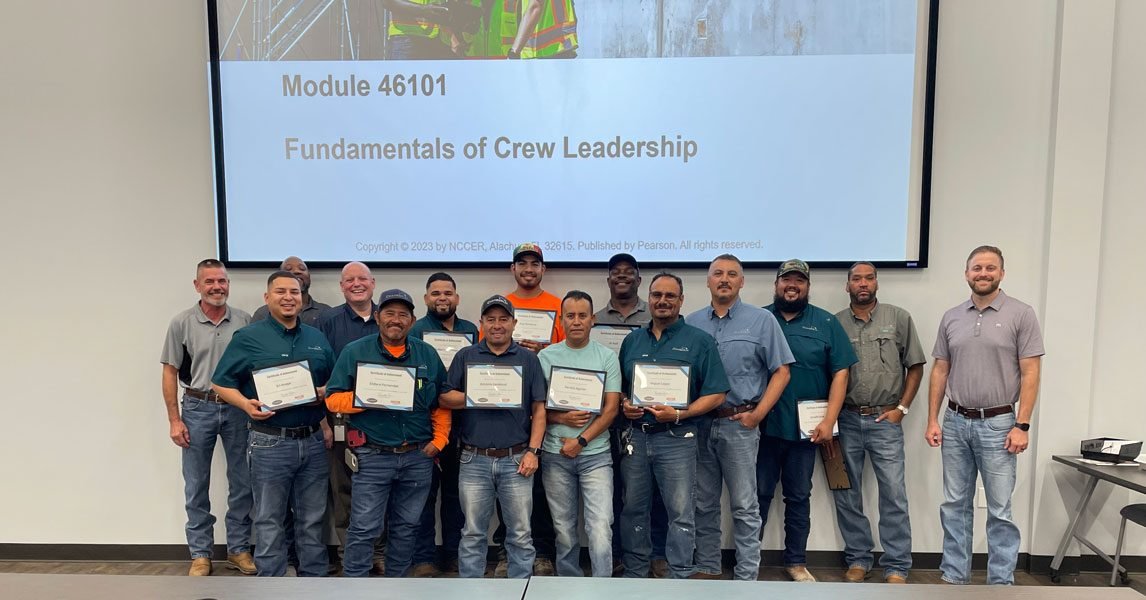
Hubbard said Chamberlin also emphasizes training for foremen and front-line positions, and the integration of NCCER leadership courses such as Mentoring for Craft Professionals and Fundamentals of Crew Leadership has benefited leadership development outcomes.

Image: Chamberlin Roofing & Waterproofing
“Since implementing the NCCER leadership courses, what I’ve noticed is the guys that we’ve taken Fundamentals of Crew Leadership to, once they’ve graduated from that class, their whole outlook on leadership and dealing with people, different personalities, and conflict has improved a lot,” he said. “There is a very noticeable improvement after taking these classes.”
The results of the classes have been so successful that Chamberlin now requires foremen and superintendents to take Mentoring for Craft Professionals classes as well as Fundamentals of Crew Leadership before graduating from Chamberlin ‘U’.
Training team – Training work
Representing the training team is Bradley Rowan, Director of Training and Development. Rowan is the exclusive administrator of Chamberlin ‘U”s NCCER certification. He started with Chamberlin in 2017 in the field, like Coston and Hubbard, then moved into quality assurance/quality control before landing in the training role.
As NCCER’s exclusive trainer, Rowan oversees leadership classes. He explained that the NCCER curriculum has made his job easier.
“Before we had NCCER, we created everything in house,” he said. “We had PowerPoints, we had pictures, but it took a long, long time. It took a long time to develop everything from scratch. NCCER has done a wonderful job standardizing everything and it’s nationally recognized.”
Rowan spoke of a recent conversation with a field operations manager who originally had concerns about the cost and time commitment for training, but has had a change of perspective after seeing the results.
“I was always asking, ‘Who’s going to pay for it? How is it going to be funded? We’re too busy. We don’t have time to train,'” Rowan recalled.
“It’s changed 180 degrees. It’s like, ‘You know what? Because of the training, we have a more skilled workforce. I’m able to do more than I used to and we’re a lot leaner. We’re a lot more profitable. Our call numbers are down and it’s a direct result of the training.’
“We’re doing more work because of the training,” Rowan said. “We’ve taken on more work and we’re doing it with fewer people because of a better trained workforce.”
To learn more about how NCCER can help contractors develop their workforce, click here.
