

A $360 million stormwater tunnel project in Manchester, NH is preparing for the arrival on site of a 281-ton TBM (dry) that weighs more than three times a 73.6-ton Abrams M1 tank.
The TBM is expected to arrive in early May and boring operations will begin in early August for the Manchester Cemetery River Drainage Tunnel project, says Mahmood Khwaja, design director of CDM Smith, the engineer of record who designed the project’s stormwater conveyance tunnel.
The combined design-bid-build sewer overflow project, one of Manchester’s largest public works projects, started in 2025, after almost five years of design. when the city awarded the contract to Methuen Obayashi Joint Venture, a national civil engineering partnership with expertise in complex infrastructure and tunnels. The project is expected to be completed in 2028.
Last month Khwaja traveled with the project’s design and construction team and officials from Manchester’s Public Works Department to Schwanau, Germany, where the TBM passed factory acceptance tests.
The US Department of Labor signed a strategic partnership with Methuen Obayashi JV earlier this year to promote worker safety and health during construction.
“The tunnel will have seven drop shafts that carry stormwater from future separation projects and current flows into the tunnel,” says Robert Robinson, chief engineer of the Environmental Protection Division of the Manchester Department of Public Works.
The wells will also serve as entry points for stormwater and provide access for construction equipment, a city statement said.
Robinson says the project is “the cornerstone” of the Phase II CSO Separation Program. aims to reduce sewer overflows by 74%, improving water quality for more than 500,000 people who depend on the Merrimack River, many in environmental justice communities.
.jpg "281 ton tunnel boring machine")
The team gathered at Herrenknecht’s factory in Schwanau, Germany, before the 281-tonne TBM passed factory acceptance tests.
Courtesy of Petra Enghhauser, Enghhauser Studio, Germany
Phase II follows the city’s $100 million investment in Phase I to mitigate CSO activation. The Cemetery Brook tunnel and seven drop shafts will carry all stormwater for Phase II CSO separation.
The tunnel will separate stormwater from sewage and transport the stormwater to the Merrimack River. The Cemetery Brook project and the overall program that includes six additional projects through 2040 will improve drainage flows, reduce CSOs and improve water quality in the Merrimack, Robinson says. The river is an important source of drinking water for more than 600,000 residents” in five Massachusetts communities south of Manchester and Greater Nashua, NH, including many environmental justice communities. Manchester receives its water supply from the city’s 15 billion-gallon Lake Massabesic watershed.
The new system is also designed to reduce flooding to alleviate basement backups and street flooding affecting about 115,000 Manchester residents, according to a statement from Parsons. The project is designed to improve public health by reducing CSOs and increasing the capacity of the sewer system during peak rainfall events.
.jpg "Internal segments of the TBM")
The inner segments of the TBM will be carried along the main body of the TBM before being loaded into the rear of the TBM transport system and brought to the mechanical arm at the end of the shield where they are placed segmentally.
Courtesy Molly Foster
Complex operation
Careful planning was necessary before tackling the more complex work that involved boring through mixed face conditions where soil and rock interface and through varying terrain, says Molly Foster, senior structural engineer for Parsons Corp., the project’s construction manager. The contractor selected a slurry tanker and is completing ground improvements to significantly reduce the risk, he says.
“There have been no rock-related issues with construction and the drilling and blasting of drop shaft two is underway,” says Foster.
Methuen Obayashi and its subcontractor, Austin Powder Co. they are managing drilling and capping.
During the design of the tunnel, CDM Smith faced technical challenges related to the difficult terrain conditions with the risk of encountering boulders.
“In areas where the tunnel crossed soft-to-hard-soil transition zones five times and the hydraulic design required an acute-angle connection to the tunnel at one of the drop-axis locations,” the team designed several tunnel rings to cut for an unusually long neck to which the inlet (shorter, smaller tunnel connection) would tie, Khwaja says.
Understanding subsurface conditions required extensive soil investigation because of the extreme variability of the soil, Khwaja notes. The research included more than 80 boreholes and an extensive geophysical survey, carried out in four phases totaling about two years.
Of the seven vortex shedding axes, five are offline and two are online, Khwaja adds. Two additional ventilation shafts connect directly to the crown of the tunnel. At the end of the discharge, the team designed a transition structure, an energy dissipation structure and a discharge structure in the Merrimack River, Khwaja says.
Drop shafts have a vortex approach channel and a vortex drop. “The vortex approach channel transforms a standard linear flow into a rotating/swirling motion,” says Khwaja. “The vertical drop shaft acts as a vertical conduit to transport the water in eddies to a lower level: the centrifugal force keeps the water ‘stuck’ to the outer walls, leaving a stable air core in the center, through which the air can escape.”
Three of the offline drop shafts have a deaeration chamber and a channel connecting to the main tunnel, the other two offline drop shafts are connected to the tunnel by a tunnel only.

Crews inject grout into the ground in a drop shaft to improve the quality and strength of the soil so the TBM can operate more safely and efficiently.
Courtesy of New England Studio
Site preparation
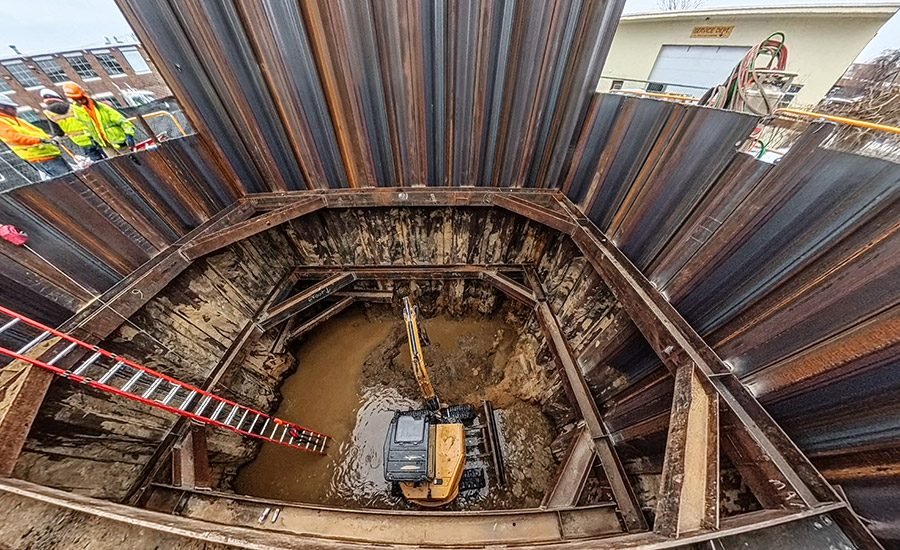
Crews are currently excavating the launch pit where the TBM will be mounted and mining operations will begin in late summer, says Jacob Blunden, project manager for Methuen Obayashi.
They are also installing tanks to hold the bentonite slurries, water and other solutions that support tunneling activities and the utilities and infrastructure needed to operate the TBM.
Working on busy city streets is difficult for the team in a location with restricted vehicle access. There is only a narrow area between the busy Queen City Bridge and the launch pit where the cranes must be positioned to lift and place the TBM components into the excavation.
In preparation for the TBM assembly, the team is busy reviewing everything, including “truck routing, grade changes, rig gear selection, turning radii, ground bearing capacity, electrical needs and worker safety requirements,” says Blunden.
Assembling the TBM will require a 700-tonne all-terrain crane and specialist equipment, he says before stressing the importance of the “skilled and specialist workers required to execute the work”.
