

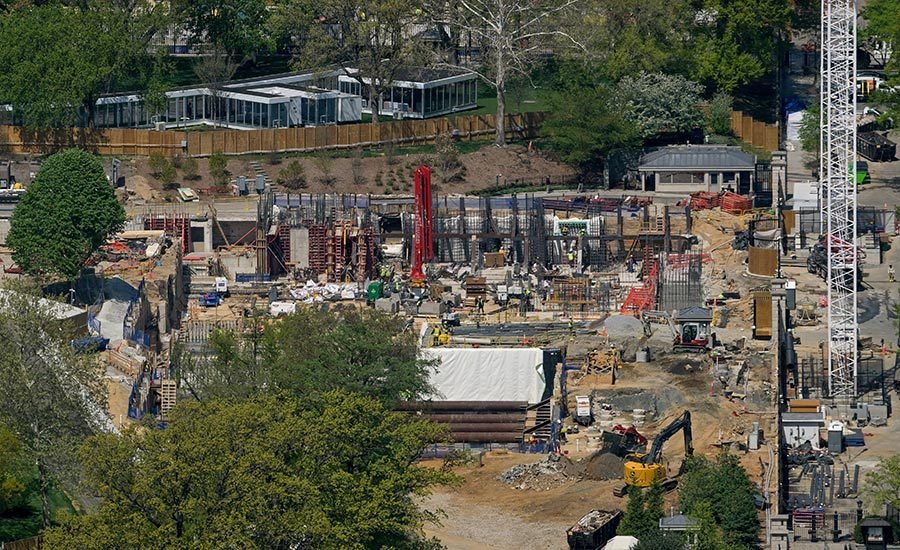

On April 16, a federal judge tightened his injunction against President Donald Trump’s planned White House state ballroom, barring any construction above the structure’s grade while allowing underground and security-related activity to continue.
In a memorandum opinion and amended order, U.S. District Court Judge Richard J. Leon clarified the scope of his March 31 injunction, drawing a legal distinction between permitted safety and security work and prohibited development of the ballroom itself, while imposing new limits on how construction can proceed.
Leon reiterated that the project must be halted unless it receives authorization from Congress, rejecting the administration’s argument that national security concerns require it to continue in full.
Calling the government’s interpretation of the original order “neither a reasonable nor correct reading,” Leon added that it was “unbelievable, to say the least, if not false” that the defendants argued that the order did not stop construction of the ballroom at all. The administration filed an appeal shortly after the ruling.
The April 16 opinion follows an April 11 order from the US Court of Appeals for the D.C. Circuit remanding the case for clarification. The amended order will take effect on April 23, with a compliance report due in mid-May.
The National Trust for Historic Preservation, which filed the suit last December, also filed a conditional cross-appeal on April 8 of Leon’s earlier ruling denying a first attempt at a preliminary injunction, preserving its broader legal claims if the appeals court reverses the March 31 order to keep the construction standing.
The court rejects the “built-in security” argument.
The administration’s central argument, laid out in an April 13 statement by US Secret Service Deputy Director Matthew C. Quinn, was that the project is “a single, coherent whole” in which underground national security facilities cannot operate without the ballroom structure above to cover and protect them.
Looking for quick answers on construction and engineering topics?
Try Ask ENR, our new intelligent AI search tool.
Ask ENR →
Quinn said planned features, including bulletproof and blast-proof glass windows, are being integrated throughout and warned that construction delays could allow adversaries to identify vulnerabilities in the White House’s infrastructure.
Leon rejected this reasoning for multiple reasons.
The security features planned for the ballroom remain months, if not years, away from installation, a point the appeals court noted, citing the administration’s own acknowledgment that the project won’t be complete for about two more years.
Leon also noted the government’s previous representations in the same litigation that the below-grade and above-grade jobs were “independent” of each other, finding those previous positions to directly contradict the current claim that the project is inseparable.
The National Trust’s April 14 response brief argued that the reversal reflected a worrying lack of candor, noting that the government had previously used representations about the unfinished design to delay a hearing on the initial injunction application.
Leon wrote that national security “is not a blank check to proceed with otherwise illegal activities,” and said four classified government statements, reviewed by the court, shed no further light on whether the upper-level ballroom is actually necessary.
In an April 16 post on Truth Social, Trump argued that the ballroom and its underground components work as a unified system, writing that the project is “a large, expensive and very complex unit” and that the underground facilities would be ineffective without the structure above. He also expressed concern for the safety of workers and challenged the court’s handling of the legitimacy in the case.
What can and cannot continue
The amended order draws a precise construction line. Work below the level may continue, including the development of what the government has described in the documents as bunkers, bomb shelters, protective partitions and military installations.
Limited above-grade work is only permitted to cover and secure those underground elements, with an explicit prohibition of any work that blocks the size and scale of the ballroom.
Waterproofing, water management, structural strengthening and addressing immediate site hazards, including exposed rebar and exposed cables that the Secret Service identified as hazards to personnel, can continue. Temporary security measures already in place for presidential protection remain under the order.
Vertical construction of the ballroom itself, including framing or structural steel construction, remains prohibited.
Acquisition and sequencing risks are growing
With the foundation systems and below-grade concrete work substantially complete, even a temporary ban on further above-grade construction could result in significant delays and increased costs given the constraints of site logistics on a restricted, high-security campus where staging and access are strictly managed.
There have also been some disputes over recruitment. Several media outlets have reported that Luxembourg-based ArcelorMittal is donating European-produced structural steel for the ballroom. This reliance on imported steel contrasts with federal “Buy American” policies generally applicable to government-funded projects, although these rules may not apply to privately funded projects managed outside of federal procurement processes. It also contrasts with the administration’s position on material procurement and tariff policies.
The cost of the project is estimated at about 400 million dollars and is financed entirely by private donations according to the administration. The White House is managing construction directly through the Office of the Executive Residence rather than a traditional general contractor.
Divided appeals court sets next fight
The appeals court’s April 11 order was not unanimous. Circuit Judge Neomi Rao dissented, arguing that the government had shown a strong likelihood of success on appeal and that the requirement should have been suspended entirely. Rao wrote that the project is likely authorized under existing federal law governing presidential authority over the White House and that the National Trust may not have standing, an outcome that could end the case without reaching the construction merits.
With the administration’s appeal filed on April 16 and the clarified injunction set to take effect on April 23, the next move rests with the appeals court and, if emergency relief is sought, likely the US Supreme Court.
