

Denver officials are exploring an infrastructure strategy that could provide a blueprint for rehabilitating dense downtowns.
The city is moving forward on a pilot project that will use geothermal wells and heat recovered from wastewater to create a shared environmental loop network between two downtown buildings and a sidewalk snow-melting system. It plans to later expand to 10 municipal buildings, at an estimated cost of approximately $280 million to $320 million over the next decade. City officials plan to reuse parts of Denver’s existing district infrastructure whenever possible to build the network, rather than building from scratch.
Drew Halpern, senior director of energy projects for Denver’s Office of Climate Action, Sustainability and Resilience, tells ENR that the city is looking at district heating infrastructure as a way to avoid the scale of power system expansion that could require widespread electrification of buildings.
But the engineering challenge shifts elsewhere.
“The geothermal piece is probably the trickiest part,” Halpern says, noting that a larger deployment could require drilling hundreds of deep wells while navigating dense underground infrastructure and restricted urban sites.
A June 2025 Environmental Loop Feasibility Study identified potential geothermal locations under parking lots and other downtown locations. While the wells themselves would not prevent future large-scale construction, excavation, foundations and future structures would require careful coordination among city agencies, building owners and utilities, among other vested interests.
A larger rollout could ultimately involve roughly 500 geothermal wells drilled to depths approaching 1,200 feet and distributed among various downtown locations, Halpern says. The concept also includes turning the former Cherokee boiler plant into what he described as the future “brains and brawn” of the system: a central hub designed to manage the overall grid.
Looking for quick answers on construction and engineering topics?
Try Ask ENR, our new intelligent AI search tool.
Ask ENR →
Halpern suggests the city may require a different delivery structure if the system expands beyond a pilot phase. “Cities are very good at building projects one at a time,” says Halpern. “They’re not always set up to create programs.” Ultimately, larger constructions could involve models that include a public-private partnership.
Denver’s approach differs from many legacy steam systems in older cities, Halpern says. Many systems established in cities such as New York, Boston, Washington, Detroit and Chicago take advantage of nearby rivers and other large bodies of water as thermal energy reservoirs, giving them the capacity Denver lacks. “Even when it’s 40 degrees or colder in the middle of winter, there’s still a lot of heat,” Halpern says. “We don’t have that.”
Denver’s hot, dry summers and cold winters create different design conditions than coastal cities, he adds, forcing planners to account for larger temperature swings without these natural advantages. These constraints pushed the city toward a multi-source approach built around geothermal heat recovery and wastewater.
RELATED
ENR Mountain States & Southwest, Best Project, Energy/Industrial: National Western Center
Sewer heat recovery meets the building limitations of the center
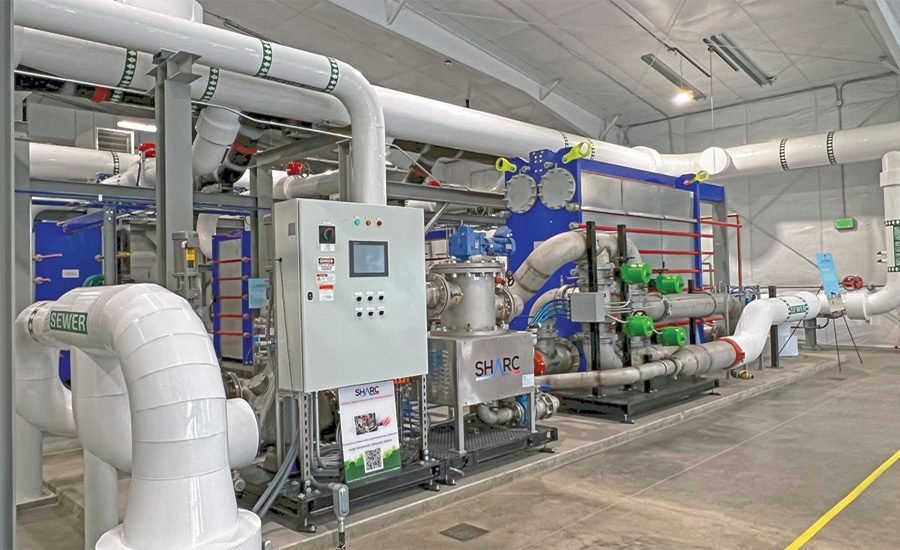
One of the first test cases was the 250-acre redevelopment of Denver’s historic National Western Stock Show campus, a best ENR project in 2023, which included what project participants describe as the largest sewer heat recovery system in North America.
The district’s energy system began operating in 2022 and now covers approximately 90% of the heating and cooling needs of seven buildings totaling more than 1 million square feet, while retaining capacity for future expansion.
A 72-inch-diameter sewer line, known as the Delgany Interceptor, forms the backbone of the wastewater heat recovery system, connecting to a 25-foot-deep wet well that transfers thermal energy to an environmental clean water distribution network. US Engineering Construction, which worked on National Western, says crews installed cooling towers, chillers, boilers and several 100-horsepower pumps, along with prefabricated piping systems, including 32-inch-diameter steel pipes integrated into the district loop.
Off-site prefabrication helped expedite the installation of 30-inch diameter carbon steel pipes, ducts and equipment. Five pump skids (each incorporating pumps, piping and fittings and weighing up to 30,000 pounds) were fabricated off-site before final connections to the utility plant were completed.
Project teams also encountered inaccurate civil construction and accelerated utility sequencing, requiring redesign and multiple concrete pours to maintain tolerances and avoid delays.
Blair Wisdom, director of energy at Metro Water Recovery, says the downtown pilot will use a substantially different approach than National Western.
How would Denver’s downtown system differ from National Western

The National Western Center District energy system uses a ex situor diversion, an approach in which wastewater is routed from the Delgany Interceptor to a wet well and central utility plant before the heat is transferred to the campus network.
Image courtesy of the National Western Center

Denver’s proposed center pilot would use one on site system that places the heat exchangers directly within the existing sewer infrastructure, eliminating the need for separate pumping and wet well systems.
Image courtesy of Huber SE
National Western relied on what Metro calls an ex-situ, or diversion, system in which wastewater was routed from the interceptor to a wet well and pumping system, then returned to the wastewater network after heat exchange. Instead, downtown Denver will rely on in-line or on-site heat exchangers installed directly into existing sewer infrastructure.
“In this case, we don’t need to build a separate wet well and pumping infrastructure,” says Wisdom. “We can only capture the heat in place.”
Wisdom says the approach reduces the infrastructure footprint and is better suited to pilot-scale demand by avoiding pretreatment equipment, wet well construction and other infrastructure requirements identified in the feasibility study.
Construction would still require work within the active sewer infrastructure. “We’re going to drain our pipe, so we’re bypassing the pumping, and then we’re going to install the heat exchangers in the pipe network,” says Wisdom. Crews would access the system through existing fences. “Most of the work goes to the interceptor,” adds Wisdom. “We really get to better management.”
Wisdom says National Western benefited from conditions downtown projects rarely have. “[National Western] it was a huge redevelopment effort,” he adds. Downtown integration, on the other hand, means working within “one of the most densely populated parts of the city.”
Metro Water Recovery expects its part of the system to require relatively limited maintenance once installed. The sensors would monitor system temperatures and thermal load. “We’ll know the temperatures, so we can know the type of heat load,” he says. “These systems require no maintenance, other than instrumentation.”
Wisdom adds that the company is already thinking beyond the initial pilot, considering whether thermal wastewater systems could play a larger role in reshaping Denver’s existing energy infrastructure. It is evaluating whether the thermal energy captured at its facility could support the decarbonization of Denver’s broader district steam network. “Really, that’s the first step,” he says.
