


Honeywell Technologies has been chosen by the Nigerian multinational Dangote Group, through its subsidiary Dangote Petroleum Refinery and Petrochemicals FZE (DPRP), as the preferred contractor to supply crude processing technology for the planned 16 billion crude processing plant in Kenya’s coastal city of Lamu.
The company will supply crude oil refining process technologies, licenses, engineering services, proprietary catalysts, equipment and digital solutions for Dangote’s 700,000 barrels per day (bpd) East African oil and petrochemical refinery project, which is expected to be the world’s largest single-train refinery when completed in 2030.
DPRP has also chosen Indian firm Engineers India Ltd for the $450 million project management and engineering, procurement and construction contract for the refinery, which was billed as Kenya’s largest foreign direct investment.
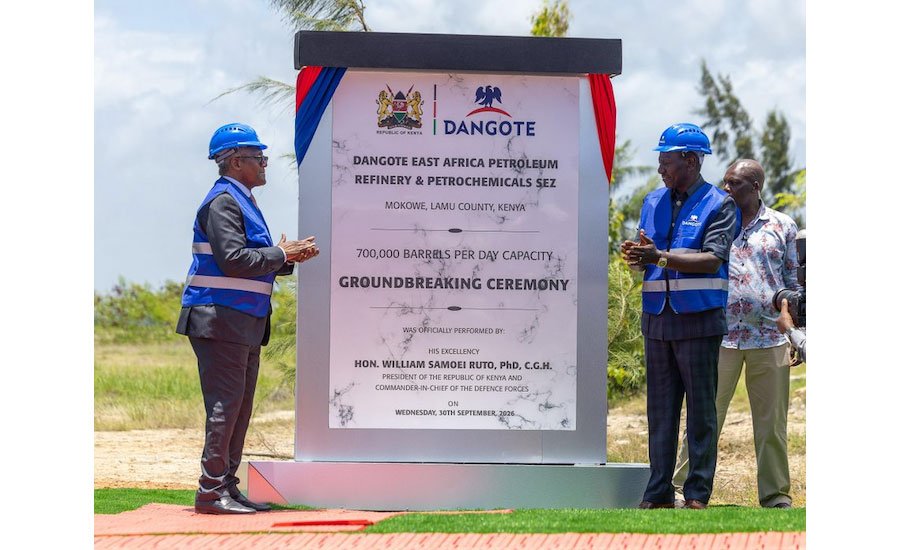
Kenyan President William Ruto and the founder and majority owner of industrial conglomerate Dangote Group, Aliko Dangote, led the groundbreaking at the project site late last month.
Honeywell was previously engaged by Dangote to provide engineering designs for the 650,000 bpd slab refinery in Nigeria’s Lekki Free Zone. The Nigeria-based refinery, with a Nelson Complexity Index (NCI) of 11.5, was completed in May 2024 and began operations in January 2024.
Honeywell said its new contract, valued at $300 million, involves leveraging the company’s “refining and petrochemical processing solutions to produce gasoline, diesel, jet fuel and polypropylene.”
Strengthen the refining capacity of East Africa
The refinery, which sits on 9,000 acres of land, with the potential to expand by another 3,000 acres, is expected to substantially reduce the volume of refined petroleum products imported into East Africa. Honeywell will provide technology capable of processing a wide variety of crudes, from light grades to heavy grades, enabling the use of raw materials from multiple regions and reducing reliance on any single source of supply.
Looking for quick answers on construction and engineering topics?
Try Ask ENR, our new intelligent AI search tool.
Ask ENR →
Aliko said the Lamu refinery would increase Africa’s refining capacity and strengthen long-term energy security for the continent while serving growing export markets for refined petroleum products.
He said the collaboration with Honeywell Technologies will enable Dangote Group to complete the new oil refinery facility on time and increase East Africa’s market share in the growing global demand for fuels and petrochemicals.
Honeywell Technologies President Rajesh Gattupalli said the partnership with Dangote has enabled the company to develop large train engineering designs suitable for the new crude oil refinery based in Kenya, with the potential to generate an estimated 60,000 direct and indirect jobs.
“We will also provide modifications that allow the refinery to process a wide range of crude feedstocks, helping to improve operational flexibility and reduce dependence on any one source or region of crude supply,” he said.
President Ruto said the refinery will “strengthen regional energy security, reduce dependence on imports and strengthen our foreign exchange”.
“This is more than a refinery. It is an integrated industrial complex that includes a 1,000MW power plant, a plastic factory and the manufacture of fertilizers and chemicals,” Ruto said. At least 50% of the output of the 1,000 MW power plant will feed into Kenya’s national grid, which currently has a capacity of 3,237 MW.
The refinery project will be financed through a combination of debt and equity with the Kenyan government pledging $500 million by acquiring a 10% stake in the project. DPRP has offered to sell 30% of the shares to other East African countries.
On September 14, Dangote launched an IPO for DPRP to raise at least $2 billion from the sale of 4.1 billion shares to fund Dangote’s East African Petroleum Refinery and Petrochemical Project in Kenya. The takeover bid, which closes on October 13, is not, however, an offer for shares in the Kenyan refinery project, according to the country’s Capital Markets Authority.
Setback due to lack of independent environmental review
However, some non-governmental groups and environmental activists have opposed the planned refinery project because there was no public participation in planning or approval as provided for in the Kenyan constitution. They also fear the adverse environmental impacts that the installation may cause.
“This project threatens to damage one of East Africa’s most fragile coastal ecosystems while locking Kenya into a risky fossil fuel future.” Greenpeace Africa said in a statement
The NGO called for an immediate halt to any development of the project until an independent environmental and social impact assessment is completed. He warned that “the refinery also risks becoming a stranded asset as the world moves towards cleaner energy and would also lock Kenya into decades of carbon-intensive development, worsening climate change and its impacts.”
“The huge capital required for a project of this scale could help accelerate Kenya’s renewable energy future through solar, wind, geothermal, storage and improved energy access,” the NGO added.
Meanwhile, Kenya’s High Court has certified as urgent the hearing of a petition seeking to compel the government to disclose official agreements and commitments regarding the planned refinery.
“Article 201 of the Constitution requires openness, accountability and public participation in financial matters. This obligation is directly committed when the State can deploy funds from the National Infrastructure Fund, public goods, patrimony, land, tax incentives, exemptions, guarantees or other tax supports,” says part of the petition. The petition is scheduled for hearing in the next seven days.
