

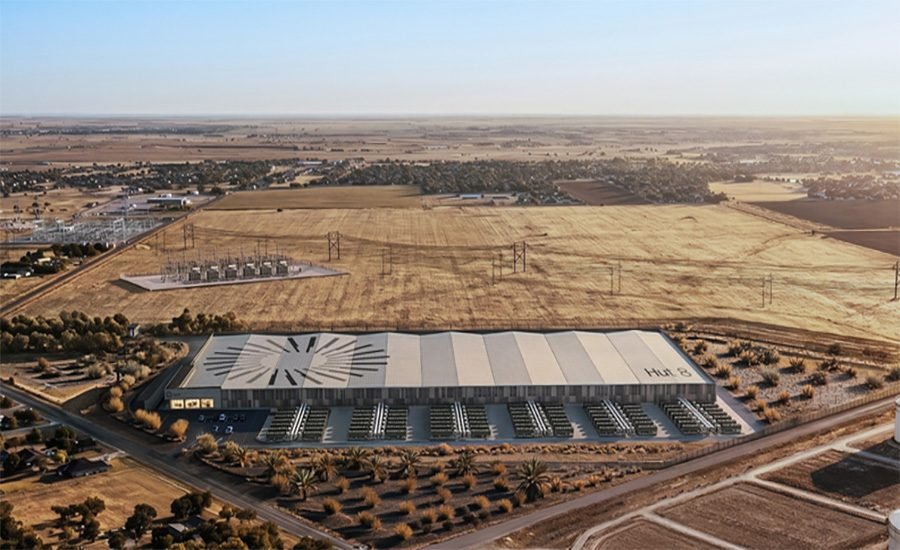
Jacobs has secured a sole-source engineering, procurement and construction management (EPMC) contract for energy infrastructure company Hut 8’s planned Beacon Point AI data center campus in Nueces County, Texas.
The award expands a partnership established earlier this year after Jacobs was named head of EPCM for Hut 8’s River Bend campus in Louisiana, and comes as contractors and network operators adapt to the growing demands for power and interconnection linked to large-scale AI installations.
The Beacon Point multi-phase campus is designed to support up to 1 GW of utility capacity. Its 352MW initial phase is backed by a 15-year triple-net lease valued at $9.8 billion over the base term, including a 3.0% annual escalator, according to Hut 8 disclosures.
The tenant, an unnamed “investment-grade firm” cited in investor materials, will deploy dedicated IT infrastructure at the site to support AI training and inference workloads.
Hut 8 CEO Asher Genoot told Reuters the deal is structured on a “take-or-pay, triple network no termination for convenience” basis. Three renewal options could increase the total contract value to approximately $25.1 billion, with expected average annual net operating income of approximately $655 million upon stabilization.
Jacobs will oversee phased delivery, integrated procurement and construction management, applying design elements of the Louisiana project to the new campus and deploying a digital twin of the data center to simulate critical assets during commissioning. Initial power is scheduled for 2027. The award comes as ERCOT advances proposed interconnection and reliability rule changes tied to heavy computational loads.
“This subsequent award underscores Hut 8’s confidence in Jacobs’ ability to deliver complex AI infrastructure with speed, security and certainty,” Jacobs President and CEO Bob Pragada said in announcing the award. “By combining our EPCM leadership with advanced digital twin technology, we are setting the benchmark for AI infrastructure deployment, optimization and resilience.”
Looking for quick answers on construction and engineering topics?
Try Ask ENR, our new intelligent AI search tool.
Ask ENR →
The project also shows how quickly power density assumptions are changing in AI infrastructure design. Beacon Point was initially underwritten to serve Hut 8’s affiliated subsidiary, American Bitcoin Corp., as part of a bitcoin mining strategy, before being repositioned to AI.

ERCOT data shows that projected high-load interconnection requests accelerate sharply through 2030 as AI campuses and other high-density computing facilities reshape transmission planning and network studies.
Click to enlarge
Chart courtesy of ERCOT
Following this change, the first data room had an initial scope of 224 MW before being redesigned to 352 MW after NVIDIA’s DSX reference architecture progressed to materially higher rack-level power densities.
Hut 8 said the redesign increased planned computing capacity by 57 percent without expanding the project’s land or utility footprint. The campus is now designed to this standard, with NVIDIA committed as a technology partner along with Jacobs, Vertiv and AEP Texas, a subsidiary of American Electric Power.
“Next-generation AI infrastructure will be defined by how quickly energy can be converted into AI capability,” said Giordano Albertazzi, CEO of Vertiv.
The first phase requires approximately 500 MW of utility capacity. Hut 8 has executed an interconnection agreement with AEP Texas for the full 1 GW campus and has already funded the construction aid contribution requirements and begun construction of the substation. The Corpus Christi Regional Economic Development Corporation is listed as a partner in the project.
Hut 8 said the project is part of a wider 8,375MW pipeline that encompasses projects under construction, development, exclusivity and due diligence. The company said its total contracted AI data center capacity now stands at 597 MW with a total base term contract value of approximately $16.8 billion.
RELATED
Report: Billions of dollars in data center construction risk not insured
ERCOT reworks the process of interconnection of large loads
The regulatory backdrop is evolving alongside a growing portfolio of hyperscale AI and computational infrastructure projects.
On April 29, ERCOT’s technical advisory committee voted to recommend new frequency and voltage requirements for data centers and other high-density computing facilities, a category that ERCOT now formally classifies as large computing loads.
ERCOT documented repeated instances of such facilities being shot offline during routine grid disruptions dating back to October 2022, and said more than 200 GW of large loads are currently seeking interconnection on the Texas grid, a volume the energy provider says has strained its existing case-by-case study process.
After the April 29 vote, ERCOT filed a technical correction to restore an exemption deadline inadvertently omitted from the approved draft, indicating that the rules remain in active refinement prior to state rulemaking.
A reform of the independent interconnection framework aims to replace individual project studies with a system-wide batch study process. ERCOT has described the current approach as “proven inadequate” amid an increase in requests for large loads, with each new application in a transmission zone capable of invalidating previous studies and extending project timelines by years. The reform was introduced on May 13 at ERCOT’s request, pending resolution of remaining technical and policy issues, with a Board vote scheduled for June 1 and an effective date of July 10.
RELATED
Oracle’s $16 million Michigan data center secures funding as power contracts face appeals
Beacon Point is Hut 8’s second AI campus, following River Bend in West Feliciana Parish, La. This project includes a lease of 245 MW of IT capacity under a 15-year, $7 billion agreement, with initial commissioning expected in the first quarter of 2027.
To finance construction of River Bend, Hut 8 closed a $3.25 billion fully amortization offering of 16.5-year investment-grade secured notes, described by the company as the first data center project from a single sponsor to access the non-recourse investment-grade construction bond market.
Back in Nueces County, commissioners met May 13, the same day ERCOT presented its interconnection review, to discuss a proposed Beacon Point data center reinvestment zone, going into closed session to talk with attorneys about the legal and economic development dimensions of a potential deal.
ENR reached out to ERCOT and Jacobs for additional information, but did not immediately hear back.
