

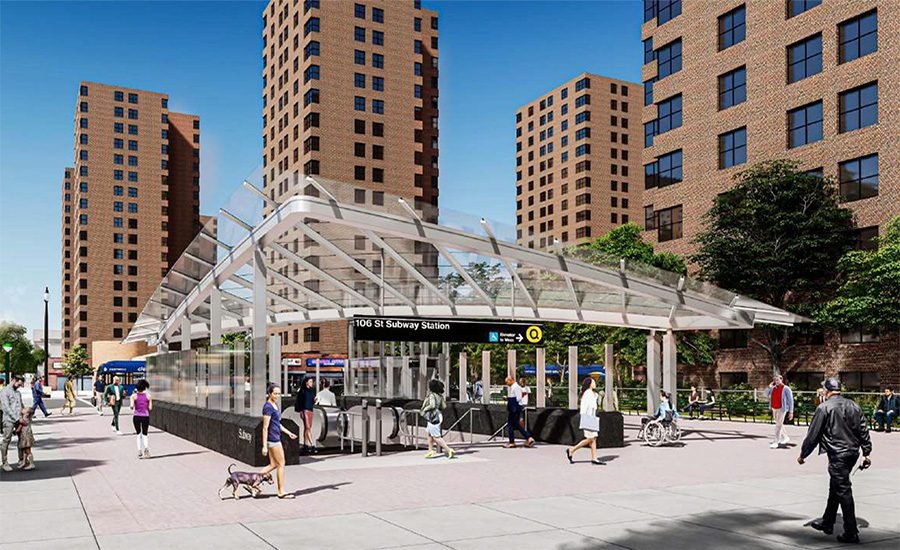

New York’s Metropolitan Transportation Authority has awarded a $1 billion design-build contract to a Skanska joint venture, Traylor Bros. Inc. and Walsh Construction for a key part of the Phase II expansion of the Second Avenue subway, advancing construction of the long-planned East Harlem extension after federal funding for the project was restored earlier this year.
The contract covers excavation, tunneling and construction of the structural shell of the future 106th Street station as part of the larger $7.7 billion effort to extend Q Line service in Manhattan north from 96th Street to 125th Street and Lexington Avenue.
The award, announced June 1, is the third of four major contracts covering the Phase II expansion.
The relocation of utilities near the future 106th Street station is already underway under Contract 1, while a separate $1.97 billion tunnel package awarded last year covers twin tunnels between 116th and 125th streets, the conversion of a 1970s tunnel segment to the future 116th Street station box, and the excavation of the Cavern the 125th Street station.
A fourth contract covering station finishes, tracks, signals, power, communications and other rail systems is still in the design phase.
The phased procurement strategy reflects the MTA’s broader efforts to reduce construction costs and risk. After Phase I examined its cost and complexity, ENR reported that the agency adopted a design-build approach, relocated utilities before major excavation and reused tunnel segments built in the 1970s.
The contract emerged from a competitive design and build procurement that included proposals from teams led by IPC2 Partners and SAS Constructors. MTA procurement documents identified Mott MacDonald as the lead designer on the Skanska-Walsh-Traylor team.
Looking for quick answers on construction and engineering topics?
Try Ask ENR, our new intelligent AI search tool.
Ask ENR →
Beyond the station shell, the team’s scope includes structural links to existing tunnels, excavation support, earthmoving, road surfacing to support traffic, construction of at-grade and below-grade station entrance structures, and utility support and reconstruction.
“We are proud to have been selected for the second phase of the Second Avenue subway, which will significantly improve New Yorkers’ mobility by extending Q Line access to East Harlem and Harlem,” Michael Viggiano, executive vice president of Skanska USA Civil, said in a statement. “Following the successful completion of Phase I in 2017, we are honored to continue our involvement in this transformative program.”
Chris Hebert, vice president of Traylor Bros., said the award continues the company’s work on the Second Avenue subway following its role in the construction of the 86th Street Cavern during Phase I.
“Projects like this demand deep underground experience, strong coordination and a commitment to working safely in one of the most complex urban construction environments in the country,” Hebert said. Continuing its partnership with Skanska, the company is “proud to help build infrastructure that improves mobility and will serve New Yorkers for generations.”
Skanska previously participated in the first phase of the Second Avenue subway through a joint venture with JF Shea Construction and Schiavone Construction.
Phase II will extend the Q Line approximately 1.8 miles into East Harlem, creating new stations at 106th Street, 116th Street and 125th Street. The 125th Street station will offer connections to the 4, 5, and 6 subway lines, as well as Metro-North Railroad service.
RELATED
DOT restores Second Avenue subway funding under court watch
The award follows months of uncertainty over federal involvement in the project. In April, ENR reported that the US Department of Transportation restored funding for Phase II after the MTA sought suspended reimbursement payments tied to the project’s full funding grant agreement. At the time, MTA President and CEO Janno Lieber said the authority would proceed with awarding contracts and mobilizing contractors after the reversal of the federal government.
“The $1 billion contract approved at our March board meeting is being awarded and contractors are being mobilized right away,” Lieber said in April.
According to procurement documents and Skanska, construction of the newly awarded package is expected to reach substantial completion in August 2030 with a contract term of 50 months. The milestone applies to this contract package; The MTA’s overall Phase II program remains scheduled to enter passenger service in September 2032.
An MTA spokesman did not immediately respond to a request for comment.
Once completed, Phase II will extend subway service from Second Avenue to East Harlem, providing a new north-south transit corridor while reducing ridership demand on the Lexington Avenue line.
