

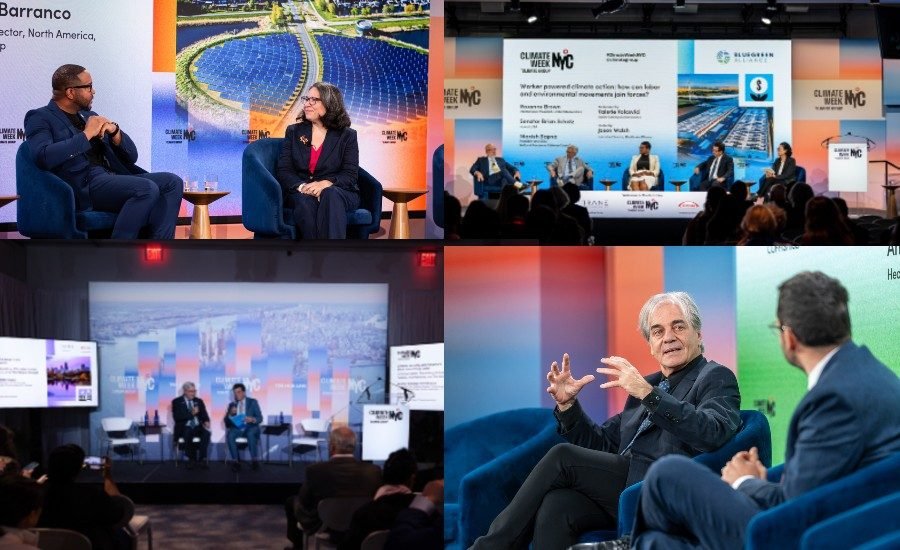

Despite the Trump administration’s ongoing efforts to spur a resurgence of fossil fuel development, many state officials, along with government leaders around the world, are moving in the opposite direction as they continue to advance programs and projects that would reduce greenhouse gas emissions.
The need has never been greater. Current climate modeling has underestimated future warming, said Phil Duffy, who served in the White House Office of Science and Technology Policy during the Biden administration and is now chief scientist at the nonprofit Spark Climate Solutions. “My mind goes to what’s called derailment risk, which is the idea that compound climate events can consume so much energy and so much attention that it becomes impossible to take the steps we need to address the underlying drivers of the risk,” he said during a September 22 panel at the annual Climate Week conference in New York City.
Timed each year to coincide with the September meetings of the United Nations General Assembly, the event shares an international focus alongside local and national concerns.
This year’s sessions and announcements demonstrated how localities, cities and regions are expanding their agency in climate response, including pooling resources and building partnerships. “In recent years we have seen state and regional governments … gain increasing international recognition as climate leaders,” said Andrew Forth, head of policy and advocacy at the Climate Group.
On September 22, the US Climate Alliance, a bipartisan coalition of 24 US governors, announced a partnership with Climate Mayors, a group of more than 350 mayors from 47 states committed to advancing climate action.
State officials noted that despite the administration’s headwinds, states and cities are still moving forward with plans and projects to reduce greenhouse gas emissions and still retain significant authority to do so.
The goals of the collaboration include sharing resources to accelerate the deployment of clean energy, reduce greenhouse gas emissions in line with the goals of the 2015 Paris Agreement, and build resilience to the impacts of climate change.
Looking for quick answers on construction and engineering topics?
Try Ask ENR, our new intelligent AI search tool.
Ask ENR →
“Together, we are a force. Working together, we can continue to make significant progress on climate, clean energy, electrification and more,” said Alliance Co-Chair and Washington Gov. Bob Ferguson (D).
On Sept. 23, he and California Gov. Gavin Newsom (D) announced that Washington had reached a milestone in updating its regulatory framework, allowing the state to join California and Quebec’s carbon market by 2027. Together, the three jurisdictions would rank as the world’s third-largest economy.
The California-Quebec carbon market has generated $13 billion since its inception, Jean Lemire, Quebec’s envoy for climate change and northern and arctic affairs, said in a separate session. “[It] put a price on pollution. That’s the key,” he said. “With the geopolitical situation, we’re not going to have a lot of money if we don’t find a way to self-fund what we do,” he added. A key use of that money is to help offset business expenses related to electrification.
The Under2Coalition, which now has more than 187 local governments, states, regions and other “sub-national governments” among its members working to achieve net zero carbon emissions by 2050, represents 1/8 of the world’s population and more than half of its GDP. “In many places in the world it’s the subnational governments that have the powers, the laws … we have to be around the table,” Lemire said, adding that the coalition shows that subnational governments have “a real influence that will continue.” The coalition also announced a partnership with Climate Policy Radar, which creates databases and other searchable information on climate legislation and legislation, to enable sharing of effective laws and policies, such as carbon markets.
“The transition to Net-zero is a construction project”
In a panel focused on sustainable materials, particularly less carbon-intensive concrete and steel, Lisa Kaufman, senior director of the Climate Group, told attendees, “Essentially, the transition to net-zero is a construction project. The climate-resilient cities of tomorrow, the levees that protect our coasts, the transmission grids that connect clean energy, all depend on low-carbon steel and concrete. This transition.”
Mariane Jang, senior adviser for policy, resiliency and sustainability at the New York State Office of General Services, pointed to a 2022 executive order from Gov. Kathy Hochul (D) that required state agencies to reduce carbon incorporated in building materials. “That’s where the opportunity for us is as a policy driver,” he said.
Since Hochul signed the order, the state has issued several sets of guidelines to agencies on how to reduce levels of carbon incorporated into materials, Jang said. He added that while New York is “very motivated and very driven,” general awareness of the issue across all sectors and across the value chain would help scale the use of less carbon-intensive materials.
The Climate Group launched its Blend Better Cement campaign earlier this year, calling on governments to switch to less carbon-intensive blended cement, which is based on supplementary cementitious materials such as calcined clay or limestone. The campaign advocates for supportive policies, such as updated building codes, and works with industry to increase the supply and access of additional cementitious material, prioritizing use in public projects.
“Working people must be at the center of climate policy and the energy transition, or we’ll be back where we started with solutions that don’t work and won’t work,” argued Jason Walsh, executive director of the environmental and labor coalition BlueGreen Alliance, in a session on how workers and environmental advocates can work together to achieve climate goals. He foresees the return of climate legislation that will merge emissions reduction targets with investment and benefits for workers.
Those goals work together in modernizing and decarbonizing ports, said United Steelworkers International union president and alliance co-chair Roxanne Brown. “Labor and environmentalists can work together to make sure we test our port infrastructure here in the United States and build that infrastructure for the future,” he noted.
“The political opening for climate change has never been more open,” said Sen. Brian Schatz (D-Hawaii). “We can say that cheapest also aligns with our work priority. Cheapest for you also aligns with solving the planetary crisis.”
While we’re still reeling from a storm that “set us back two years of the progress we were making,” Gary, Ind., Mayor Eddie Melton is preparing the city for a recovery that will harden infrastructure in anticipation of future migration influenced by climate change, he said in an interview. “[The] The Midwest is going to be a key area where people will be moving from all over the country because of the largest body of fresh water in the Lake Michigan area, so we need to protect that asset,” he said, while balancing the needs of surrounding industry and infrastructure, including construction of a new convention center and plans for a downtown rail station to make the area more walkable.
Gary has begun to “bridge the gap” in the relationship between the city and US partner Nippon Steel, “advocating for a green steelmaking process that is more energy efficient and cleaner, because we know that the steelmaking process is something we need as a nation.”
