

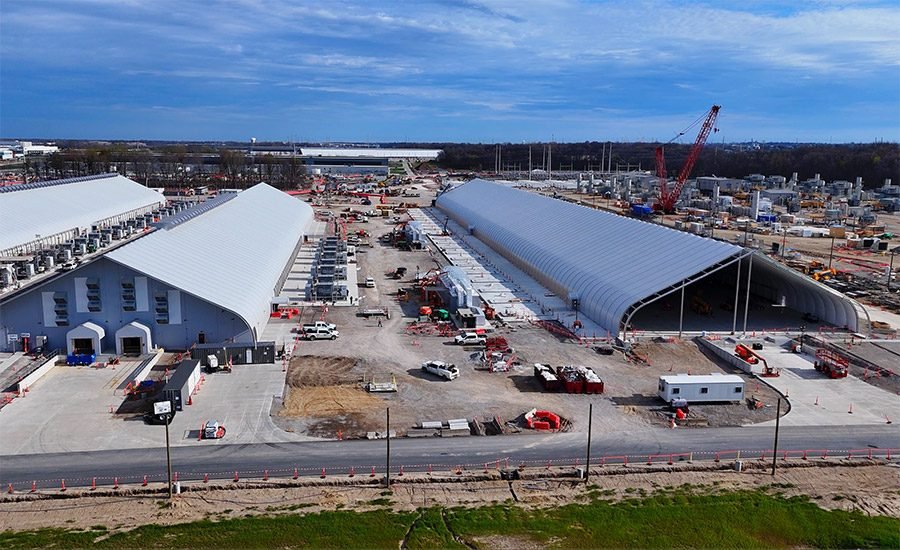
The explosion of data center projects in the U.S. to build capacity for AI companies has seen a broad mobilization of talent and resources across the industry to advance this massive construction capital expenditure. But labor shortages, high-demand skilled trades and relatively high worker turnover can create cracks in existing safety cultures.
“We’ve been very involved in hyperscale data centers and there’s been an increase in tempo,” says Marc Hutson, senior vice president and director of construction operations at JE Dunn. The Kansas City, Mo.-based general contractor is keeping up with the demands of hyperscalers, but not at the expense of safety. “Security is paramount in my company’s culture and we wanted to instill that in our data centers.”
But hoping for a strong security culture is not enough to make it happen in complex and ever-changing data center megaprojects. Multiple general contractors working on different projects with different sets of responsibilities create a tangled web of responsibility for safety training and management. General contractors across the industry are seeing their safety approaches tested by this booming industry.
“On a typical commercial construction job, like a big $200 million hospital, you’re doing $15 million a month in construction,” Hutson says. “But in hyperscale data centers … we do $60 million to $70 million in turnover in a month. If you approach it with an old-school mentality, you’re going to continue to fall short when it comes to preventing injuries. It’s very reactionary.”
There is no panacea for instituting a safety culture, but with multiple projects showing signs of stress and potential conflicts in how safety was applied on site, he turned to Caterpillar Safety Services, which JE Dunn has used in the past for safety training during subcontractor onboarding.
An external perspective on security management
It may seem strange that an original equipment manufacturer like Caterpillar has an in-house safety culture consultancy, but it has allowed the company to offer a different kind of help in the workplace. Not tied to any purchase or lease of Caterpillar equipment, Caterpillar Safety Services offers safety assessments and training, from existing modules and programs to packages tailored to meet the needs of contractors. And data center projects have been calling lately.
“In our conversations with contractors representing six of the largest data center companies, all of the information that has flowed over the past two years has similar themes: around precursors to near misses,” says Justin Ganschow, director of business development for Caterpillar Safety Services.
Looking for quick answers on construction and engineering topics?
Try Ask ENR, our new intelligent AI search tool.
Ask ENR →
Although part of the equipment maker’s larger global business, the safety unit is not tied to Caterpillar’s equipment customers or its dealer network. Instead, it offers its training and assessment services as a stand-alone service to contractors and their subcontractors. Ganschow notes that while the security unit has consulted in industries from mining to manufacturing and some of the riskier construction sectors, the data center construction boom brings its own set of challenges.
“What we are hearing [data center contractors] It’s that they’re seeing what we call error precursors,” he explains. This covers behaviors that don’t necessarily rise to the level of a recordable incident or a formal warning, but are the kinds of actions and warning signs that can precede serious safety incidents: communication errors that waste time and put workers in the wrong place; near misses in collisions and falls; and other small errors due to the stress
“Right now, data center owners and customers are driving different expectations about safety; some are so focused on recordable injury rates that they miss the ‘things that can kill you,'” says Ganschow. The debate over recordable injury rates (RIR) versus the more modern assessment of “things that can kill you” (often abbreviated STCKY) has been ongoing in the construction field, but Ganschow says Caterpillar Safety Services has embraced the philosophy. STCKY, especially in large and complex projects and deployments.
“Some of these [data center owner] clients put pressure on the contractor to reduce the [RIR]but there are mixed messages,” he explains. “For example: A contractor talked to the owner for about 20 minutes about safety and then spent over two hours on the schedule, so safety feels like a checkout activity to some of these people. This downward pressure on the schedule is causing a lot of negative responses in the field.”
And while it’s larger contractors who do the bulk of data center work—a recent ABC survey found that contractors with more than $100 million in revenue get the largest share of data center work—even a solid security program in place can come under strain when working in hyperscale data centers.
Ganschow says operating at full capacity can strain existing programs. “What I keep hearing is that these [large contractors] they’re running out of capacity and can’t handle more projects.” And that can make early precursors of unsafe practices harder to spot. “One of the big general contractors told me that we do big projects, but that [data center] the work we do now is two or three times more than what we did before,” he says. “We did a safety perception survey for a GC with 90 subcontractors: How do you establish a safety culture in 90 companies?”
Focusing on what works
The solutions to these security problems are not easy, but there are approaches that have yielded results. JE Dunn’s Hutson says he likes Caterpillar’s approach to safety services because it aligns with one thing he believes: safety can’t go its own way, it needs full adoption of operations.
“If operations leadership doesn’t adhere to security, you’re going to have security cops and all they’re going to get is a bad reputation, you’re going to become an enforcement arm with no recognized authority,” Hutson says. But if you can get superintendents and project managers safely on board, that goes over the line, he says. “The workers respect the super who leads the project and does the work, so they say and do [these safety practices]the craft [workers] emulate it and do what they do. It sounds pretty simple, but most things can be simple and still have leadership.”
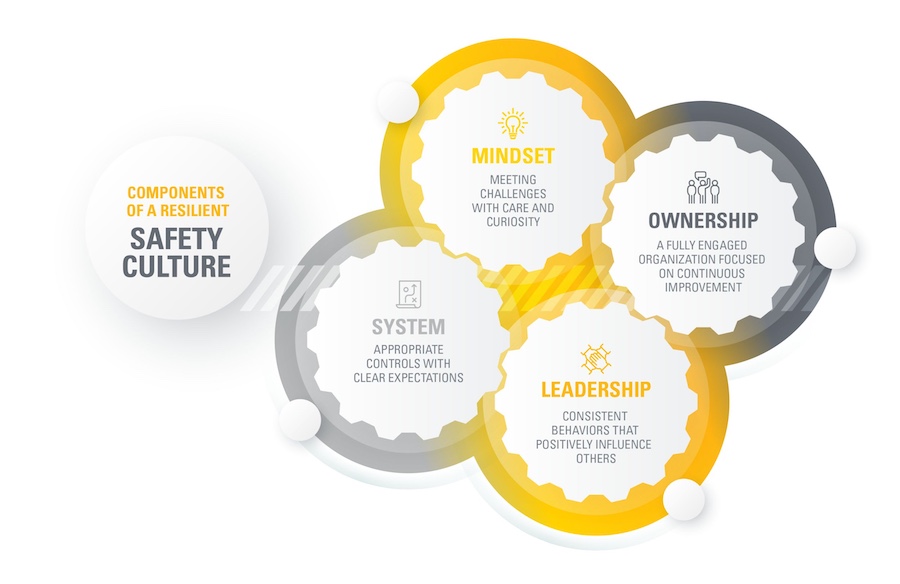 Graphic courtesy of Caterpillar
Hutson says that instead of just handing out flyers and reminders to staff, Caterpillar’s safety program encourages project managers and superintendents to be directly involved in safety enforcement. “Our firsts and supers need to focus on safety [as much as] the schedule They are better equipped than external consultants to identify hazards; many of our supers came up through the trades, so they understand how to connect and make things work in the trade. [workers].”
Caterpillar’s safety program works best when it’s built in from the start, Ganschow says, but they’ve been called on by ongoing projects to review safety programs. It starts with workshops at all levels of the job, and workers are asked to assess the safety of their bosses to find where the leadership gaps are. But it cannot stay here, he adds. “If we just do a workshop to tick the boxes, nothing changes. They’re not happy and that damages our reputation.”
The initial assessment is followed by on-site interviews, analyzing the approach to safety through 11 cultural indicators that Caterpillar Safety Services has identified. Incident reports are also reviewed and workers are asked how they responded. Ganschow says the goal is to encourage workers to talk about problems and not fear retribution. “We call it Talk and Listen. We want crafters to give and receive feedback and not be afraid of security cops.” Cat conducts bilingual training courses for on-site workers and puts front-line supervisors through root cause analysis training, helping to identify precursors to safety incidents.
And change is also needed at the top, with a one-day training course for senior supervisors and project managers. “For this top layer, we look at how humans work: why we make mistakes, how to learn from those involved to improve our system, and how it reacts to change,” says Ganschow.
Hutson had training from Caterpillar Safety Services on one of their data center projects for about eight months and was already seeing real results. And while the approach may seem simple, it’s the dedication to implementing it that makes it work, he says. “We’re doing very well at the old RIR, but more importantly we’re doing very well at executing the work safely.” He says he plans to roll out Cat’s safety approach to all JE Dunn data center work this year, with craftsmen not coming to work until they complete a one-day course and superintendents not allowed to work until they complete a three-day course.
“These hyperscalers have multiple GCs doing their work, but it’s a very collaborative group,” observes Hutson. And when these workplaces can have thousands of workers on site and multiple overlapping layers of management, there’s no time to value proprietary solutions. “We don’t really have any trade secrets when it comes to security. We share openly and willingly if it works. With the tight labor market and the pressure on materials and equipment, we’re all going to have to collaborate more and more.”
