


Months after the Port Authority of New York and New Jersey concluded its 30-year plan several years ago, the pandemic changed daily operations. What used to be a predictable ebb and flow of cargo arrivals over the course of a year has turned into volume swings that challenge the supply chain, according to Beth Rooney, the bistate agency’s port director. In 2025, its volumes exceeded by more than 4% what the master plan predicted for the year.
Rooney discussed post-pandemic needs at a panel this month in New York City hosted by the Transportation Research Forum, an independent industry research group. Despite the new normal at the authority’s five terminals, Rooney said she still feels confident in almost all of the agency’s forecasts for the next three decades and the infrastructure changes it plans to handle the increase in imports.
Some of the most important projects scheduled are on waterways. The authority has plans to deepen 28 miles of federal shipping channels to 55 feet, which would be 5 feet deeper than now. It took 27 years to complete the previous dredging project that ended in 2016, but the authority knew during construction that it would have to dig deeper into the rock, Rooney said, since the new standard vessel is now larger. Deepening an additional 5 feet will take 18 years and $10 billion, he added. About three-quarters of the project’s funding will be federal, and construction should begin in 2027.
The moorings and docks must also be reformed. The cleaner waters have fostered thriving fauna such as shipworms that carried wood from the outside to the inside and vice versa. “A lot of our piles that hold up the pier infrastructure went from a two-foot-diameter pile to essentially a number two pencil,” Rooney said. The authority is spending $180 million on repairs, and about $14 billion will be needed to completely rebuild the storm breakwater and the next 55 feet of depth.
Another priority is organizing storage. Dockside warehouses have largely been eliminated, but storage of imported items can be chaotic: piles of road salt could be next to vehicles, for example. “On windy days, the automakers would scream,” Rooney said. Pre-Covid, an internal assessment also found that not all tenants renting properties in the terminals maximized their space. Some had 3,000 bins per acre per year, while others only had 80 or 90.
To solve these problems, the Port Authority is creating port districts, or areas where similar elements will be located. The new land leases, recently waived at all but one container terminal, also include performance reports aimed at encouraging more containers per acre. Finally, the ports will also have parking decks for vehicle storage, which could be particularly useful for consolidated charging of electric vehicles. The authority is also removing goods that damage the ports themselves, such as junk, which can cause fires that take days to extinguish.
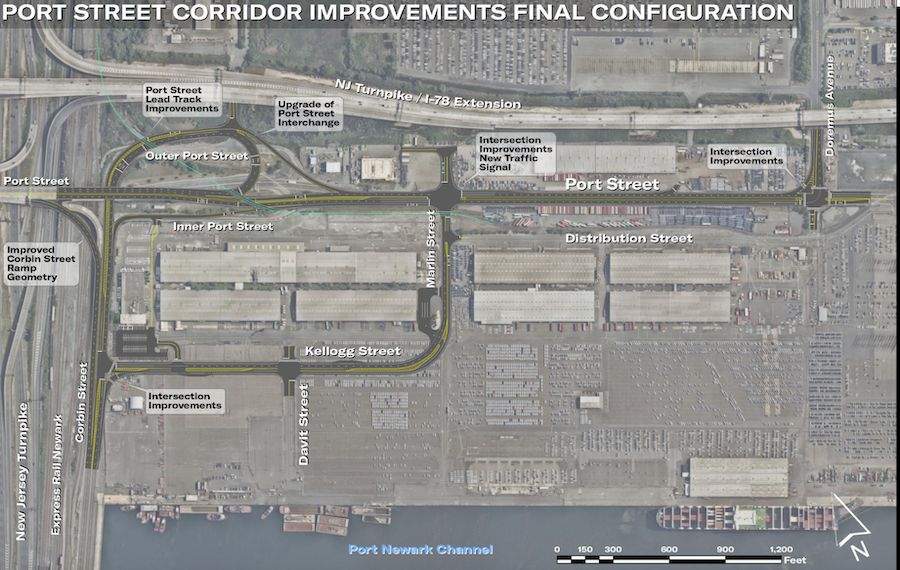
Other site modifications include the relocation of the drinking water and fire pump house at the Port Newark-Elizabeth Marine Terminal and the completion of the Port Street Corridor Improvement Project, which is smoothing road curves where closed turns have caused fatalities.
Looking for quick answers on construction and engineering topics?
Try Ask ENR, our new intelligent AI search tool.
Ask ENR →
Conti Civil is the main contractor for this $100 million project and should complete work in May.
In the more distant future, the authority could see new infrastructure for hydrogen fuel. The New Jersey Economic Development Authority has invested $13 million in a station to fill four hydrogen trucks in Port Newark. The site should open in the next few weeks.
