

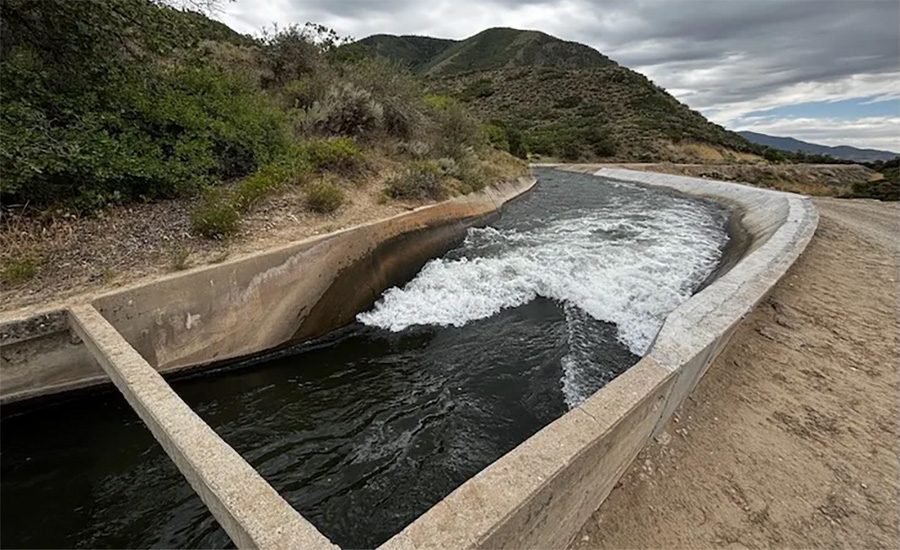

The Central Utah Water Conservancy District has awarded a $750 million contract to joint venture Jacobs/Bowen Collins & Associates to design the Strawberry High Line Improvement Project, a modernization effort to close a century-old open water channel into a pressurized pipe system built to serve a future population of about 420,000 people.
Originally constructed around 1916 as part of the historic Strawberry Valley Project, the Strawberry High Line Open Water Canal has transported water from Strawberry Reservoir and the Spanish Fork River. But rapid population growth in southern Utah County and eastern Juab County has made upgrading the system a top priority.
“The existing Strawberry High Line channel is more than 100 years old, prone to breaches and rapidly being surrounded by urban development,” says Brad Perkins, senior district engineer. “By closing the canal, the project will reduce the risk of flooding and other safety issues caused by aging infrastructure.”
Perkins says the site will conserve water lost through evaporation and seepage into the existing canal system, saving thousands of acre-feet of water each year. The project also integrates the channel into the recently completed Spanish Fork-Santaquin pipeline, expanding operational flexibility and resilience to serve both agriculture and M&I users through the end of the century.
“Finally, the project improves water quality by improving river water desedination and connecting to a future regional water treatment plant,” he adds.
Because the project is in preliminary design, the district has not yet identified construction zones or final sequencing, but with an existing channel footprint that ranges up to 200 feet wide, crews should have enough right-of-way for the closure work.
Initial construction and various design phases will begin over the next year, and within two years, a significant amount of pipeline is expected to be in the ground, with up to six different sub-projects under construction and several more in various design phases.
Pipe diameters and materials are still being determined through models and preliminary design studies, Perkins says. He says the district has conceptually planned 36 inches. to 84 inches. pipe depending on the purpose, pressure and location of each of the pipes involved.
“We’ve had great success in the past with welded steel pipes that are mortar/tape coated and mortar lined,” he says. “Additional geologic studies are underway to identify risks within the rights-of-way and inform mitigation efforts.”
This update follows a massive regional water push.
Earlier this year, the US Department of the Interior backed the effort with $100 million in federal funding. The project links directly to the 49-mile Spanish Fork-Santaquin pipeline, which finished construction in May. While that previous pipeline built new routes to bring water from the Colorado River to southern Utah County, this new project focuses on improving the existing distribution network. It connects these new supply lines directly to the area’s existing network, making the entire regional system work together.
