

With energy demand continuing to rise, efforts are intensifying to complete the construction of Europe’s pioneering ‘energy island’ – a deep-water offshore center that will gather, scale and distribute massive amounts of high-voltage offshore wind power to several countries on the continent.
The artificial island would house both DC and AC electrical equipment and would be the mainland connection point for offshore wind farms in the North Sea, with others to follow. Although they generally land at a single point, developers of several European projects in various stages have envisioned multiple connections, providing capacity to serve a wider market and have man-made or naturally adapted hubs as a link between national transmission operators.
Europe has a total installed wind power capacity of more than 281 GW, according to the International Energy Agency, but offshore wind accounts for a much smaller share of renewable energy growth for the region to 2030 compared to onshore wind. Proponents of energy islands say they can open up new areas for offshore wind development further offshore than is practical now.

The Power Hub, a 15-acre built-up island located 30 miles off the coast of Belgium’s North Sea, is a $4.2 million project by contractors Jan de Nul and the DEME Group that is set to more than double the country’s installed offshore wind capacity of 2.3 GW, according to the developers, over 100 miles of high-voltage cables, each rated between 220 and 220 V. connect with the coast
Image: Elia Transmission
About 30 miles off the coast of the North Sea of Belgium, the construction of the first center of its kind in the world, the island of Princess Elisabeth of 4.2 billion dollars. With a capacity of 3.5 GW, the 15-hectare built-up island, named after Belgium’s next monarch, would be a hub for two to three wind farms that would more than double the country’s current installed offshore wind capacity of 2.3 GW, according to developers. A spokesman for the project’s owner, Elia Transmission, says there are discussions to also develop an interconnection with the UK. The company operates the Belgian electricity grid, as well as grids in parts of Germany.
Construction milestone
TM Edison, a consortium of Belgian marine contractors Jan De Nul and DEME Group, reached a major milestone in August when they completed the installation of the 23rd and final concrete caisson that forms the perimeter of the island. This marks the end of “one of the most complex phases of this project,” said DEME project manager Gert De Smet.
“The caissons are like little apartment buildings,” he said in emailed comments to ENR. “We built 23 of them in a relatively short space of time.”
Looking for quick answers on construction and engineering topics?
Try Ask ENR, our new intelligent AI search tool.
Ask ENR →
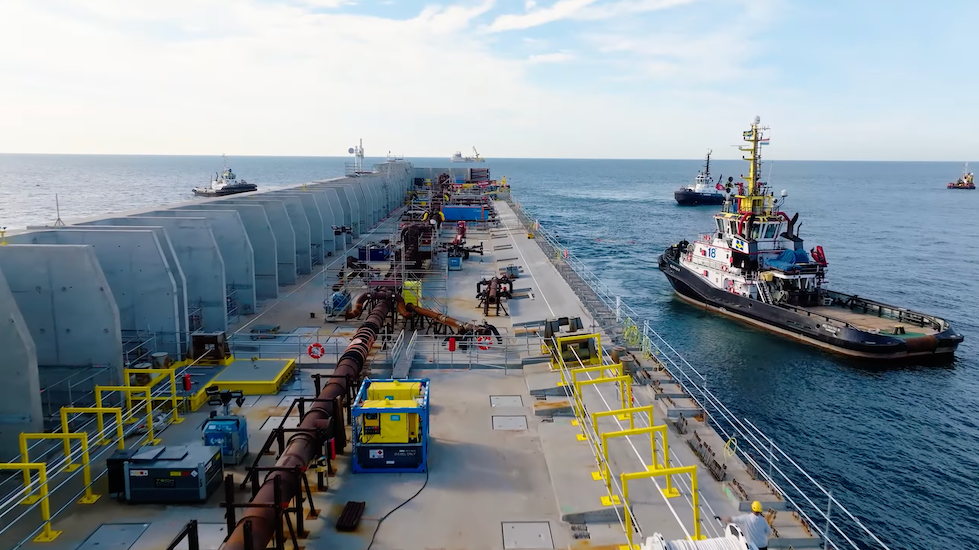
Each of the caissons is about 190 feet long, 92 feet wide, up to 105 feet high and weighs about 22,000 metric tons. Contractors produced the caissons on the ground at a facility in Vlissingen, the Netherlands, with a crew of 300. The process, including the assembly of a reinforced base slab, slip forming of walls, installation of cable tubes and construction of a roof slab, took about 85 days per caisson. The facility was equipped to produce up to five caissons at a time, with production running from January 2024 to early this year.
Once cured, the crates were loaded onto a semi-submersible barge and floated in a harbor storage area until they could be towed to site and placed by a team of four tugs. A rock foundation was installed on the seabed and leveled to support the caissons. Once in place, crews installed their joints and used dredges to fill them with sand to sink them into place. Scrub rocks are placed around the island to help protect it from the sea.
With the perimeter caissons now in place, crews will build the interior of the island with about 2 million cubic meters of sand, according to Jan De Nul project manager Bart Callens. The soil will then be compacted using vibroflotation to form a surface suitable for future electrical installations.
Once Princess Elizabeth Island itself is completed, the second phase of the project will involve the installation of high voltage lines and other infrastructure for energy storage and distribution. A temporary concrete plant will be built on the island and preparations are underway for civil works to begin in 2027, according to Callens.
“The electrical infrastructure is being designed and built to the highest offshore engineering standards, ensuring it can withstand the harsh environmental conditions at sea throughout its operational life,” Elia representative Carolien Pouleyn told ENR.
Finally, more than 100 miles of high-voltage cables, each with a capacity of 220 kV, will be installed in 2027 and 2028 to connect to the coast.
“These three Belgian companies have shown that it is feasible, that energy islands are possible,” says De Smet.

Contractors recently completed installation of caissons, each about 190 feet long, 92 feet wide, up to 105 feet high and weighing about 22,000 metric tons, to form the outer perimeter of Princess Elisabeth Island, the first energy island. Image: Elia Transmission
Collaborative Projects
Princess Elisabeth Island features a “nature-inclusive design strategy” aimed at enhancing biodiversity on the island. The boxes include ledges for nesting birds. Below the surface of the sea, they feature raised panels for small marine life, while scrubbing rocks that protect the island will become a haven for oysters that are planted there before installation.
“The rocks protect the island from erosion and form the basis for a new oyster reef,” Callens said in a statement.
The Princess Elisabeth Island is also designed to be completely dismantled at the end of its useful life, if desired. But developers say they hope it can still be used for other purposes so it can continue as a valuable marine habitat.
Preparations are also underway for an energy island off the Baltic Sea coast of Bornholm, Denmark, the first of two such projects proposed in the country. Now resuming planning after a seven-month hiatus over financial concerns, the $8 billion Bornholm Energy Island project would be built on the Danish island of Bornholm to enable 3 GW of offshore wind development.
The European Union has committed more than 700 million dollars in support for the project, which will be connected to the Danish and German grids. In January, the countries’ officials signed an agreement for the financing of joint projects.
“Cross-border projects like this reduce critical dependencies, strengthen our strategic autonomy and make us more resilient to political and economic pressure,” Katherina Reiche, Germany’s Federal Minister for Economic Affairs and Energy, said in a statement at the time.
The 30-acre island is planned about 10 miles off the coast of Bornholm. With the agreement in place, the Danish Energy Agency is ready to issue a tender for the offshore component, although the agency’s representative, Rasmus B. Andersen, said the timetable has not yet been finalized.
Danish grid operator Energinet and German operator 50Hertz will also implement electricity infrastructure projects related to the island of Bornholm. Energinet awarded a design-build contract to Per Aarsleff A/S in July for onshore facilities to house the related power infrastructure, including inverter stations. Construction is scheduled to begin next spring and be completed in 2031.

Contractors produced caissons on the ground in Vlissingen, the Netherlands. The process, including the assembly of a reinforced base slab, slip forming of walls, installation of cable tubes and construction of a roof slab, took about 85 days per caisson. Each was towed to the site and placed with tugs. A rock base was leveled and installed to support them until they could be sunk into place.
Image: Elia Transmission
Costs and demand
According to Energinet, a proposed second Danish energy island in the North Sea could also enable another 10 GW of offshore wind development. Called Energy Island North Sea, the project could also connect to Belgium via the proposed Triton Link interconnection, although it has been postponed amid financial concerns over rising construction costs and profitability issues.
Although upfront costs have delayed some energy island projects, European officials and grid operators see value in the energy they can provide. This month, the European Investment Bank agreed to grant a soft loan of $1.2 billion to Elia to support the Princess Elisabeth project, in addition to the green credit of $700 = million granted in 2024.
“Energy prices are a major concern for citizens and a key reason for this [bank] “Invest in a better integrated and more resilient European energy system,” European Investment Bank Vice President Robert de Groot said in a statement. “Connecting more offshore wind power and expanding grid capacity will help create a more stable market.”
The bank’s funding will cover a 22kV substation on Princess Elizabeth Island, along with 66kV switching stations, transformers and connections to the mainland.
