


With the European Union working to achieve climate neutrality by 2050, efforts to reduce the carbon impact of the construction industry are moving forward with projects that bring technological innovations to scale.
The European Commission has identified more than 120 decarbonisation projects across the continent, although progress towards completion and competitiveness will depend on factors such as incentives for carbon dioxide reduction, energy costs, labor availability and regulatory issues, according to industry group Cement Europe.
“Climate ambition and competitiveness must move forward together,” group chairman Jon Morrish said in a statement after a March 25 meeting between European leaders and cement industry leaders.
Production of electrified clinker
Switzerland-based global materials producer Holcim, which operates in 45 markets and last year spun off its US business Amrize, is working to open what it says is the world’s first all-electric cement plant by 2028.
Holcim has signed a joint development agreement with Swedish electrification company SaltX Technology to develop and validate equipment to be used for the production of fully electrified clinker for cement, SaltX announced on March 23 following Holcim’s investment in the company last summer.
The European location of the full-size plant was not disclosed, but the two companies are testing their process at a facility in Hofors, Sweden.
Looking for quick answers on construction and engineering topics?
Try Ask ENR, our new intelligent AI search tool.
Ask ENR →
“By combining our technology with Holcim’s industrial expertise, we can jointly develop and industrialize solutions for large-scale electrified cement manufacturing,” Lina Jorheden, CEO of SaltX, said in a statement.
His plan is based on electrified calcination, a process that involves heating raw cement flour with plasma burners, replacing an energy-intensive clinker production step traditionally fueled by fossil fuels. Holcim and SaltX plan to combine the process with electrified sintering, although they are still developing the technology for this stage and testing material to validate the process.
Because electrified calcination and electrified sintering can be implemented together or separately, there is flexibility available in how the technology can be implemented in future plants and added to existing facilities, according to SaltX.
Global cement production generates around 8% of global carbon emissions
Holcim’s partnership with SaltX, estimated at about $4 million, is one of 19 investments the Swiss firm has made in startups focused on decarbonization technology through its corporate venture capital arm, Holcim MAQER Ventures. Investments are not exclusively focused directly on cement production. In January, it announced its latest investment in Capsol Technologies, a Norwegian company that has developed a carbon capture and post-combustion heat recovery system.
Other investments have focused on technology such as robotics and energy storage, along with water conservation. The firm announced in March investments of $20 million in its Mexican operations to reduce freshwater extraction by up to 33% by 2030, with previously announced measures to reduce water use by up to 38% at its facilities in Belgium, Spain and Greece.
CCUS and liquid hydrogen
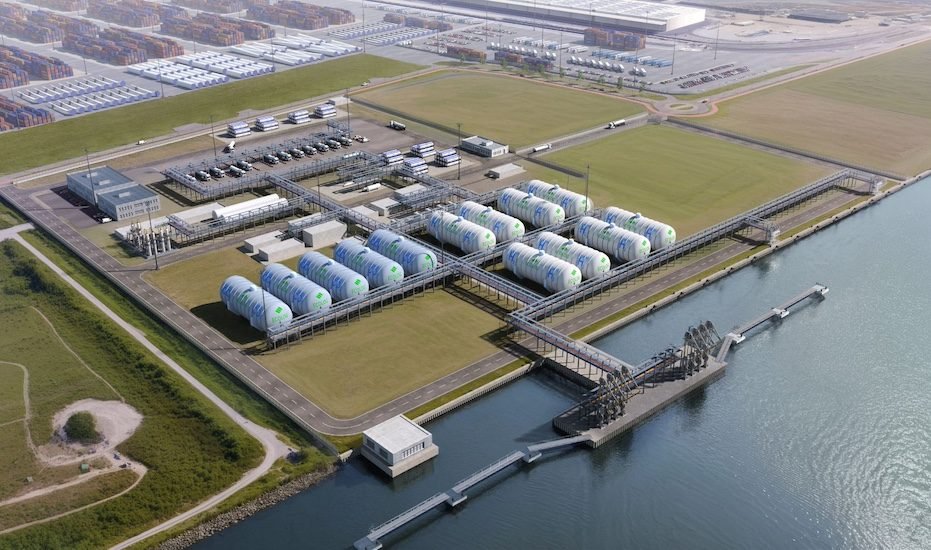
In the Netherlands, another development is being planned to boost the continent’s decarbonisation in several sectors, says the owner of EcoLog, a Dubai-based company specializing in carbon dioxide and liquid hydrogen services.
The construction of the dual-purpose EcoLog Amsterdam terminal is planned for the import of liquid hydrogen and the export of liquid carbon dioxide, reusing the cold energy released during the cryogenic hydrogen regasification process to liquefy carbon dioxide. The hydrogen would then be transported to end users across Europe by pipeline, truck, rail or barge, and the carbon dioxide would be shipped abroad for reuse or permanent storage.
The terminal would be the first facility of its scale worldwide, with an initial capacity expected to annually import 200,000 metric tons of liquid hydrogen and export 1.8 million metric tons of carbon dioxide. EcoLog aims to complete this first phase by 2030, with future expansions planned that could expand annual capacity to 600,000 metric tons of liquid hydrogen and 4.25 million metric tons of liquid carbon dioxide.
“EcoLog Terminal Amsterdam aims to make a major contribution to the decarbonisation of sectors such as steel manufacturing, heavy road mobility, maritime transport and data centers, among others,” EcoLog CEO Ellen Ruhotas said in a statement.
EcoLog recently selected its engineering team for the project, with KBR set to provide front-end engineering design and Mott MacDonald appointed as owner’s engineer.
KBR said in a statement that the FEED work, which began in January and is expected to be completed this year, will determine the facility’s storage systems, operational envelope and safety standards. Mott MacDonald will oversee planning, design and construction.
