

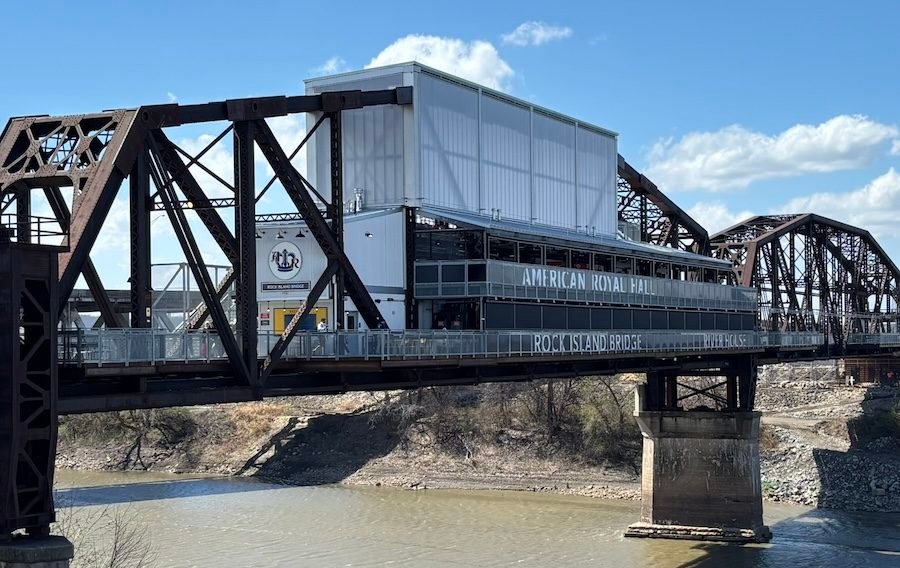
Mike Keller remembers the pivotal moment in 2007 when he boarded a friend’s motorboat on the Kansas River. “We were seeing the city from the river, which is rare,” he says. “We were going under a lot of bridges. I saw this abandoned railroad bridge sitting there. It looked big and sturdy. I thought, ‘Someone should do something about it.’
He would spend the next decade trying to do something about the century-old Rock Island Bridge between Kansas City, Kansas and Kansas City, Missouri. Early concepts included a restaurant called “Chicken On a Bridge,” Keller says, recalling how the mayor at the time “called me Chicken Boy.”
“I went to high school in one of the river valleys. We used to hang out on a railroad bridge,” Keller says. “Even in college, we’d meet up there on the Missouri River.” Because the Kansas City River was muddy and low-lying, “it didn’t get much attention. . . . I had a broad yearning to do more with the river.”
Finally, he founded Flying Truss, LLC, in 2017, and developed a public-private partnership with the Unified government of Wyandotte County and Kansas City, Kansas, which bought the bridge from its namesake Missouri city and granted the company a 66-year lease to convert and operate the structure, which now has 35,000 square feet of space, including a two-story restaurant (called The River House instead of Chicken on a Bridge).
“Kansas City, Kansas asked if we wanted to do a P3,” Keller recalls. “They were building levee trails on both sides.” He looks at the many concepts that came and went, such as considering the bridge as a town square, as part of a trail system, as a space for food vendors working with shipping containers. “There were things we still didn’t understand. There was no template for it,” he says.
The project became a community effort. Keller sought advice from city engineers and Dennis Strait, principal emeritus of Gould Evans, now Multistudio. He pooled funds from the city, the state Department of Commerce, the Kansas Department of Transportation, loans and philanthropic donations. “Thirty-five companies donated materials and labor. A local law firm did pro bono work for 7 years,” he says.
Construction began in 2023. LG Barcus and Sons, Inc. completed the bridge’s new approximately $16 million entertainment venue for an April opening. The unified government and Kansas City are still completing a $10 million effort to complete a trail and ramp system on the west side of the bridge, contingent on the U.S. Army Corps of Engineers completing a levee expansion project along the river. These components are expected to be done this fall.
Looking for quick answers on construction and engineering topics?
Try Ask ENR, our new intelligent AI search tool.
Ask ENR →
“We specialize in railroad bridges,” says Daniel Gibson, vice president of Barcus’ structures division. “We’ve turned bridges into walking routes in the past, but nothing like this.”
Converting the bridge
A 2016 engineering report by TranSystems found the bridge can support 3.16 million pounds. “We chose to use TranSystems who were familiar with the structure and had performed maintenance on it,” says Matt Farber, senior director of Thornton Tomasetti, the structural engineer. There were some minor modifications such as replacing missing screws or addressing rust. TT carried out analyzes of the loads on the new structural components and lateral forces such as wind.
“The Real Railroad [bridge] it’s pretty narrow,” notes Farber. The design called for 15-foot overhangs on either side of the 18-foot-wide bridge to create more real estate and galvanizing of the beams for the restaurant’s second floor at the center light. “On the lower level, we use heavy-duty steel. The overhang itself worked well because the trusses had enough capacity.” However, “one of the unique things we’ve had to think about is how the bridge is loaded. What if everyone goes off to the side watching the fireworks?” adds
Multistudio met with Barcus and two other contractors to gather their ideas about the build, Strait says. The bridge, about 60 feet above the river, originally had two 300-foot steel trusses, with a third 100-foot western truss added in the mid-1900s, he says. “The central stretch is where the event center is now,” he says. The team had to figure out “how to get public footpaths through there, how to build under the trusses without covering them up”. The developer suggested the second story for private restaurant functions, which left the main level with nearly 50 feet of public space.
Crews added about 680,000 pounds of steel to reinforce the structure, Gibson says. “All the beams on the walking surface add up to 1 million pounds of steel. We put the beams to make the overhangs on each side.” Barcus removed 1,400 feet of old railroad track with a total weight of more than 50 tons and nearly 700 tons of concrete. All the construction was done on the bridge, because the river is too shallow for barges and cranes, he adds.
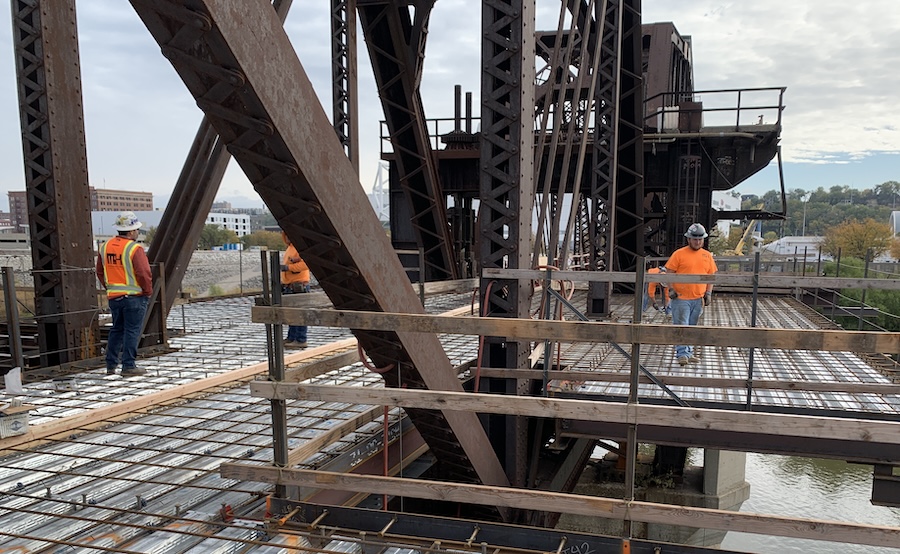
Overhangs were built on both sides of the bridge to create more community space. Photo courtesy of Thornton Tomasetti
In a June 2023 news release, Barcus described the main components of the bridge’s structural work: raising all three trusses, plus the center truss, to 3 feet 4 inches to meet 750-year flood standards and match the new Corps levees. Barcus was the original contractor for the liftgate systems installed in 1952 after the flood, and reused those systems to raise the bridge 71 years later.
“Barcus employed new engines along with the original 1950s gears and mechanisms to raise the bridge to its new height,” the statement said. Gibson noted that much of the original equipment is in good condition because it remained well oiled. “We’re replacing 70-year-old fat with new fat.”
Watch the challenge of installing new steel beams in place. “We were moving them 180 degrees from inside the armor,” he says. “We ran cables to protect ourselves from falls. It was like a jungle gym.” The four longest beams, about 60 feet, are in the stairs and entrances to the upper deck, with tolerances of a quarter inch. “The heaviest member we chose was about 26,000 pounds,” he adds.
Crews only had access from one side and battled strong winds as they poured 932,000 cubic meters of concrete 6 days a week, 10 hours a day at most, he adds.
The bridge is part of the High Line Network, inspired by the elevated park in New York City. “They provided emotional support as much as anything,” says Keller, noting that “the P6 [public-private-philanthropic-people-purpose-process] what we did here is novel.” He cites further inspiration for traveling around Europe and seeing private investments in public areas.
“I’ve worked on a lot of challenging renovation projects,” says Farber. “This was unique, and will probably be copied. There are a number of abandoned railway bridges in this country that have a lot of structural capacity.”
Keller says Flying Truss LLC is looking at opportunities in other cities. “We have an initial list of 22 bridges.”
