

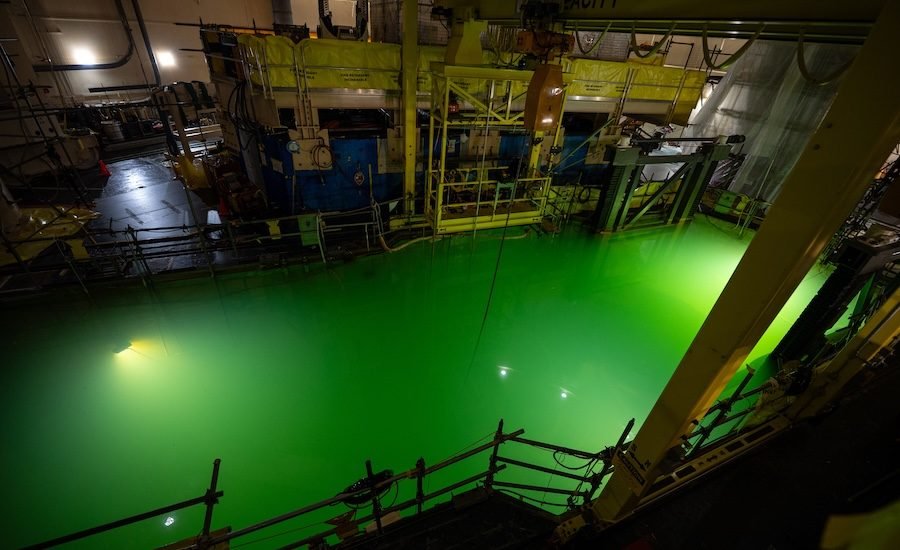
Federal appeals court judges will soon hear oral arguments on decommissioning company Holtec International’s plan to release more than a million gallons of lightly radioactive water from the shuttered Indian Point nuclear power plant on the Hudson River in Buchanan, New York.
The case represents another test of state versus federal authority over nuclear safety—a question that dates back to the early days of nuclear power in the 1970s. While many old nuclear power plants remain in operation, there are now a total of 15 decommissioning underway in the US, according to the US Energy Information Administration.
Indian Point is proving to be one of the most controversial.
In March, U.S. Energy Secretary Chris Wright and local Rep. Mike Lawler (R-NY) held a press conference outside the project’s gates calling for the five-year-old decommissioning to be reversed and the power plant to be brought back into operation.
A similar dispute over water releases is playing out in Massachusetts, where state environmental officials have blocked planned discharges by Holtec at another decommissioning project.
In 2023, in response to Holtec’s release plan, New York State adopted an amendment to state law prohibiting the release of radioactive materials into state waterways. Holtec sued, saying the releases, which occurred regularly during the plant’s decades of operation.—fell safely within the US Nuclear Regulatory Commission’s safety thresholds.
Holtec, the Camden, N.J.-based company that took over ownership and the $2.4 billion shutdown of the shuttered power plant in 2021, challenged the amended state law, saying the NRC had authority over nuclear plant safety.
In response, New York lawyers said the state law was about the regional economy related to the state of the river, not safety, and therefore was not subject to the federal NRC rules.
Looking for quick answers on construction and engineering topics?
Try Ask ENR, our new intelligent AI search tool.
Ask ENR →
Holtec prevailed in a decision issued last year, but the state has appealed.
On June 18, an advisory board on the plant’s decommissioning, made up of officials from the state, county, city and town of Buchanan, was told that lawyers for both Holtec and New York had asked to make oral arguments to judges in the case being heard in federal court in White Plains, NY.
The water problem and Holtec’s response have injected new uncertainty into the cleanup of radioactive materials and demolition work. The water release issue has likely delayed some work while Holtec continues with many other tasks.
Matt Johnson, a regulatory manager at Holtec in Indian Point, told the advisory board last time it met that “we were somewhat dismayed by the comment from an employee that we had stopped dismantling” pending resolution of the water discharge. He reassured the board that “a lot of work has been done and it remains the plan to continue to complete the closure.” Of the 300 people on site, half are Holtec employees and half are “trades,” Johnson said.
Tritium is a colorless and odorless isotope of hydrogen. Its weak radiation is more dangerous if ingested. Discharged regularly during normal plant operation, it is rapidly diluted upon release.
But its post-shutdown release has become a problem for anti-nuclear activists, some of whom argue that because taxpayers no longer benefit from power generation, public waterways should not be used as a means of low-cost disposal.
A similar controversy over the release of tritiated water arose in 2024 as part of Holtec’s decommissioning work at the Pilgrim Nuclear Power Plant on Cape Cod Bay in Plymouth, Massachusetts. Holtec told the various stakeholders that it could either treat and dump the water, transport it before treating and dump the water elsewhere, or slowly evaporate it.
All radiation levels were well below hazard levels recognized by the NRC, Holtec noted.
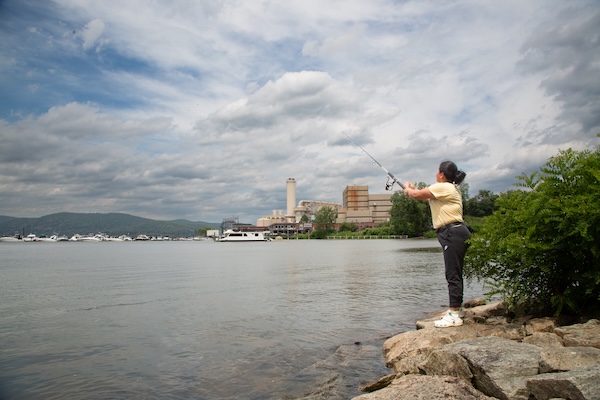
A woman fishes in Buchanan, New York State lawmakers emphasized the health of the waters of the Hudson River when they amended state law to prohibit the dumping of radioactive materials into the river. Photo: Harvey Wang for ENR
The state refused to allow Holtec to amend its existing permit to allow the release of water, and while the administrative mechanism and possible lawsuit on the matter drags on, the company is evaporating the water by venting the pools where it is located.
Holtec is also decommissioning a nuclear power plant in Forked River, NJ, and is equipping the Palisades Nuclear Power Plant in Covert, Michigan for operation.
Indian Point water discharge problems
State lawmakers amended state law in 2023 to prohibit radioactive contamination, or to “dump, drain, run or discharge” a radioactive agent into “waters of the state.”
The appeal in New York hinges on questions of law rather than the medical science of radiation and cancer: one is whether state law preempts federal authority, and another is whether the radiation discharge amendment was motivated by economic or safety concerns.
State lawmakers who sponsored the amendment said the health of the Hudson River was of great economic importance.
But Holtec argued that “every reference to economic concerns in the Senate and Assembly debates links those concerns to fears arising from perceived security risks.”
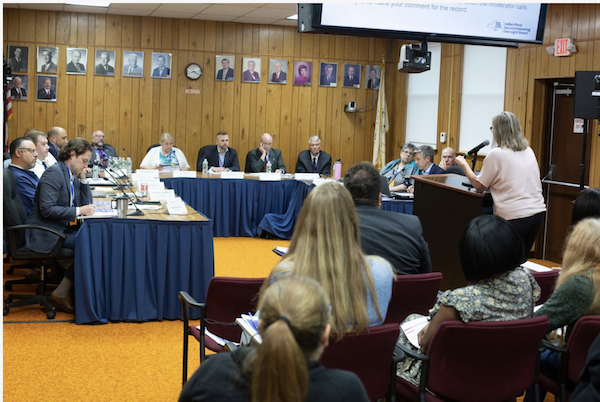
An opponent of nuclear power addresses the Indian Point Decommissioning Advisory Council in Buchanan, New York, on June 18. Photo: Harvey Wang for ENR
In his ruling issued late last year, Judge Kenneth M. Karas wrote that the amendment forces Holtec to change how it plans to dispose of tritiated water and “has the effect” of overriding the NRC’s decision-making on nuclear safety. And the NRC’s authority, he wrote, should prevail over nuclear safety.
Although New York makes a number of counterarguments, Karas wrote, “none of it is good.”
The appeal of his decision now awaits oral arguments.
