

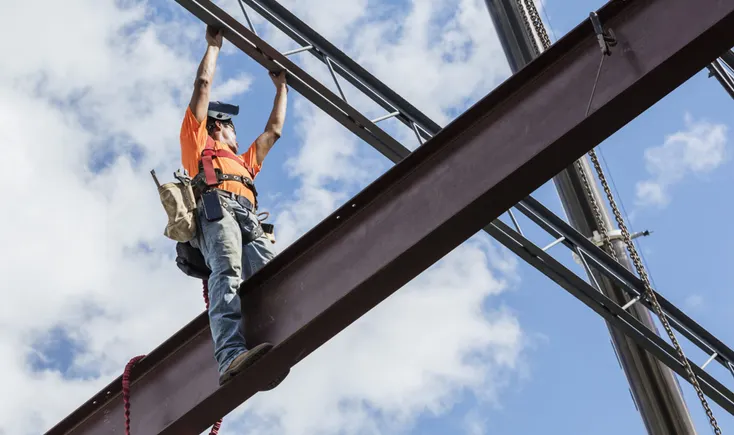
A steel worker two levels above, attached to a steel beam, detects a connection that is not seating properly as more steel is lifted into place above. He can’t radio it down and yelling is no use to the noise of the equipment echoing through the open shell. He has to stop, disengage and go down two levels to find someone who can relay the problem.
By the time he does, eleven minutes have passed and the next beam is already being moved into place directly above the connection he just dialed. He doesn’t know where the nearest manager is, so he heads first to the central construction office, the only place he’s sure someone with a radio will be.
Megaprojects like hyperscale data centers and large distribution centers, where crew counts run into the hundreds across 500,000 square feet and multiple levels, operate with narrow margins of error. A dozen teams of subcontractors overlap, executing electrical, mechanical, structural and finishing work in parallel on a timeline where a single day’s delay carries a contractual penalty. The workforce often speaks four or more languages and the build schedule is not slowed down by the communication gaps created.
This gap goes back to how construction companies assign radios on a modern project like this, usually to supervisors and a handful of key personnel, but never to the full crew. It is a standard practice, carried over from project to project, and most megaprojects continue to use it.
The real cost of the communication gap
In 2013, when Sprint shut down the Nextel iDEN network, commercial construction lost the closest thing to a workplace communication standard. Most contractors retired with walkie-talkies and personal smartphones and general workers returned to word of mouth or waiting.
A crew that can’t reach a supervisor is idle, and with a dozen subcontractors working simultaneously, that idle time adds up in shifts. Sequencing decisions are routed up the chain and back when workers cannot self-coordinate, adding delay to each delivery. In a schedule with penalty clauses tied to go-live dates, this delay carries a dollar figure.
A Survey 2025 of frontline workers found that 53% lose at least 5% of their workday waiting for safety-critical information, which translates into about 120 hours of lost productivity for each shift on a 300-person megaproject.
A daily safety briefing takes place before the crew disperses, but if the time comes mid-shift, a worker without a radio has no way to get that update until someone meets them in person. At a 300-person site, relaying hazard information from person to person introduces delays and errors at the worst possible time, and exposure to liability increases with every hour left untreated.
The model has persisted, as most workplace practices do, driven by cost, inertia and the assumption that the absence of a visible catastrophe means, for many, that the current architecture is working.
Universal communications for construction
Closing the communications gap in construction requires a different category of equipment, one designed specifically for the modern workplace rather than tailored to consumer technology. Walt for Weavix is an example of this approach. The devices are weatherproof, designed and engineered without the consumer applications that personal smartphones get banned from active sites first of all For general contractors who have already restricted personal devices for safety or productivity reasons, equipment like this works in dedicated channels built to meet those same standards.
Subscription-based per-device pricing replaces a capital purchase with a predictable operating expense, making universal distribution affordable in a way that traditional radio purchase never was.
Most construction teams are multilingual, and built-in AI translation changes the way teams communicate. A Spanish-speaking railroad and an English-speaking foreman can exchange information in real time, each in their own language, even in noisy environments, without going through a bilingual supervisor handling four other conversations at once.
Better coordination at scale
When hazard alerts reach everyone at once and operations coordinate sequencing without waiting for a relief, phase timelines are compressed and multilingual crews share the same situational awareness. The workforce begins to function as one team instead of a dozen separate teams.
For general contractors managing penalty clause delivery schedules, the margin for coordination failure is slim, and those with universal communications infrastructure do not do so for safety credit. They are doing it because the math of the timetable leaves no other choice.
Radio silence is a management option. In a build with so much at stake, it can be an expensive one.
