

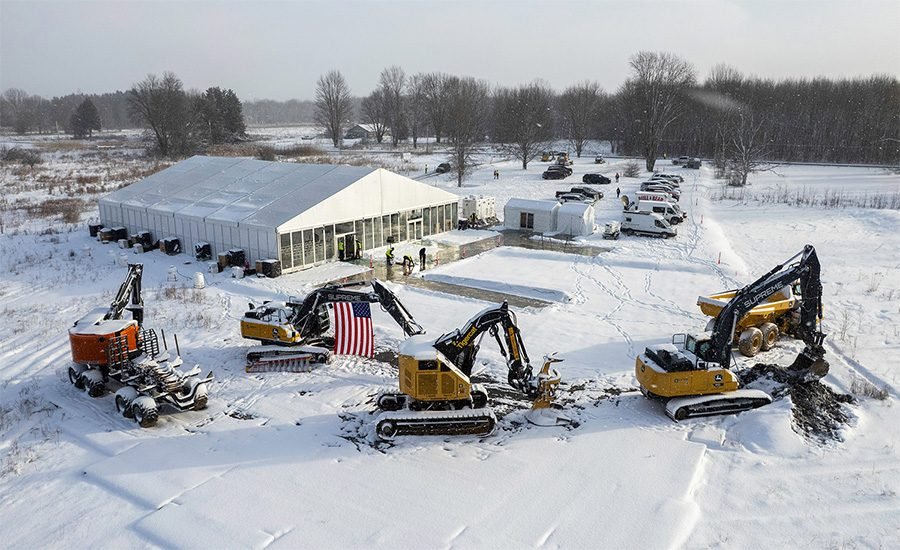
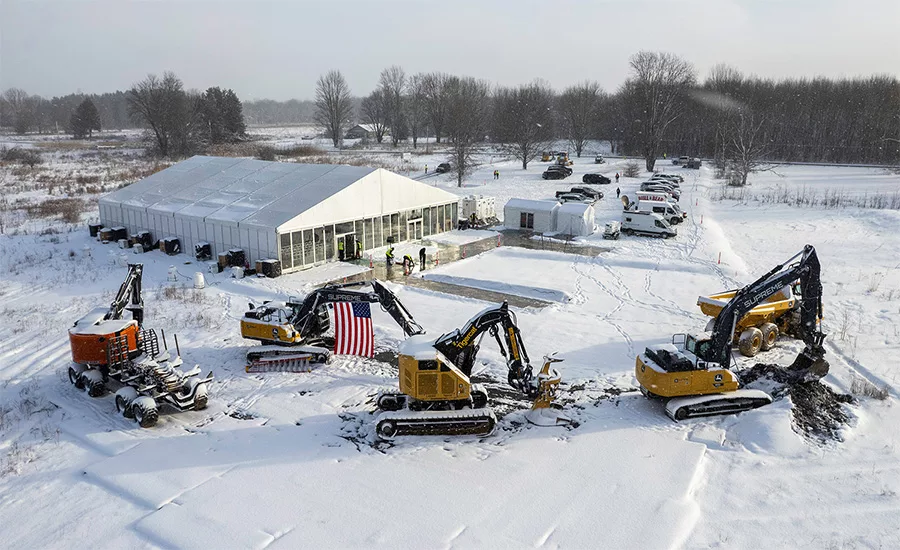
Micron Technology has selected Bechtel as its engineering, procurement and construction partner for the first phase of its planned semiconductor campus in Clay, New York, moving from planning to full-scale construction of what is expected to be the nation’s largest semiconductor complex.
The companies jointly announced June 10 that Bechtel will immediately mobilize to the White Pine Commerce Park site in Onondaga County to support construction of the first phase of the memory chip manufacturing project.
The campus is part of Micron’s plan to invest up to $100 billion in Central New York over several decades and is expected to create about 50,000 jobs statewide, including more than 4,500 construction jobs.
The selection marks a shift from infrastructure enablement and initial site work to the implementation of the first semiconductor manufacturing plant, a critical step in the multi-decade project.
“Our New York project will be home to the world’s most advanced memory manufacturing and will serve as a cornerstone of America’s leadership in the AI age,” Manish Bhatia, Micron’s executive vice president of global operations, said in the announcement. “We are entering an exciting new phase of construction.”
Under the agreement, Bechtel will provide engineering, procurement and construction services for the first phase of the project.
The companies said the contractor will deploy an integrated EPC delivery model that combines engineering, procurement, advanced digital construction technologies, modularization strategies and project controls aimed at supporting schedule certainty, workforce coordination and operational readiness.
Looking for quick answers on construction and engineering topics?
Try Ask ENR, our new intelligent AI search tool.
Ask ENR →
Bechtel President and COO Craig Albert said the project represents “part of the foundation of America’s industrial future,” adding that Micron is making a “generational investment in American manufacturing.”
Semiconductor manufacturing facilities are among the most technically demanding industrial construction projects, requiring specialized cleanroom systems, high-purity process infrastructure, advanced electrical systems, vibration-sensitive foundations, and tightly controlled manufacturing environments.
Bechtel brings recent experience in semiconductor manufacturing to the project. Intel selected the contractor in 2022 to lead the first phase of its Ohio chip manufacturing campus, where it has been involved in building manufacturing facilities and related infrastructure in one of the largest semiconductor developments in the country.
Micron’s award advances a project that has steadily progressed through environmental review, utility planning and initial site development work.
RELATED
New York Greenlights Power Link for Micron’s $100M Megafab
Last October, the New York State Public Utilities Commission approved the construction of a dedicated 345 kV underground transmission line linking National Grid’s Clay substation to the future Micron campus, a key component of the electrical infrastructure needed to support the facility’s projected electrical demand.
ENR previously reported that the transmission connection and associated substation expansion constituted the first major construction package directly linked to the project.
Public filings released late last year also revised the project’s timeline, indicating that construction of the first manufacturing plant would begin in 2026 with operations planned for 2030. Micron began building the first factory in January.
A Micron spokesman declined to comment beyond the June 10 announcement, citing the company’s quiet period before the June 24 earnings release.
The joint statement did not disclose details about the contract value, maximum construction manpower, subcontracting plans or how Bechtel’s responsibilities will interact with the site enablement work previously assigned to Gilbane.
Publicly available information indicates that Gilbane remains associated with site preparation and previous infrastructure activities on the Clay campus.
The project is expected to include up to four semiconductor manufacturing plants on approximately 1,400 hectares. State officials have described it as a cornerstone of broader efforts to expand domestic semiconductor manufacturing capacity under federal and state incentive programs.
