


Diversified in architecture, planning, interiors and conservation, along with expertise in both new construction and adaptive reuse, Beyer Blinder Belle Architects and Planners is the ENR MidAtlantic Design Firm of the Year 2026. The international architecture firm ranks 56th on the ENR East Top Design Firms list with $68.6 million in regional revenue in 2025, up 9.4% from $62.7 million in the year before, when it was ranked No. 62. Based in New York City with about 190 employees in four offices, the company allows the company’s management structure to expand and target large interventions. simultaneously
In the Mid-Atlantic region, the firm is working with David Rubin Land Collective in Washington, DC, to reimagine the future of Pennsylvania Avenue between the White House and the US Capitol, and with Nelson Byrd Woltz on a comprehensive landscape plan for George Washington’s historic Mount Vernon home in Alexandria, Virginia.
The designer is also leading planning and approvals for the proposed expansion of Washington’s Union Station train hub to serve future transportation needs while preserving the historic character of the station. The firm is also active in office-to-residential conversions in Washington, DC, including 1250 Maryland Avenue SW, which began construction in June 2025.
One of Beyer Blinder Belle’s most notable efforts was the 16-year implementation of a master plan to revitalize Washington’s Courthouse Square, including the restoration, renovation and expansion of the H. Carl Moultrie Courthouse. The project received a Justice Facilities Review Award, the American Institute of Architects’ highest recognition for civic architecture. The designer also worked on the new Irish embassy in Washington.
Beyer Blinder Belle also partners with Washington-based Phelps Architecture, Construction and Engineering High School, with the firm’s staff participating in student activities, midterm reviews and final reviews. The designer also offers an annual youth education scholarship to its students. It also offers annual scholarships to Howard University and the University of the District of Columbia, as well as paid internships to the recipient of the Howard Scholarship. The firm has also provided past community grants to local organizations such as the River East Design Center, and donates to various outside organizations and committees such as Women in Architecture, Big Green Commute, the Urban Land Institute, and AIA events.
Beyer Blinder Belle partners Jill S. Cavanaugh (JC) and Kevin Storm (KS) discussed some of these topics with ENR. This Q&A has been edited and condensed.
Some recent projects at a glance:
1250 Maryland Avenue SW, Washington, DC
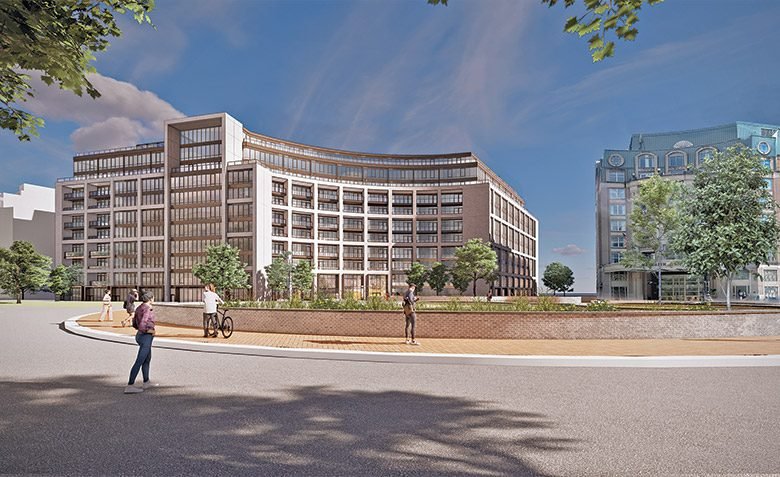
Construction began in June 2025 on an eight-story office building that was transformed into an 11-story multifamily residential building with approximately 428 units. Located in the Portals de la Ciutat development, the building is being restored with a contemporary facade and expanded vertically with a three-storey addition. The color palette and materiality combine prefabricated panels and bronze metal, and two abstract portal elements pay homage to the building’s original design.
Inspīr Embassy Row, Washington, DC
Beyer recently converted the historic Fairfax Hotel into a senior living facility, preserving the building’s historic aspects while updating it into a contemporary luxury residential community. The design includes comfort and clarity, addressing diverse physical and cognitive needs and creating an inclusive hospitality environment that allows seniors of all abilities to thrive.
H. Carl Moultrie Courthouse, Washington, DC
With the completion of the restoration, renovation and expansion of the H. Carl Moultrie Courthouse, 2024 marked the culmination of Beyer Blinder Belle’s 16-year implementation of a master plan for the revitalization of Courthouse Square. The courthouse has been expanded with six new courtrooms and rooms for 21 judges and staff, and the structure features a contemporary facade.
What is a major project in the Mid-Atlantic region that you can talk about?
CS: Our office-to-residential conversion and three-story addition at 1250 Maryland Avenue is important to our office on several levels. It continues the legacy of our creative adaptive reuse firm, an area of practice we have pioneered since our founding. It contributes to much-needed housing stock and the ongoing revitalization of downtown Washington, and allows us to innovate alongside a visionary client-developer in the growing post-war conversion sector.
The most obvious design challenge here involves adapting deep post-war commercial floor plates into functional and livable residential units. We met this challenge through a variety of design strategies: changing exterior walls to create generous recessed terraces, above and beyond the typical 4-foot balconies seen around the city, that encourage true outdoor living and reduce the depth of interior units and incorporate unit-specific amenities in daylight-challenged areas, such as larger service areas associated with homes with larger rooms.
How have the office-to-residential conversion challenges played out?
CS: There is no doubt that the recent interest in office to residential conversions has resulted in a number of false starts and challenging financial models. Perhaps initial optimism has tempered somewhat when faced with the difficult reality of finding ideal conversion candidates. But we remain optimistic that this sector will continue to grow, help mitigate the twin crises of office vacancies and housing shortages, and shift the needle toward more vibrant, mixed-use downtown neighborhoods.
As architects, we can use our creativity and technical knowledge to help our clients find realistic paths forward as the most suitable pre-war conversion opportunities become scarce and we are left with often less than ideal post-war candidates.
These are often very complicated projects with numerous challenges: unexpected existing conditions revealed late in the design process, challenging physical constraints such as deep floor slabs and inefficient building envelopes, the need to balance significant changes within the constraints of the historic fabric, and a host of other unique obstacles.
Beyer Blinder Belle in numbers:
2.87 million dollars – Eastern region government/public service revenue, 2025
3.73 million dollars – Commercial income of the East region, 2025
4.36 million dollars – Mixed-use revenues of the East region, 2025
8.41 million dollars – East region multi-unit residential income, 2025
12.22 million dollars – Education income of the Eastern region, 2025
27.18 million dollars – Religious and cultural income of the East region, 2025
61.65 million dollars – East region architecture revenue, 2025
68.63 million dollars – Total revenue of the East region, 2025
74.20 million dollars – Global income, 2025
84 – Number of authorized architects
How did you manage to diversify your service lines?
JC: Beyer Blinder Belle was founded in 1968, driven by the urban renewal movement and around a commitment to preserving existing buildings as a means of preserving the social integrity of communities. This mission has shaped our practice and draws us to projects that span different sectors for a wide range of clients. Although we are best known for our stewardship of historic and sensitive urban sites, through the planning, restoration and design of new buildings, all of our work is unified by a persistent exploration of historical, cultural and civic significance.
Why is it important to balance big and small projects?
JC: What matters is not size, but complexity and impact. Naturally, some complex projects are small and some are large. But the range allows us to be constantly challenged and takes advantage of the breadth of our skills and agility. Smaller projects traditionally have shorter lifespans with a tighter team, while larger projects have longer trajectories and larger teams. The combination allows for resilience and provides our staff with diversification and opportunity.
How are repeat customers both satisfied and challenged?
JC: Like any relationship, the feeling of familiarity is comforting. From a practical point of view, working with regular clients allows us to focus on the work and not on marketing research or the learning curve. Established relationships usually reflect mutual trust and respect, but still require diligence and creativity to avoid complacency. If either organization sticks too closely to what has worked before, it can sometimes be more difficult to introduce—and become more adept at—innovative approaches, processes, or design materials.
Tell us about your partnership with Phelps Architecture, Construction and Engineering High School.
JC: BBB has partnered with local organizations in each city where the company operates. We recently completed Just 3.0® registration with the International Living Future Institute, and our collective volunteer efforts across the company were instrumental in achieving exceptional performance levels for the inclusion and management categories.
Since 2014, BBB has mentored dozens of students at Phelps Architecture, Construction and Engineering (ACE) Public High School, participating in fall and spring semester architecture shouts and the year-end Capstone Senior Team Project Symposium.
