

This audio is automatically generated. Please let us know if you have any comments.
Cities must act now to protect residents and infrastructure from the impacts of extreme climate events, but not all are created equal, and low-resource localities that need funding the most lack the ability to do so, according to experts at a recent Clark University panel on how cities can thrive in the it was an extreme climate.
“The resilience gap we have is as much a capacity gap as it is a knowledge or planning gap,” said Mark Davidson, professor of geography in Clark’s School of Climate, Environment and Society. Municipalities understand what needs to be done, he said, but “the hardest question for them is how do we act on what we know at this stage? How do we achieve capacity?”
Cities lack the fiscal and administrative capacity to carry out and plan for resiliency projects, he said, citing a National League of Cities survey that found 84 percent of municipalities say they don’t have sufficient capital budgets and 81 percent are rethinking infrastructure investments as Biden-era funding winds down. Cities can’t address climate risk, a permanent and growing problem, with temporary money, he said.
“In the past, we’ve often tried to fill capacity gaps through competitive grants, with the state and federal governments giving money, but winning those competitive grants requires capacity,” Davidson said. “You need staff time, you need expertise. Sometimes you need matching funding, and that’s a paradox. So cities often have to compete with each other for money to build capacity. So the ones that have the capacity already have an advantage.”
Cities can expand their fiscal and administrative capacity by sharing knowledge with each other and with universities, community organizations, private companies, regional bodies and networks such as ICLEI – Local Governments for SustainabilityDavidson said.
Panelists offered three solutions to help cities finance resilience infrastructure.
1. Respond with layered programs.
In 2024, Riverside, Calif., experienced 79 days above 95 degrees Fahrenheit, a 65 percent increase from 2003, and had a high of 115 degrees Fahrenheit, said Riverside Mayor Patricia Lock Dawson.
In response, Riverside, a city of about 323,000 people located about 55 miles east of downtown Los Angeles, created a stack of programs to address the extreme heat and wildfires, which it said “is also a big one for us right now.”
Riverside is working with Bloomberg Philanthropies to create a Youth Climate Action Fund and writing a climate adaptation and action plan, Dawson said. The Fire Department’s Emergency Management Office has been launched Ready Riversidecampaign that informs residents about how to stay safe during heat events and prepare for emergencies, and last year the city received a grant from the National Oceanic and Atmospheric Administration to conduct a extreme heat peak and Tabletop Exercise, a simulated emergency planning session involving public and non-profit partners.
The city also offers a community engagement map for city officials and residents to assess the existing tree canopy and plan tree planting, which Dawson said helps the city apply for grants. The map helped Riverside get one California Transformative Communities grant to plant 1,000 trees and putting solar panels on 100 homes in a neighborhood disproportionately affected by the heat. “It’s helping us address heat islands in the city and providing shade, and it’s also giving us a data set for planning documents, mitigation and working with our universities,” he said.
“Despite the federal government backing down … the work goes on,” Dawson said. “He has to.”
2. Build new financing infrastructures.
“These are difficult times,” said Melissa Hoffer, Massachusetts’ first climate director. “And those are times that really require us to think very differently about how we’re going to approach this problem.”
When Hoffer first took office in 2023, his priority was to understand how much the state should invest in decarbonization and resilience. His office’s analysis found that $90 billion to $130 billion is needed address key resilience needs such as high-risk dams, coastal investments and tree and wetland protection until 2050, he said. The Office of Climate Resilience and Innovation released that study, along with a funding handbook, last year, Hoffer said.
“We know we’re not going to have enough money to invest in these resiliency investments if we’re just doing it through grants,” Hoffer said. “We had to start really thinking about funding tools.”
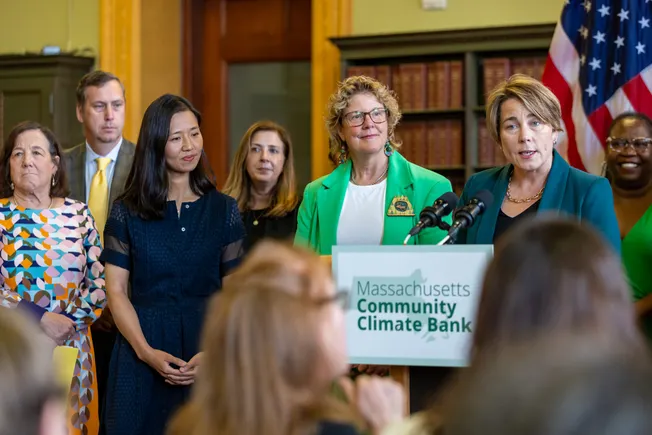
These tools include Massachusetts Community Climate Bankinitially capitalized with $50 million in dedicated state funds, which provides low-interest financing to help preserve and retrofit affordable housing with improvements such as reinforced roofs and heat pumps, Hoffer said.
After catastrophic flooding exposed gaps in federal disaster assistance in 2023, Massachusetts created a Disaster Response and Resilience Fund to address disasters that do not qualify for Federal Emergency Management Agency assistance while requiring recipients to rebuild more resiliently, Hoffer said. This fund is included in the Act of preparation for mass, a state environmental bond bill introduced by Gov. Maura Healey last year. If Mass Ready is approved, the fund would be one of the first revolving funds in the country to finance low-interest loans for resiliency projects, Hoffer said.
Local governments across the country are also shifting toward hiring private capital early on in resilience projects, structuring public-private partnerships as part of project design from the start, said Saharnaz Mirzazad, executive director of ICLEI USA.
ICLEI USA recently published a Resilience Financing Guide to help local governments determine the real value of reducing risks “and translate that into language that a lender, an insurer or a private investor will act on,” Mirzazad said. “And that has been, in my mind, a real game changer at the local government level.”
3. Involve the community in an early and structural way.
Mirzazad and Dawson emphasized that community engagement should be built into funding requirements. “It shouldn’t be an afterthought or just a ‘nice to have’ – it’s important to think about it and value people’s views on the receiving end of infrastructure,” Mirzazad said.
For large infrastructure projects, Mirzazad recommends establishing a local governing body with a direct role in prioritizing spending, maintenance and other decisions to create greater accountability and transparency while giving communities a meaningful voice in how projects evolve. “This has many benefits: fiscally, in community satisfaction and in helping people feel empowered and see what really matters,” she said.
In Riverside, Dawson said the city held 36 events and gathered more than 4,000 comments in the process of creating its climate adaptation and action plan. “Public involvement is at the heart of it,” he said. “So they’re involved every step of the way.”
