

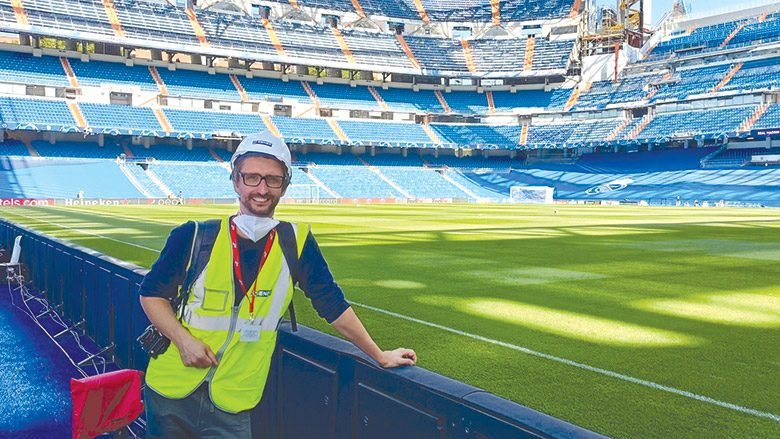

Jorge Vizcaya, an architect at the Spanish design firm Sener, compares the company’s patented retractable system for using and storing a stadium soccer field to installing a car engine. “It’s very compressed with a lot of different conduits and electricity and you have to consider the whole design at the same time,” he explains.
As a marquee component of the renovation of the Santiago Bernabéu stadium in Madrid, home of Spain’s famous football club Real Madrid, the Hypogea system enables year-round use of the venue by quickly removing and storing its natural grass pitch, or “pitch”, in a compact, advanced maintenance storage space below that preserves the quality of the turf with lighting, heating, irrigation and drainage. It is the first application of the system in a sports stadium worldwide.
According to Vizcaya, it took intense collaboration between the owners, design and construction agents to adapt the system to the team’s plant floor needs. That meant blowing up the original stadium renovation game plan to accommodate Sener’s design, he says.
“It is not about dividing the project into different parts, this is not the way to approach this type of project”, says Vizcaya. “This forced us to be very well connected and coordinated in the design.”
Excavation of the system, which reached depths of 25 to 30 meters, required the installation of concrete retaining walls and retaining structures to maintain soil stability and prevent displacement that could compromise the integrity of the stadium and surrounding buildings. This included a continuous monitoring system with sensors to record vibrations, settlements and ground movements in real time. Sener also engaged renowned London field management specialist Paul Burgess to help oversee all agronomic elements of the maintenance system.
Getting the goals
According to Vizcaya, the stadium’s owners had been looking for a solution to expand the use of the facilities without compromise for more than five years, so it was important that Sener’s system fulfill all the project’s objectives for Real Madrid and the club’s die-hard fans. Vizcaya says there was pressure for his team to get off the field, just like there was for the footballers. “It’s the same. You have to win. You can’t lose,” he says.
Vizcaya says the pressure to deliver was as intense as it was to ensure the renovation would not disrupt events and would be something the football club could seamlessly integrate into its operations.
“We can say that most of the project was fast,” adds Vizcaya, with challenges like navigating the COVID-19 pandemic and keeping the stadium open for games affecting construction logistics. “The project forced me and the colleagues involved to not only focus on my specific part of the project, but also to consider the whole thread at the same time.” The World Football Summit named the Bernabeu facility as the “best stadium in the world” in 2024, specifically citing the retractable pitch and other innovations.
As for his own professional growth, Vizcaya calls the project “life-changing,” adding that it encouraged him to think more like an engineer in his architectural work. “I can say that I’m probably more of an engineer than an architect now,” he says. The project also changed its view on sustainability, noting that the plot change system increases the use and capacity of the building, and can potentially be applied to other buildings, adds Vizcaya.
“We often think of sustainability as resources like water and energy. This project not only focuses on these [things] but also in the system itself,” he says. “This solution tries to change these buildings and their use.”
