

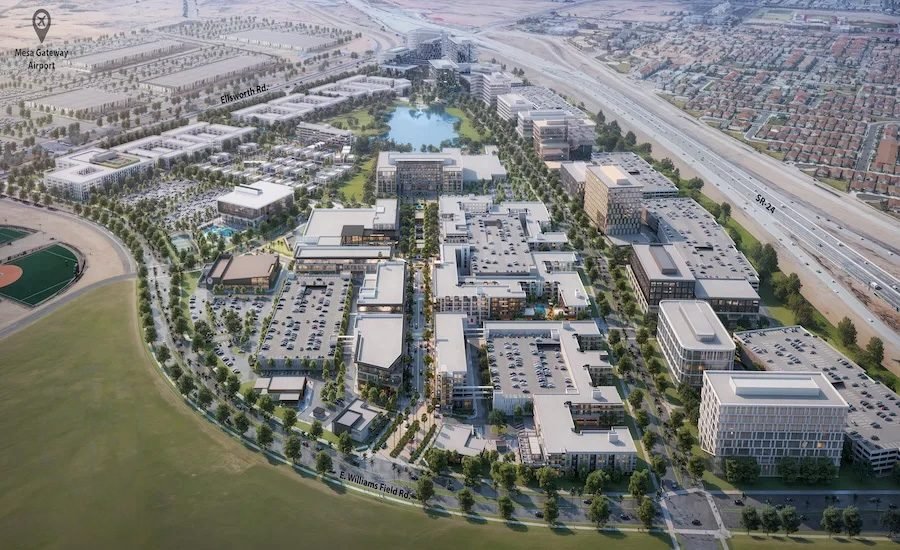

On Sept. 14, the Mesa City Council approved Legacy Park and Gateway Crossing, an approximately $3 billion mixed-use development that will support a growing area that includes the Mesa Gateway Airport, the Arizona State University Polytechnic Campus, the Arizona Athletic Grounds and State Route 24.
Both projects are planned as mixed-use destinations connected with hospitality, dining, retail, offices and residential development, along with a public park. The developments also include pedestrian connections and transport and utility improvements.
“Legacy Park is a generational opportunity for Mesa and the largest private investment in our city’s history to date,” Mayor Mark Freeman said in a news release. “This is the kind of investment that can shape Mesa’s economy for decades to come.”
Phase 1 of the project is a $1 million infrastructure and public park construction that is on target to open in October 2029. The highlight of this phase is a 10-acre man-made lake that needs special permits and cannot use municipal tap water.
To fill the lake without using Mesa’s municipal water, developer Vestar must purchase private Type II groundwater rights. Under Arizona law, these rights are transferable water bills that are not attached to any specific land. This means that a developer can buy the rights to a closed factory or mine and transfer them to his own project and use them to pump water from a new private well.
Because of this rule, engineers will have to build a completely separate pipe system for the lake so it never accidentally gets stuck or mixed with Mesa’s clean drinking water. And because the lake is in a hot desert climate, the team has to use special plastic liners and engineering tricks to keep the water from the private well from evaporating.
While the purchase of Type II rights gives Vestar the legal authority to pump groundwater, regulators stress that drilling a major commercial well requires specific state review. “When non-exempt wells (wells pumping more than 35 gpm) are permitted, they must submit a well impact analysis to ensure that withdrawals from the proposed well do not cause unreasonably increased harm to surrounding land or other water users,” says Doug MacEachern, spokesman for the Arizona Department of Water Resources.
Filling a large lake in the middle of a desert is also very restricted. “Arizona law prohibits the use of any water to fill or refill all or part of a body of water for scenic or recreational purposes, with specific exceptions,” MacEachern says. Vestar’s project works because the lake is located within a planned park primarily intended for public ownership. The project meets a state exemption for bodies of water “located in a recreational facility open to the public and owned or operated by the United States, this state, a city, town, or county . . .”
A recent analysis says the development could generate an estimated $58.8 billion in economic activity, 13,500 jobs and $1.4 billion in tax revenue over 30 years. Under this agreement, Vestar must pay in advance for all initial infrastructure. The city will gradually reimburse them through a tax sharing plan with sales and lodging taxes collected on-site, with total reimbursement capped at $76.4 million. The city will not release the full funds until Vestar meets milestones, secures water rights and delivers the completed 20-acre park by the final deadline of Dec. 31, 2034.
A general contractor has not yet been selected for the infrastructure works.
