

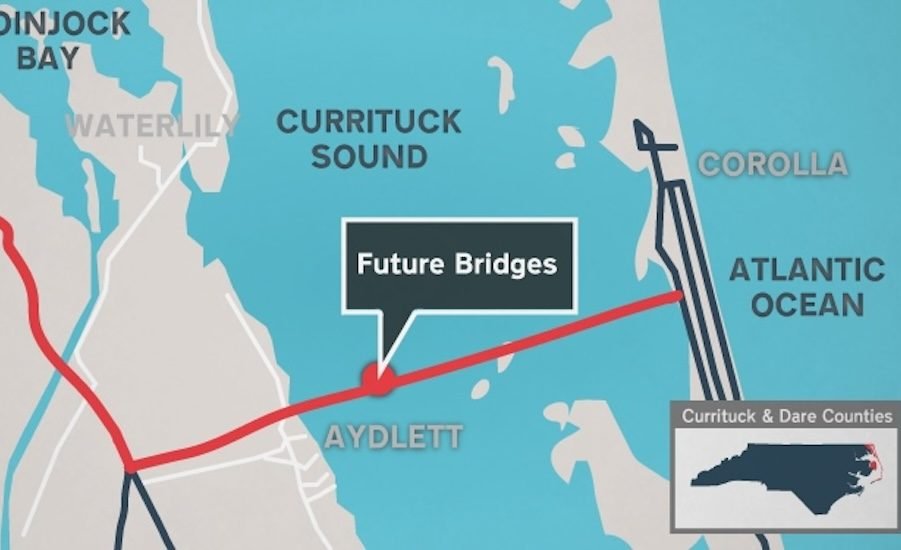
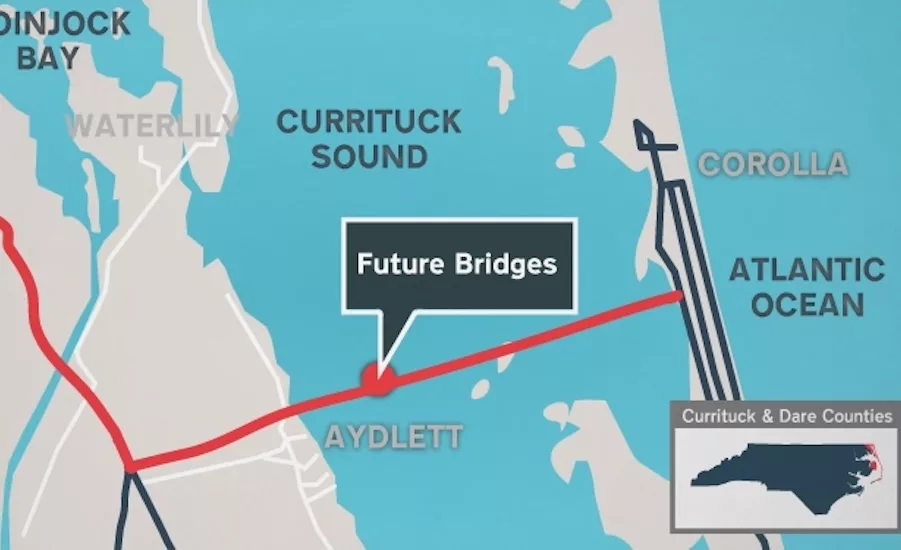
Despite having a favorable federal record and many key permits in place, the long-planned Mid-Currituck Bridge in North Carolina’s Outer Banks is still far from becoming a reality, according to a June 22 report from the state’s audit agency.
Using data from the North Carolina Department of Transportation, the State Auditor’s Office found that in the years since the Federal Highway Administration approved the seven-mile, two-lane toll bridge across Currituck Sound in 2019, steep increases in construction costs have more than doubled the project’s original $491 million estimate, with a current estimated cost of roughly $12 billion of dollars The escalation has resulted in a gap of up to $832 million from the original funding plan. Using a public-private partnership to build the bridge would narrow the gap only slightly, to $702 million.
In addition, updated studies commissioned by NCDOT predict slower regional economic growth than originally expected more than 15 years ago, a trend that would reduce the new bridge’s expected traffic volume by more than 40 percent, compromising the agency’s toll borrowing capacity. Making up for the decline would require substantially higher tolls, a move that would likely further discourage motorists from using the crossing, the audit found.
NCDOT has long sought to improve access to the northernmost section of the barrier islands that make up one of the state’s most popular tourist destinations. A new connection between U.S. Route 158 in Currituck County and state Route 12 near Corolla would provide a time-saving alternative to the existing four-lane Wright Brothers Memorial Bridge further south, which is regularly congested during the summer travel months. The new bridge would also provide an additional hurricane evacuation route for full-time residents and visitors to the Outer Banks.
In the more than 30 years since the Federal Highway Administration announced plans to begin environmental studies, however, the proposal has struggled to maintain momentum amid local opposition and legal challenges. According to the audit, NCDOT has spent $61 million on the project during that period, including nearly $8 million for an aborted pre-development agreement in 2009 that would have made the project North Carolina’s first P3 bridge, with a construction team led by Dragados USA, Traylor Bros. and Weeks Marine. Other costs over the years include environmental and engineering studies, consulting and legal fees, and acquisition of rights-of-way.
NCDOT told local officials earlier this year that it believes the Mid-Currituck Bridge is not “currently likely to be financially viable without additional project funding.” While a P3 remains a possible option to move the project forward, NCDOT’s Division of Toll Oversight, the NC Toll Highway Authority has yet to settle on a project delivery strategy or identify a development/construction team.
In response to the audit findings included in the report, David Roy, the Turnpike Authority’s director of innovative financing, said the observations “are consistent with the studies and events of the project that have taken place over the past 30 years that the project has been under study.” He added that NCDOT “remains committed to completing projects requested by local governments and scheduled in the State Transportation Improvement Program.”
Absent a path forward, NCDOT says no construction will take place on the Mid-Currituck Bridge until at least mid-2028. The project’s US Army Corps of Engineers Section 404/Section 10 permit, issued in October 2025, will expire at the end of 2030. Most of the other required statewide permits have been issued, while the result of the permit application to the US Coast Guard is pending.
In a June 22 presentation to the Currituck County Board of Commissioners, State Auditor Dave Boliek said the audit, one of a series of fiscal investigations being conducted across the state, is not intended to revitalize or directly undermine the bridge project.
“Our goal is to help move things along, one way or another,” Boliek added.
