

.webp?t=1780405179)
In May, Bluebeam made its latest release of Max available to all customers, adding artificial intelligence capabilities through its recent acquisition of Firmus AI and Claude AI from Anthropic.
Announced at last year’s Bluebeam Unbound event, Bluebeam Max expands the capabilities of the company’s flagship product Revu, a platform for reviewing and marking up construction drawings in PDF (Portable Document Format) format.
“AI is ushering in a new era for the built environment – one where complexity becomes manageable and data becomes actionable,” said Usman Shuja, CEO of Bluebeam. “Bluebeam Max is designed to help every user operate like a power user, building intelligence into familiar workflows while seamlessly connecting PDF and BIM. The result is a more connected and productive project experience, where teams can focus less on managing information and more on delivering results.”
Contractors and designers using Max updates will have access to Revu + Anthropic Claude via the Model Context Protocol, allowing contractors to use natural language prompts to talk to Bluebean MAX, automate repetitive tasks, and transform markup data into useful information.
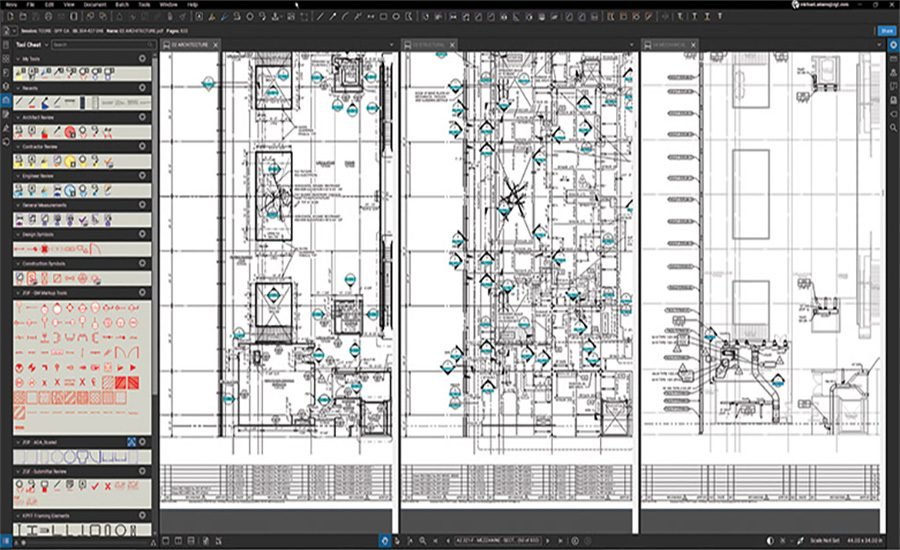
Stitching is a capability that combines multiple drawing sheets into a single navigable, scaled view for large linear infrastructure projects, such as highway projects that require a 2D aerial view, even if 3D models are available for individual sections of the project.
A new class of markup tools, known as Magic Markups, automates repetitive markup and reduces manual clicks, making takeoffs faster and more accurate. Studio sessions connected with a Revit API link, which allows Bluebeam markups to be placed directly in the correct location in Revit drawing and model views to effectively collaborate between PDF and BIM.
“A lot of customers in our beta program have been able to take their existing tools that they have and all of a sudden they can supercharge them,” says Luke Prescott, head of product at Bluebeam, using AI prompts.
Looking for quick answers on construction and engineering topics?
Try Ask ENR, our new intelligent AI search tool.
Ask ENR →
Martin-Harris Construction, a construction manager and contractor in Las Vegas, was in the beta program and used Bluebeam Max on complex project plans in a variety of developments. Martin-Harris’ projects span the multifamily, industrial, educational, healthcare and high-rise sectors.
The team used Bluebeam’s intelligent overlay and intelligent review capabilities in Max to compare price revisions and impact analysis during both design and construction, helping to quickly identify where construction teams should focus their attention.
“Bluebeam is already the backbone of how we review and collaborate on projects, but Bluebeam Max takes it to another level,” says James Miranda, director of preconstruction at Martin-Harris Construction, ranked #32 among the best contractors in the West by ENR.
“Features like Smart Overlay help us instantly see what’s changed and where to focus, which is critical when you’re managing complex projects at scale,” Miranda continues. “As comprehensive AI capabilities continue to evolve, this has the potential to significantly reduce manual effort and free up our teams to focus on coordinating and making higher-value decisions.”
