

AI data centers are no longer just buildings. They are increasingly reaching levels of energy demand more commonly associated with municipalities, prompting industry groups to launch a new framework they say is needed to keep pace with rapidly changing power, cooling and reliability requirements.
“Data centers are fundamentally different from any other type of building,” says Patrick Hughes, senior vice president of technology at the National Electrical Manufacturers Association. “You have to think of them more as cities than as a building.”
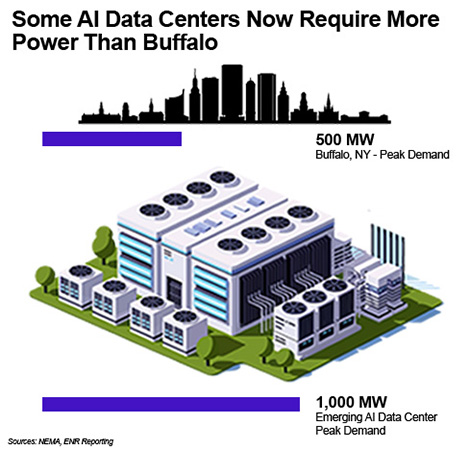
To illustrate the scale, Hughes points to Buffalo, New York’s peak electricity demand of roughly 500 MW. Emerging AI data centers are increasingly approaching or exceeding 1 GW of demand.
In response, NEMA, ASHRAE, and the Pacific Northwest National Laboratory on June 10 released the AI Data Center Energy Performance Framework, describing it as a resource intended to guide planning, siting, design, commissioning, operations, retrofit strategies, and interactive network design for AI facilities.
The framework includes guidance on energy storage, microgrids, demand flexibility, liquid cooling and other technologies increasingly being incorporated into large-scale projects.
The effort comes as NEMA’s Grid Reliability Study, prepared by PA Consulting for the group, predicts that data center electricity consumption will increase by about 300% over the next decade and account for 38% of the net growth in US electricity demand through 2037.
Hughes says the framework stems from concerns that electrical equipment is increasingly being deployed in applications for which existing codes and standards provide limited guidance.
Looking for quick answers on construction and engineering topics?
Try Ask ENR, our new intelligent AI search tool.
Ask ENR →
“What we saw was electrical equipment being installed and used in ways that weren’t necessarily designed, and the building codes and standards didn’t exist for that specific application,” he adds.
Unlike formal standards, which can take years to develop and revise, the framework is designed as a living resource.
“Standards take time,” says Hughes. “This does not match the pace of technological innovation and the speed of construction of today’s data centers.”
For Kathryn Thompson, founder and CEO of Thompson Research Group, the scale of construction is often misunderstood.
“People ask if this is a bubble,” Thompson says of data centers. “It’s like wondering if building the U.S. interstate system in the late 1950s was a bubble. It was just getting started.”
Contractors increasingly describe the challenge in similar terms.
“Five years ago, the challenge was building a data center,” Abrar Sheriff, president of Turner Construction Co., said in a statement to ENR. “Today, success depends on providing an entire ecosystem of power, cooling, workforce, digital infrastructure and supply chain capability at an unprecedented scale.”
Chris McFadden, Turner’s senior vice president of global communications, points to a multibillion-dollar AI data center campus the company is building in the Southeast as an example of how projects have evolved beyond building individual facilities.
“There’s a huge investment in workforce development. There’s a huge investment in getting people into the trades. There’s a huge investment in energy and a huge investment in providing all the utilities needed to run that data center,” says McFadden.
These investments can extend beyond the project itself. McFadden said large AI campuses often require upgrades to power generation, transmission and utility infrastructure that can have broader benefits for surrounding communities.
“It’s really any of these multi-billion dollar projects [that] they often lead to a broader view of this development, beyond the creation of a single data center,” he adds.
The demands on the workforce can be equally significant. McFadden says Turner currently has about 7,500 workers at the AI data center campus compared to about 2,200 workers at a current NFL stadium project.
RELATED
Network access, not land, emerges as bottleneck for data center construction
Power moves to the forefront
Access to electricity has become the industry’s dominant challenge, overtaking more traditional concerns such as site selection and building construction.
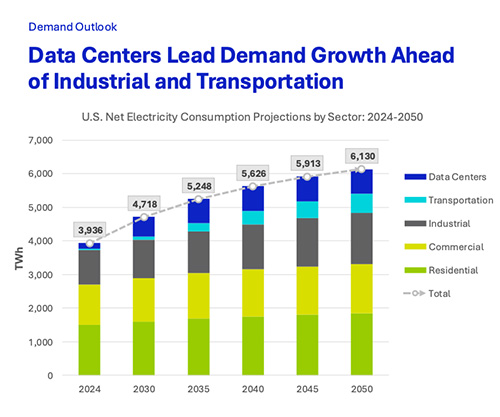
Data centers are expected to become the main driver of US electricity demand growth through 2050, accounting for 38% of net consumption growth through 2037, according to NEMA’s Grid Reliability Study.
Chart: Courtesy of NEMA
“That speed-to-feed concept, I think, is number one,” Hughes says, referring to the industry’s struggle to secure utility interconnections and power capacity. “Going through the utility interconnection queue.”
Wood Mackenzie sees similar challenges.
“The planning processes of doing load and generation not together would probably be the main ones,” says Allison Weus, the company’s global head of storage: “The lingering issues of getting the new generation online. And then the cost of the new generation.” In many organized wholesale electricity markets, the generation and load interconnection processes remain separate, making it difficult to align new power supply with rapidly growing AI demand, he adds.
Developers are increasingly looking to power infrastructure alongside the data centers themselves.
Weus says that about 35% of planned data center projects, as measured by power demand, include some type of associated generation, storage or flexibility resource intended to help speed deployment.
In some cases, batteries and storage systems are being used to reduce peak demand and ensure faster approval of utilities. In others, developers are turning to gas generation, microgrids or dedicated power systems.
“It’s done because they’re desperate to connect,” explains Weus.
In general, developers would prefer traditional network service because of its reliability and operational advantages, he adds, but long interconnection times are forcing many projects to look for alternatives.
Asked whether AI data centers should increasingly be seen as infrastructure projects rather than real estate developments, Weus says many developers are now taking on responsibilities historically associated with power sector companies.
“A lot of data center developers are basically becoming IPPs now because that’s the key challenge,” he notes, referring to independent power producers.
RELATED
FERC Weighs Federal Oversight of AI Data Center Network Connections
A challenge on an industrial scale
However, energy is not the industry’s only challenge: Hughes ranks labor availability as the second biggest constraint facing the development of AI infrastructure.
”
People wonder if this is a bubble, Thompson says of data centers. It’s like wondering if building the US interstate system in the late 1950s was a bubble.
— Katheryn Thompson, founder and CEO of Thompson Research
The workforce challenge extends beyond construction work. Contractors, manufacturers and analysts interviewed for this story pointed to shortages of workers needed to produce transformers, switchgear, energy storage systems and other electrical equipment.
“If you look across the supply chain at what it took to build this data center, it really is an industrial renaissance. [demanded] in the United States,” says Hughes. “We need more.”
Thompson cited an example in northern Virginia where an ambulatory care center received only a single electrical bid as demand for electricians intensified amid data center growth.
These work pressures are helping to accelerate interest in modularization and standardized design approaches.
Hughes says standardization can improve workforce productivity by reducing project-to-project variability. Thompson comes to a similar conclusion, saying, “The US has talked for years about the modularization of construction … it’s finally happening, because it has to.”
Looking ahead, Hughes points to DC power distribution as an area where significant innovation is likely to occur.
“We’ve been talking about 800 volts DC in the rack, but we even had an internal meeting of our members a few weeks ago where they were planning on delivering 1,200 volts or 1,500 volts DC power,” he says.
Higher-voltage architectures could improve efficiency by reducing repeated conversions between alternating current and direct current, Hughes adds, although they also pose new safety and engineering challenges.
Weus identifies another challenge: the operational complexity of managing generation and storage assets historically owned and operated by utilities.
“It’s not as simple as buying some gas and batteries, and then it’ll be nice to be off the grid,” he says.
