

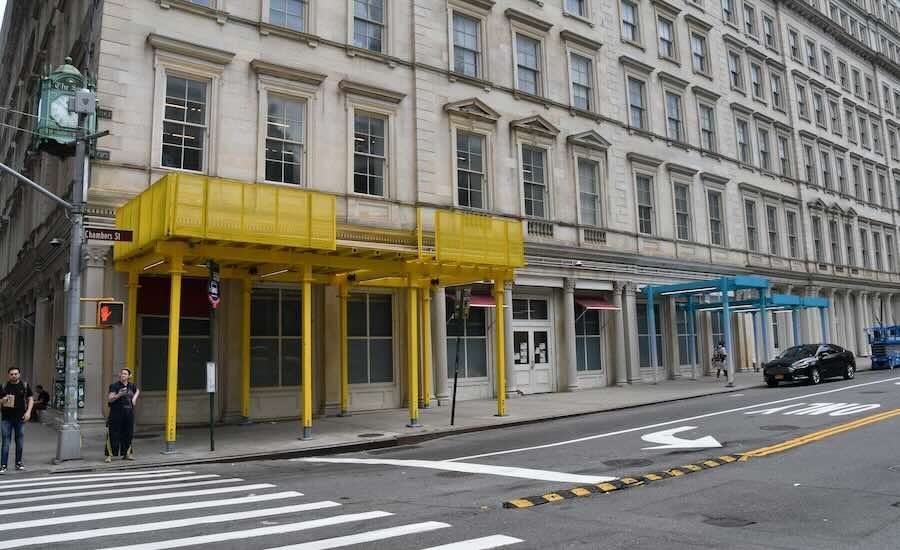
Two new designs of sidewalk sheds went up in lower Manhattan last week, and New York City officials say they will be available for use in the coming months.
The models are the product of an RFP issued by the Department of Buildings in 2023, as the then-Adams administration sought to move away from the “covered by BSA”, or the typical dark green, tunnel-like plywood structures used in projects throughout the city. The Mamdani administration has continued the program and plans to introduce the new shed options, six in total, as part of a package of new rules around scaffolding and facade inspections as soon as this summer.
Designs by a team including Arup and KNE Studio were on display. One version, the yellow rigid cover, is intended for construction and other heavy-duty applications, with solid sheets or a steel grid as a protective cover. The flexible blue cover is intended for less intensive street protection, such as facade care. Its roof is largely made of Plexiglas. A third version of the design group that attaches to an accompanying building and offers minimal protection was not built for the demonstration but will still be available to contractors, says Arup director Seth Wolfe.
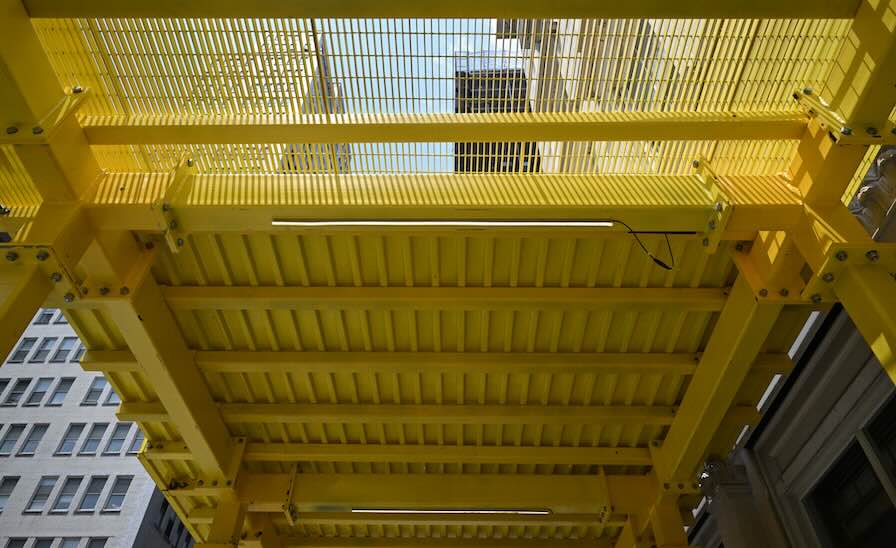 The prefabricated nodes at the edges of each shed design can contain beams of various lengths, regardless of how high the protection needs to be or how far from the building it needs to extend. Photo courtesy of the New York City Department of Buildings.
 The new scaffolding swaps the aluminum pipes of the BSA sheds for heavier steel, which is part of the reason the structures don’t have additional reinforcement parallel to the pavement, says Suchi Reddy, founder of Reddymade, an architecture and design firm that was part of the project to redesign the exposed structures. Neither the design team nor the city has an estimate of how much these new scaffolding options will cost. The materials will be more expensive compared to the standard BSA models for which there is already a large supply. “There are parks full of this material,” points out Ahmed Tigani, curator of the. NYCDOB. But as stock components grow, the cost of newer designs should come down, Tigani says.
Subsequent production and implementation of the new shed parts should reduce costs because the components are reusable. Precast steel nodes, or the joints that allow the pillars and roof beams to come together, are attached using industry-standard equipment, Wolfe says. Scaffolding contractors can change different connector beam lengths to match the dimensions needed for a particular site.
Banning BSA sheds depends on market adoption of the new options, Tigani says. The DOB has pre-approved the intellectual property of the designs to facilitate the authorization process. Scaffolding plans for a project can be approved “pro cert,” where the engineer of record takes full responsibility that the design is up to code, or the drawings can go through a standard file, which is a longer, more in-depth review by a DOB examiner, says Willy Pilku, CEO of Core Scaffolding, who worked on the designs currently on display. Typically, custom racks go through the latter, longer overhaul, while BSA sheds get the professional treatment.
Links to the new designs, including a trio of options from a team led by architecture firm PAU, will also be included in the new scaffolding rules the DOB plans to issue. The city plans to extend the time between facade inspections and reduce the maximum distance scaffolding must extend along the side of a building to 40 feet. New penalties will also be introduced for sheds that remain for more than 180 days. To that end, the city has also made progress on needed capital work on some of its own properties, such as the $650 million in NYCHA facade repairs the mayor announced in March.
