

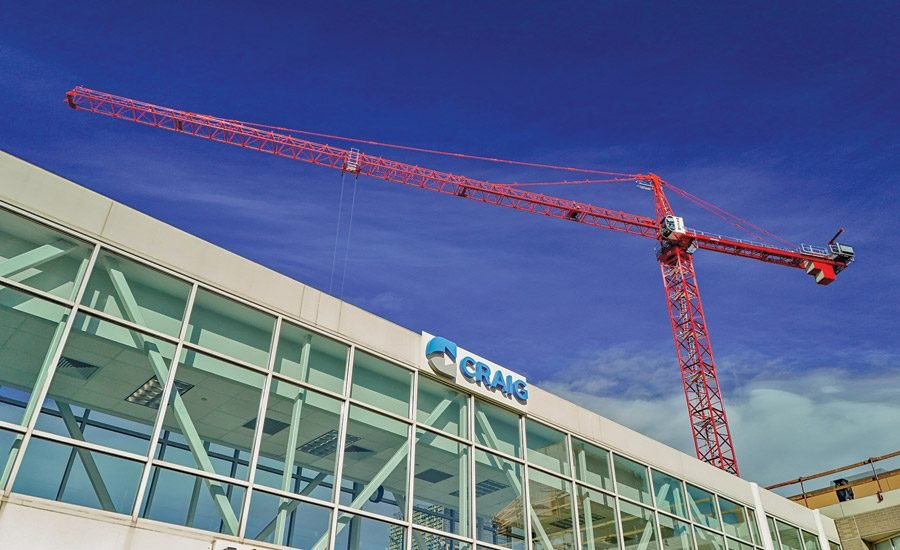
A world-class rehabilitation center for brain and spinal cord injuries, Craig Hospital moved from Denver to its current location in Englewood, Colo., in 1970. A pair of expansion projects in the 1980s and 2010 increased the number of beds to 88, but high demand has stretched capacity to its limits.
Dan Frank, Craig’s chief financial officer, says the hospital is typically more than 90 percent capacity, with about 50 patients waiting for a bed at any given time. “We started looking at how we could get patients to Craig faster and also see more patients overall,” says Frank.
Shortly after joining the hospital in 2018, Craig CEO Dr. Jandel Allen-Davis spearheaded a new master development plan to chart the course for the 119-year-old organization. “It was a multidisciplinary effort that involved all levels of the organization, from front-line staff to the executive team to board members,” says Frank.
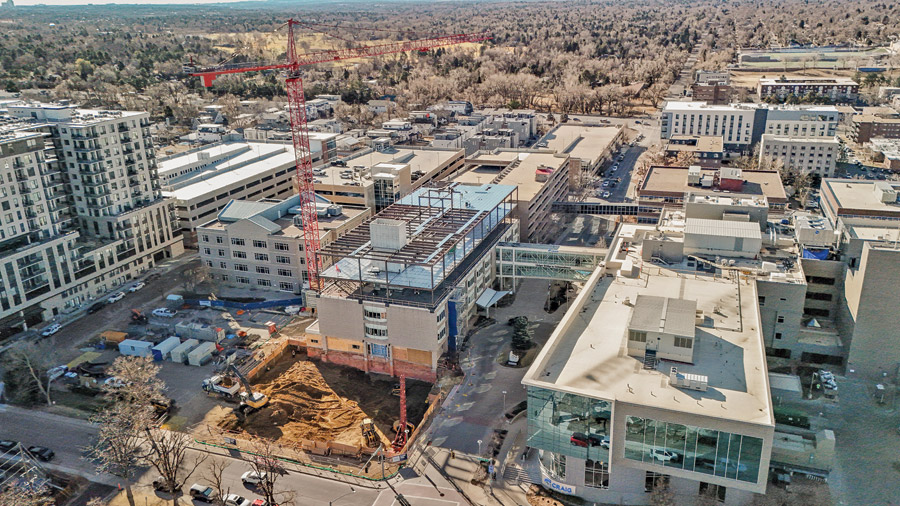
The hospital’s location in Englewood, Colorado is surrounded by largely residential development, leading to a design that seeks to maximize existing property.
Image courtesy of DPR Construction
The resulting $250 million project includes two new levels atop the East Building and a horizontal expansion on its north side, a new level on a bridge connecting the East and West buildings, and a series of MEP projects to separate the hospital from the nearby HCA HealthOne Swedish steam system. The project will increase capacity by around 15% with 26 new patient rooms.
The bridge structure is a steel frame with a cast-in-place deck, and the vertical and horizontal additions are a steel frame with concrete over metal deck with concrete cores. The total area of the expansion is about 86,000 square feet, which will bring the total campus to 330,000 square feet.
DPR Construction broke ground on the Davis Partnership-designed project in October 2025. The target to complete the vertical expansion is September 2026 and completion is expected by the end of 2028. The crew will reach a maximum of 160 workers.
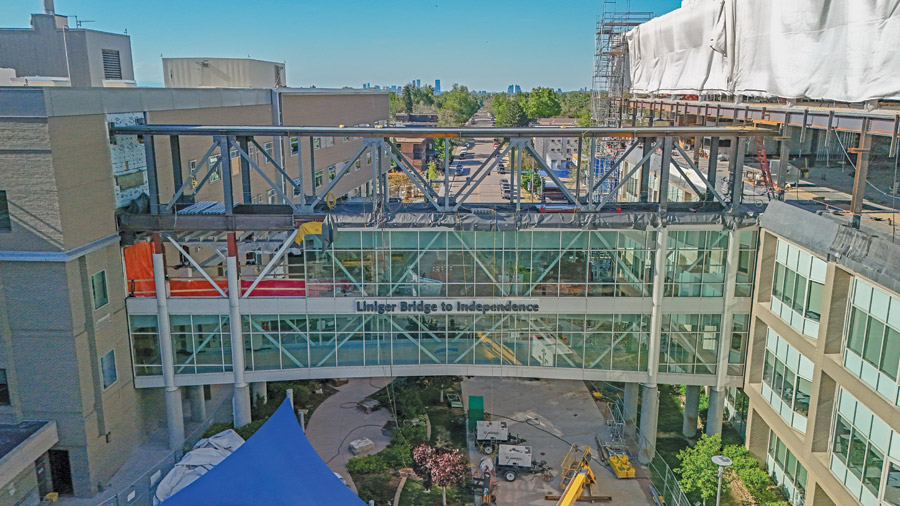
The pedestrian bridge between the East and West buildings is one of the most challenging features of the expansion project.
Image courtesy of DPR Construction
Continuity of construction
Healthcare had long been one of the most important market sectors for both DPR and GE Johnson when they merged in 2021. “There was a very similar culture and market sector work, and we were able to combine more than 50 years of healthcare experience under one roof with coast-to-coast resources,” says Theron Skidmore, DPR project executive.
GE Johnson was the general contractor for Craig Hospital’s West Building expansion in the 2010s.
“We were here for 42 months building a very similar project,” Skidmore recalls. “It was a great experience. It changed my life, personally.”
Skidmore cites “the relationships that were built, the inspiration, the ability to get involved and go to work every day and have positivity around you,” adding, “Craig is a special place and it makes it so much easier to get up and do what we do.”
This continuity has benefited the project, says Frank. “What DPR brought was not only industry-leading experience in the healthcare space, but they also brought back talent that had been involved in the previous construction project. They knew the culture, they knew the campus, they knew the challenges of taking a phased construction approach and the complexity that adds to the project. That was a huge advantage for us,” he adds.
Like Skidmore, DPR project superintendent Andrew Googins worked on the previous expansion in the early 2010s, along with Wendi Ekborg, director of the Davis Partnership. “It’s great to get the band back together,” says Googins, who has worked in hospital construction for 20 years.
“Before that, I was doing a high-rise multifamily project in downtown Denver,” he says. “It really makes you appreciate going back and doing this more technical work, because if you take the contrast of building a skyscraper of rinse and repeat to build that, the square footage is not great here, but the level of effort to build that square footage compared to a skyscraper or a data room is astronomically higher.”
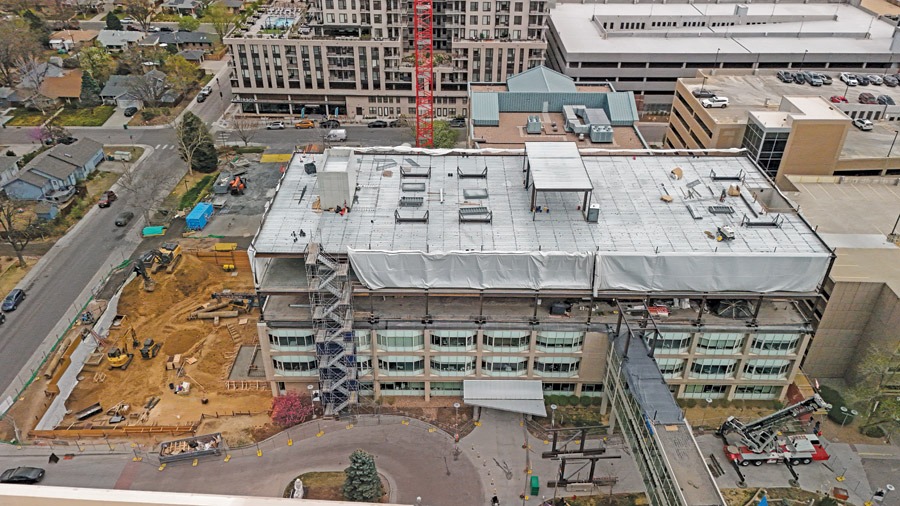
The existing mechanical infrastructure will remain operational until a carefully choreographed changeover.
Built with care in mind
The project includes a new “neuromedical service line to get ICU patients to Craig faster,” says Frank. “We’re expanding our neuromedical service line by 12 beds and we’re adding about 15 new rehab beds to our capacity so we can address the waiting list issue and see patients faster and see more patients in our neurorehabilitation program.”
Davis Partnership’s Ekborg says his previous work at Craig Hospital provided a foundation for the current project. But the “relatively landlocked” location adjacent to a residential neighborhood in Englewood raised a question: “How do you make this start to feel like a campus and not an individual building?” she says
The answer came largely in the form of an expansion that emphasized better connections for patients and improved workflows for staff.
“The building is going to stay busy. It’s going to be 24/7, so I think that underlines everything we do.”
—Andrew Googins, Project Superintendent, DPR Construction
“Inpatient floors were misaligned in terms of patient population,” says Ekborg. “On the third floor, a bridge from this latest expansion connected those patient floors, but for brain or spinal cord injuries, [the buildings] they were misaligned and did not connect. One of the big elements of the design was taking that bridge and expanding it vertically with the vertical expansion of the project, and that allowed us to align those patient floors by patient type.”
The coordination of the MEP work and the expansion of the East Building has also been demanding logistically. “One of the main mechanical goals was to get the campus into a centralized system. Each of the buildings operated independently, so we incorporated a four-pipe system to achieve centralized heating and cooling, and then also to set them up for future electrification,” says Ekborg.
“Because we’re expanding vertically and the existing air handling systems are on the roof, we’re basically building around the air handling units while they’re still running. Ultimately, when the new system is tied in, they’re going to take out those old units and build the patient floor,” he adds.
With foundation work underway, the horizontal expansion on the north side of [the East Building] “It will provide most of the new acreage,” says Googins. “Our short-term goal is to start erecting steel in the first week of July.” With four upper levels and a basement, the horizontal expansion includes an 8,500 square meter “human movement laboratory” for research, along with the neuromedical service line and new patient rooms and conference spaces.
The bridge is “a difficult little feature of the job,” says Googins. “It’s such an important conduit to go between buildings, so keeping it usable to some degree while expanding on top of it was an interesting challenge.”
The elevators in the East Building have been equally complicated in terms of how to manage the placement of new elevators, the removal of old elevators and keeping one in continuous service at all times, he adds.
“It’s a very complex phase about how things change and when,” says Googins. “The goal is to build all the new floor space, and that turns around and allows us to go in and renovate the existing floors to keep that patient population where it needs to be.”
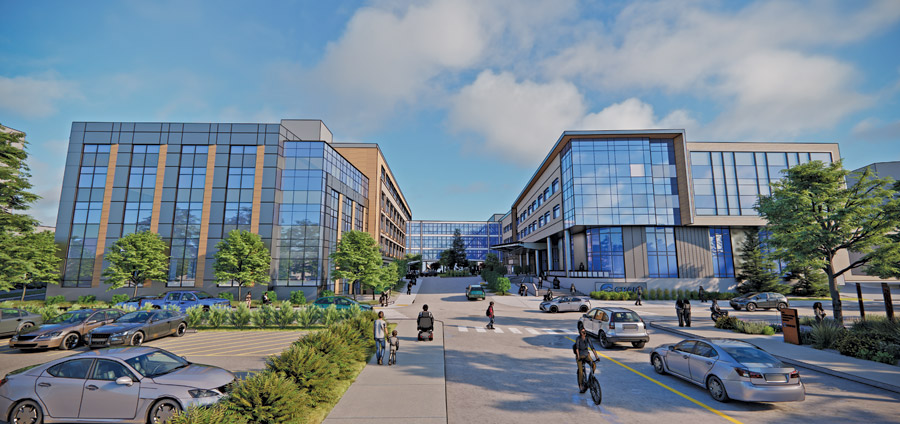
A key principle of the design is to foster a campus feel at Craig Hospital.
Image courtesy of Davis Partnership
A complicated dance
That sequencing is imperative to “make sure we can still provide care to our patients and not jeopardize that while we’re building around,” says Toby Huston, Craig’s vice president of neurorehabilitation services.
Project planning involves choreographing work on electrical and air handling systems, along with minimizing vibration and noise to avoid any impact on the hospital’s core mission. The hospital will rely on emergency generators for a 12-hour shutdown in June, Huston adds. “It’s a very complicated dance.”
Many patients are sensitive to vibrations and noise, notes Ekborg. “There’s been a real coordination effort with Craig on the operations side to do this kind of work when these patients have finished therapy for the day and do it before they go back to their room.”
Citing rates and market conditions, Ekborg says rising costs have posed another challenge. “The design hasn’t necessarily changed, but we found that we had to defer some of that scope that was in the original project,” he explains. “From a team perspective and working with Craig, we’ve all had to roll up our sleeves and dig in [to ask] ‘What are the priorities?’”
Ekborg always comes to the same answer: “Ultimately, the priority is the patient.”
