

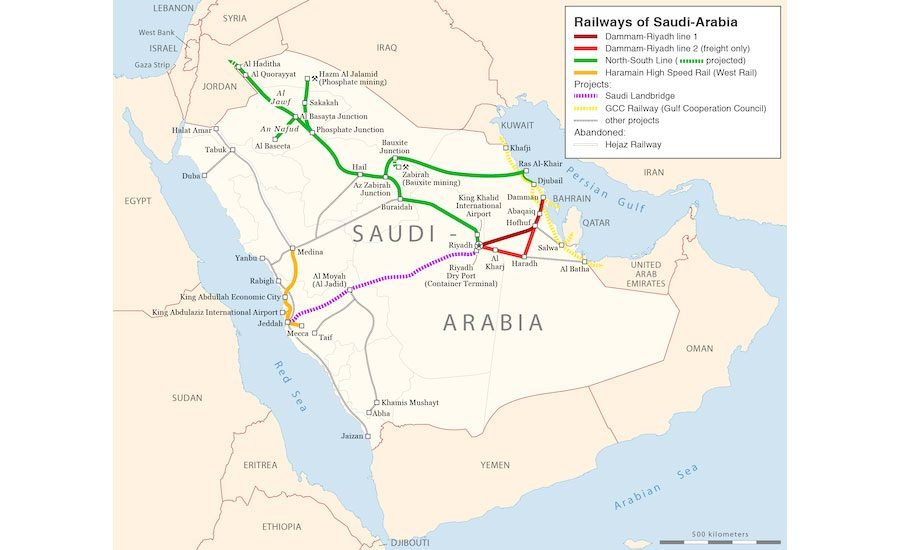
Saudi Arabian Railways (SAR) is moving ahead with its long-awaited Landbridge project that will cross the Arabian Peninsula linking the Persian Gulf industrial cities of Jubail and Dammam with the capital Riyadh and the Red Sea port of Jeddah. The $7 billion, 1,500 km project is part of Saudi Arabia’s Vision 2030 program that incorporates numerous billion dollar projects aimed at modernizing the country.
Construction of the passenger and freight railway began in December last year, and in April, SAR awarded the main design contract to Spain’s Sener/Typsa.
The work has not been interrupted by the US-Israeli war with Iran, but has been accelerated, according to some media outlets. The railway has been under consideration for several years and the closure of the Strait of Hormuz due to the war is serving to encourage construction of the project, which is now expected to be completed in 2034 at a total cost of $7 billion, although the entire project is believed to require an investment of $26.6 billion.
The Landbridge aims to reduce the need to transport products and materials produced in Saudi Arabia’s two main industrial regions, Jubail and Yanbu, across the Strait of Hormuz to global markets.
It will also offer a passenger rail service, with trains operating at up to 250 km/hour. The goods will travel up to 160 km/hour. The new railway line will not offer high-speed service due to the dual nature of its use.
Initially, the Landbridge was created as a public-private partnership, but this has evolved into a phased implementation strategy to increase construction flexibility and speed up work. SAR has divided the project into modular segments that allow the railway section to continue with timelines. The project is in advanced planning under Sener/Typsa, which is drawing up construction packages to be tendered at different times as work progresses.
The Jubail-Dammam section of the railway was completed and inaugurated in April 2024.
Looking for quick answers on construction and engineering topics?
Try Ask ENR, our new intelligent AI search tool.
Ask ENR →
The scope of work includes a new 950 km dual-track/mixed-traffic railway line between Jeddah and Riyadh. The existing network between Riyadh and Dammam, covering 450 km, will be upgraded and the extended railway lines between Damman and Jubail will be upgraded or added. A ring road will also be built around Riyadh connecting with links to port cities. There will also be rail extensions to the industrial city of Yanbu and King Abdullah Port.
Hill International is working with Sener/Typsa as a member of the project management consortium, along with Italy’s Italferr, which contributed to the detail design when the project was considered in 2013-17.
The Saudi China Landbridge Consortium is tasked with delivering the project and consists of SAR, China Civil Engineering Construction Company (CCECC) and Saudi firm Al-Ayuni Contracting. Recent contractual development has reactivated localized engineering and structural arrangements under consortium supervision. Some of the first key construction packages to be offered include viaducts, signalling, utilities and civil works along the 35km Riyadh rail link. Work around the capital includes a 22.7km single-track railway, a 265m bridge over the HW615 highway and a 118m bridge over the Saudi Aramco pipelines.
The Landbridge is owned by the Government of Saudi Arabia through SAR, the principal owner and operator, which is state-owned and fully controlled by the Public Investment Fund, the ultimate owner. The PIF’s role in the project is funding, strategic oversight and integration with the other Vision 2030 initiatives. None of the contracted partners has a stake in the project.
