

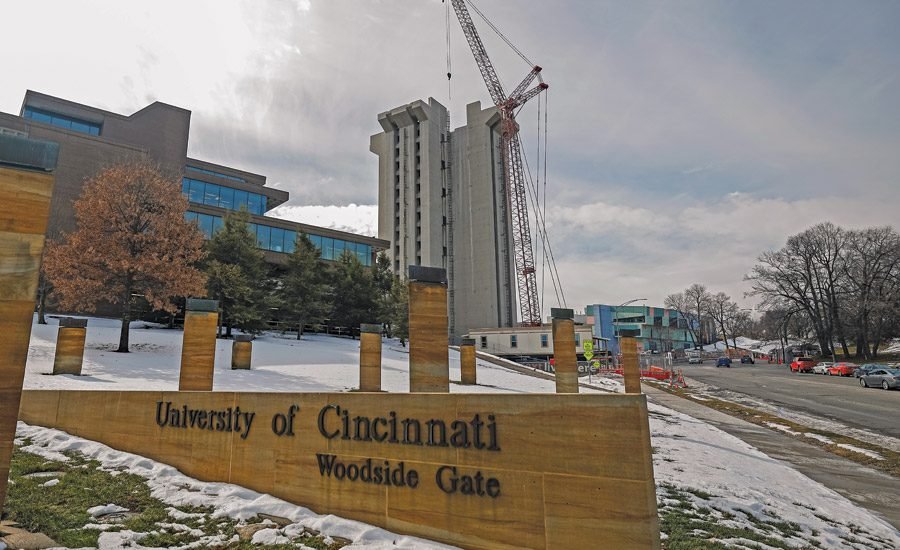
For decades, the 17-story Crosley Tower towered over the University of Cincinnati campus, inspiring reactions ranging from scorn to devotion. Architectural Digest once compared the Brutalist concrete behemoth to the lair of an evil Disney villain and ranked it among the seven ugliest college buildings in the country. However, many students embraced the tower’s unique charms, building gingerbread replicas, choreographing light shows to music through its vertical rows of windows, and even forming a fan club in its honor.
Considered variously as an object of loving nostalgia, the tower, designed by architect Charles Burchard while working for Cincinnati firm AM Kinney Associates, has another claim to fame. During construction in 1969, crews poured concrete 24 hours a day for 18 days and nights, making it second only to the Hoover Dam as the nation’s largest structure made of continuously poured concrete.
More recently, however, the tower, which had housed classrooms and research labs, has been identified as unsuitable for renovation due to its aging concrete and foundations and outdated layout. It’s being painstakingly removed in a $47.5 million top-to-bottom, piece-by-piece demolition that emphasizes precision over strength. The project began in 2026 and is expected to be completed in early 2027.
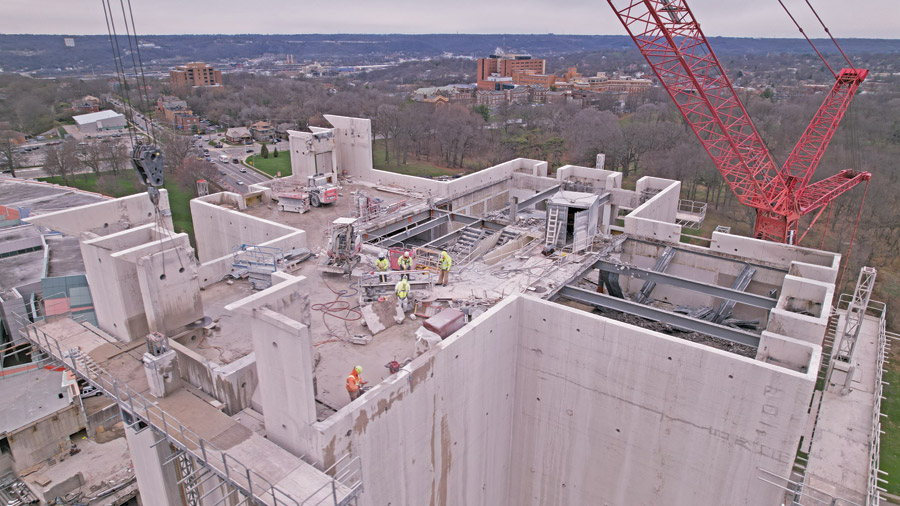
Crews are working top-to-bottom on a floor-by-floor demolition that began in January and is expected to be completed in early 2027.
Photo courtesy of O’Rourke Wrecking Co.
Implosion Never on the table
Mike O’Rourke, a University of Cincinnati alumnus and president of O’Rourke Wrecking Co., which is partnering in the demolition with Skanska Cincinnati, says blowing up the building was never an option.
“Crosley Tower is in the middle of an active and dense urban campus with busy buildings, utilities and constant pedestrian traffic immediately adjacent,” he says. “Implosion was not feasible due to risk tolerance, air overpressure and debris footprint. Complete mechanical demolition from grade was also limited by the height of the structure, the reinforced concrete system and the lack of safe collapse zones.”
The team chose a slab-by-slab deconstruction approach selected to control load paths and create a predictable sequence for removing the building.
Each floor is sawn into manageable sections, which typically range from about 8 feet by 10 feet to 10 feet by 12 feet, depending on the structural layout, O’Rourke says. “The slabs are not perfectly uniform: column spacing, beam drops and mechanical penetrations create variations.”
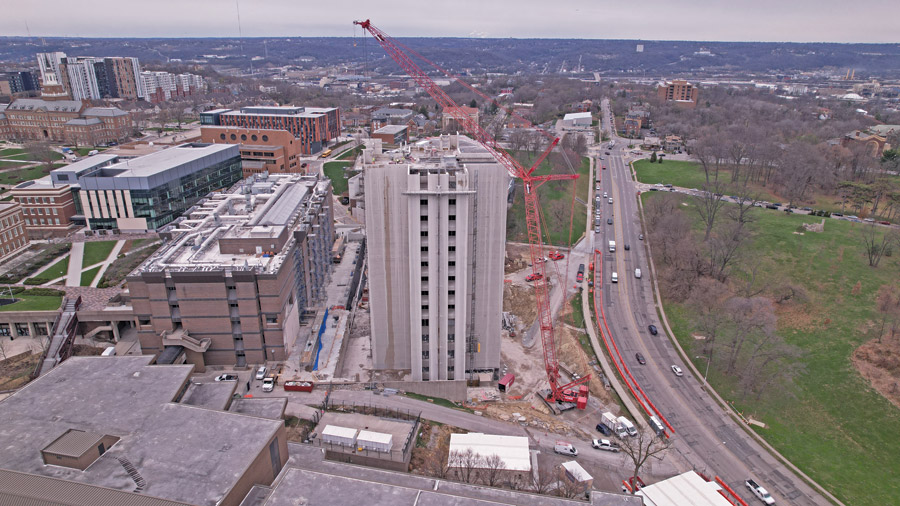
The demolition strategy ensures that Crosley Tower remains stable at each stage of the process.
Photo courtesy of O’Rourke Wrecking Co.
Finesse, not Strength
“It’s a methodical process and that discipline directly supports worker safety and public protection.”
—Chris Hopper, Executive Vice President and General Manager, Skanska Cincinnati
“Removing a single slab section can take anywhere from 20 minutes to over an hour to cut, assemble and completely remove, depending on the density and accessibility of the reinforcement,” notes O’Rourke. “The process is repeated floor by floor, maintaining structural stability at all times.”
“After the slabs are removed, the supporting beams and columns are removed in carefully planned sequences before moving to the next level,” adds Chris Hopper, executive vice president and general manager of Skanska Cincinnati.
Hopper says the tower was designed with different floor plates, slab thicknesses and bracing patterns. Completing the demolition of an entire floor typically takes several days, depending on the complexity. The largest slab is expected to weigh approximately 16 tons.
“Brutalist structures like Crosley Tower are extremely robust, made of thick concrete, heavy bracing and construction methods that don’t lend themselves easily to demolition,” says Hopper. “From a safety perspective, this means the work cannot be rushed. O’Rourke’s experience with complex and high-risk demolitions has been essential in sequencing the removal so that the structure remains stable at all stages. It is a methodical process and this discipline directly supports worker safety and public protection.”
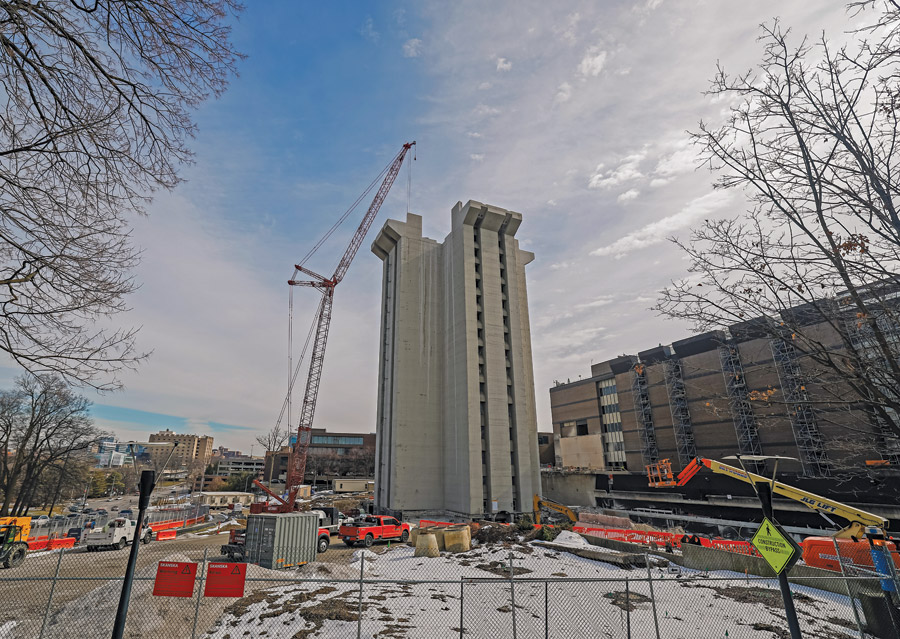
Tens of thousands of tons of concrete went into the construction of the Crosley Tower, and much of it is expected to be recycled.
Photo courtesy of Conor Boyle
Maintain an active campus
The biggest challenge was planning the work that needed to be completed without disrupting daily life and operations on campus. Skanska, O’Rourke and the University of Cincinnati worked together to create a plan that prioritizes pedestrian safety, emergency access and clear communication.
“We have developed highly sequenced work zones, dedicated haul routes and just-in-time trucks to avoid site congestion,” says O’Rourke. “Every move, from crane selection to debris removal, was modeled to minimize impact on daily campus operations.”
Before each mobilization, all subcontractors must prepare a construction work plan (CWP), which helps identify potential hazards and establishes the safest methods for carrying out each task. As work progresses, CWPs are updated for new activities to ensure ongoing risk awareness and mitigation.
In addition, daily hazard analyzes are performed and documented.
“These sessions actively involve all workers in reviewing the day’s tasks, identifying potential hazards and environmental considerations, and confirming appropriate controls,” says Hopper.
Deconstructing a building that was altered in various ways over the decades has brought other challenges.
“Everything is planned before the cut is made.”
—Mike O’Rourke, President, O’Rourke Wrecking Co.
“As with many buildings of this era, we encountered areas with heavier reinforcement than expected and localized modifications from decades of renovations,” says O’Rourke. “In some cases, embedded elements and undocumented utilities required adjustments to our sequencing. We address these conditions through field verification, real-time engineering review, and adaptation of cutting patterns or handling methods. Flexibility is critical, but always within a controlled engineering framework.”
The team uses specialized tools that include track-mounted saws and strategic core drilling for clean separation, high-capacity cranes for controlled peaks, and high-reach excavators equipped with processors when the team moves to lower elevations. The mating systems are designed for each peak to manage weight, balance and swing control.
“Everything is planned before the cut,” says O’Rourke.
Although the building has outlived its usefulness, the materials that went into making it have not. A significant portion of the structure, approximately 25,000 to 30,000 tons of concrete and 1,000 to 1,500 tons of rebar and structural steel, is expected to be removed and processed during demolition.
“Materials separation and recovery are closely coordinated with demolition operations to maximize landfill diversion, with a large portion of uncontaminated concrete expected to be recycled,” says O’Rourke.
“As expected with a building of this age and type of construction, field conditions sometimes require adjustments, and the team stops to reassess before moving forward,” adds Hopper.
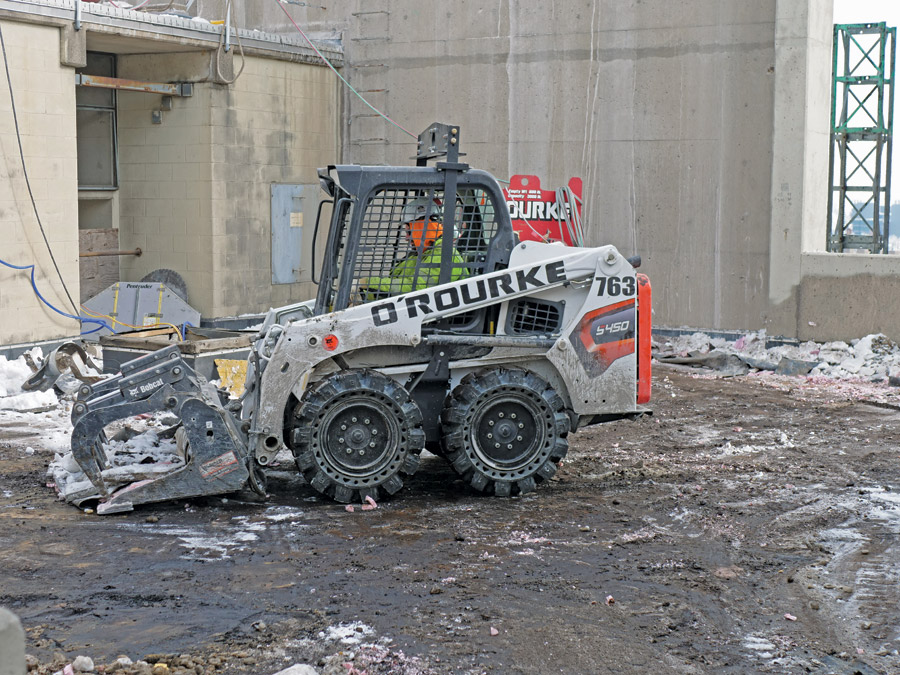
An operator removes roofing material from the top of the Crosley Tower during the initial phase of the demolition.
Photo courtesy of O’Rourke Wrecking Co.
personal connection
For O’Rourke, the decommissioning of Crosley Tower represents one of the most complex projects in his portfolio, not only because of its size, but because of its many constraints.
“The combination of a heavily reinforced Brutalist concrete structure, vertical deconstruction and a fully active campus environment demanded a level of coordination and precision beyond conventional demolition,” says O’Rourke.
He also has a personal connection for the president of the demolition company, who spent time at Crosley Tower as a student putting in long hours in the chemistry lab.
“There is a sense of history attached to this building,” he says. “It’s been part of the campus skyline for decades, and for a lot of people, it holds memories. I remember being in those labs as a student, so it’s personal.”
Although details are not yet available, the university’s board of trustees advanced a plan in April to build a new science and research facility to replace Crosley Tower, a future that O’Rourke says could not happen without work to demolish the old building.
“To be a part of its removal and to know that it is leading to something new that better serves the university today is meaningful,” O’Rourke says. “It’s what demolition is really about. Not just tearing something down, but creating opportunities for what comes next.”
