

Can the private sector save high-speed rail projects in the US? Experts are skeptical.
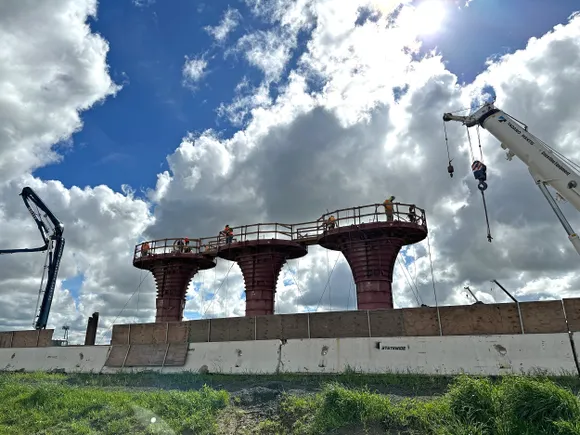
The California High Speed Rail Authority has turned its attention to private investment in the absence of federal funding. It entered into a co-development agreement last week with a consortium of investment, infrastructure and high-speed rail companies in hopes of attracting outside investors.
The group will spend the next six months “identifying viable strategies” to finance construction beyond the current initial phase of 119 miles from Merced to Bakersfield, California. The $25 million deal has an initial term of 30 months.
“These are all very positive developments aimed at a partnership to evaluate accelerated delivery, private investment and public partnership opportunities for high-speed rail expansion,” an authority spokesman said in an email.
The project has few other funding opportunities as things stand. The Federal Railroad Administration, under Transportation Secretary Sean Duffy, canceled about $4 billion in unspent federal funding previously awarded to the authority. The authority’s only guaranteed source of funding is the state of California’s commitment to contribute $1 billion annually to the project through 2045 from the state’s Cap and Investment Program, which allows greenhouse gas emitters to buy and sell allowances at auctions based on their needs, with some of the proceeds going to the state’s Greenhouse Gas Reduction Fund.
The authority needs $126 billion to complete the full San Francisco to Los Angeles project, according to its 2026 business plan. It currently has $39.3 billion available, authorized or in planned future funding through 2045, including $20 billion from the cap-and-invest program, leaving an $87 billion gap. Transportation experts Smart Cities Dive spoke to little opportunity for private investment of the magnitude needed to close that gap.
“If they had been able to get private sector investment [for the California project]they would have already gotten it,” Baruch Feigenbaum, senior managing director of transportation policy at the Reason Foundation, told Smart Cities Dive.
Feigenbaum, in a column published on the Reason Foundation website, said the authority’s partnership with the consortium “is a standard engineering contract paid for by taxpayers.” Smart Cities Dive asked the authority for a response to this statement, but did not receive a response before publication.
The realities of private finance ‘catching up with ambition’
The results so far of two other passenger rail projects that promised success as private companies may serve as a warning to potential investors.
Brightline West, the proposed 200-mile-per-hour line from Las Vegas to Southern California backed by Fortress Investment Group, has seen its projected cost increase from $12 billion to $21.5 billion and moved up the completion date from 2028 to 2029. A Brightline West spokesman said in an email, “It’s pretty quiet on the project completion date right now.”
Construction on its Las Vegas station had been underway since January, according to local media. Beyond that, most of the construction activity has been for field investigation, which Brightline West describes on its website as “geotechnical drilling and sampling, caving and terrain surveying.”
The project had promised to raise $400 million by March 31, 2026, but failed to do so, according to Bloomberg.
“The private sector plans are not really viable, and I expect Brightline West to pivot to wait for even more federal funds,” Alon Levy, a fellow at New York University’s Marron Institute, said in an email.
Brightline Florida, not considered a high-speed rail line but also backed by Fortress, faces default if it can’t make payments or restructure its debt obligations due July 1.
“Brightline deserves credit for trying, but the challenges they face are not surprising,” RedCoach co-founder and board member Florencia Cirigliano said in an email. RedCoach is a luxury intercity bus company in Florida, Texas and Oklahoma. “I think what we’re seeing now is reality catching up with ambition.”
Despite the financial hurdles, the two high-speed rail projects are moving forward. Brightline West in 2024 chose Siemens Mobility to produce its high-speed train sets, which will be manufactured at a new facility in Horseheads, New York.
The California High Speed Rail Authority completed track installation at a railhead facility in Kern County, California, which will serve as a center for the distribution and installation of high-speed track and systems. It also gave the go-ahead to install track, overhead electrical contact system, train control and communications infrastructure along its 119-mile Central Valley segment. In addition, the authority opened a request for contractor qualifications to extend the Central Valley line to Madera, California, a $2.4 billion project.
The question remains whether these multibillion-dollar projects can go beyond the fundraising phase to a time when trains are running on the railway. “For most private sector developments, the financing agreement is designed to limit downside and allow for full upside,” Levy said. But if the railway does not become profitable, governments are unlikely to bail out investors, he said.
“I didn’t think the numbers were ever drawn in pencil,” Feigenbaum said. “If I am a private investor, [high-speed rail] It’s not the best place to put my money.”
