

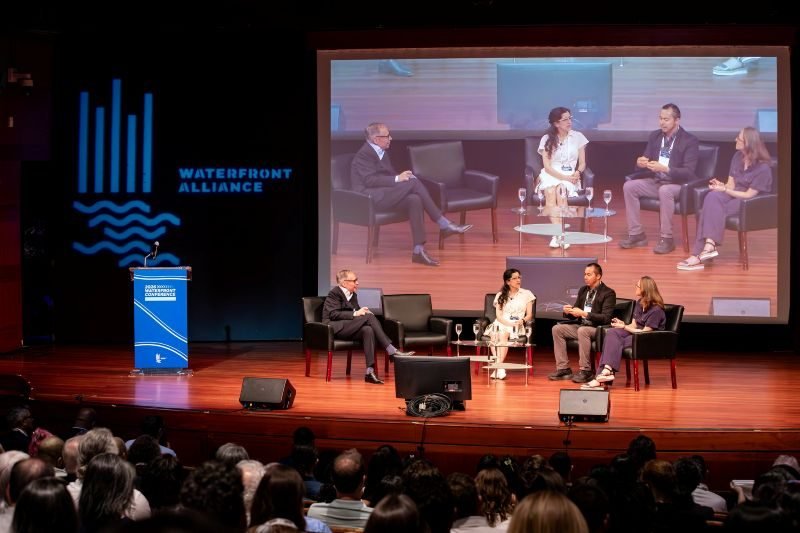
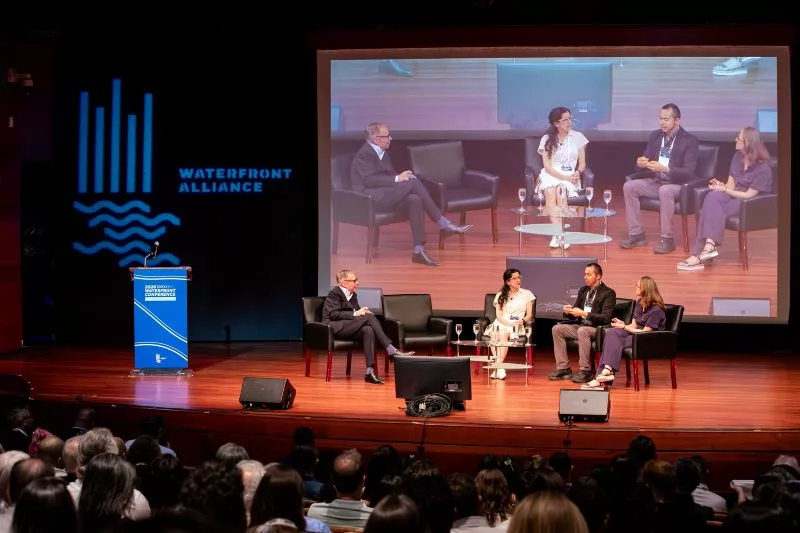
Engineers, policy professionals and analysts at a waterfront resiliency conference last month in New York City agreed that communities need to be better prepared for drastic changes in water levels, whether rising or falling, but had a more contentious debate over the responsibility for executing and funding those preparations.
The issues arose during the opening plenary of the event, organized by the Waterfront Alliance, which explored how coastal cities around the world manage waterfronts. In the UK, the Thames Estuary 2100 Plan sets out targets that municipalities should meet every five years to improve flood defences, but the non-statutory program is difficult to enforce, said Charlie Wood, London area director of the country’s Environment Agency.
Flood prevention oversight responsibility was also the subject of a separate panel related to design for rising groundwater levels. In the Queens neighborhood of South Jamaica, groundwater flooding became a recurring problem after the mid-1990s, when the New York City Department of Environmental Protection acquired the last private water company that had supplied well water to homes and businesses in the borough and connected residents to the larger Catskill municipal system, participants said. When well pumping stopped in 1986, the groundwater rose, and by 2007, water levels in the neighborhood were 35 feet higher, according to agency statistics.
York College, a branch of the City University of New York based in the neighborhood, has hired consultant Arcadis to help prevent water from seeping into its subbasement. The school pumps 15,000 to 100,000 gallons per day to minimize damage to its mechanical equipment. Arcadis is injecting grout into the subbasement slabs, though that’s only a temporary solution, acknowledged Michael Escobar, the company’s water engineer.
Other area residents and business owners with flooded basements have asked the department to resume pumping wells, said William Scarborough, president of the Southeast Queens Residents Environmental Justice Coalition. The official agency’s position is that it is not responsible for mitigating underground flooding in the area, he noted. The agency has installed “reverse seepage basins,” a type of underground catchment basin, in some areas to help drain water into Jamaica Bay. “We have not received information about how successful they are, if they are successful at all,” Scarborough said. “I know it’s on everybody’s radar screen.”
A department spokesperson who responded to an ENR inquiry said the agency recognizes that Queens communities are experiencing a number of flooding challenges, including stormwater, sewer capacity and groundwater. “We remain committed to collaborating in efforts to understand the scope of the problems and the feasibility of potential solutions. It is also important to note that [the agency] has made, and continues to make, significant infrastructure investments in Queens, including construction of a $2.8 billion sewer line in southeast Queens that will reduce street flooding and groundwater recharge,” the spokesperson said.
Shared responsibility
Experts at the conference also discussed the logistics of what shared responsibility looks like, noting that which parties bear the risks have changed over time. NYC Ferry has split public and private management, with the city’s Economic Development Commission in charge of development and maintenance of the landing and Hornblower Group in charge of the boats and in charge of day-to-day operation. Previous contracts between the city and the company put most of the risk on the operator, though the balance has since shifted, said Jeff Brault, vice president of global public affairs for the Hornblower Group.
Looking for quick answers on construction and engineering topics?
Try Ask ENR, our new intelligent AI search tool.
Ask ENR →
Rebecca Fischman, principal resilience planner at Arcadis, noted her interest in determining how insurers can become more active investors in projects as federal funding dries up for coastal defense infrastructure in New York City and other municipalities. “The elephant in the room is the insurance companies,” he said.
In the past, better availability of federal funds reduced the need for state and local governments to seriously consider their own project financing strategies. But with that funding unsecured, the pressure is on, said Alison Branco, director of climate adaptation at The Nature Conservancy in New York. “We are having [a] conversation about how to be a little more self-sufficient in terms of financing … and I think that’s a good thing,” he noted.
A $4.2 billion bond measure passed in New York in 2022 could set a good example, said Kisha Santiago, assistant secretary of the New York State Department. Funds are earmarked for stormwater management, coastal rehabilitation and other infrastructure projects. There are other methods for funding resilient options, including state legislation that would allow stormwater to be regulated the same way it does wastewater, allowing water authorities to charge fees related to runoff.
The federal Inflation Reduction Act, enacted in 2022 in the Biden era, created a “wild time of opportunity,” Santiago said. The funding may have been clawed back by the Trump administration, but it created some lasting benefits. “This also helped bring state agencies together in ways that local governments need to work together,” he said.
For its part, credit rating agency Moody’s has tried to be more transparent about how climate risk influences its ratings, said Jennifer Chang, vice president and senior credit officer in its sustainable finance group. Relief funds and insurance available, as well as physical defenses, impact ratings, he said.
