

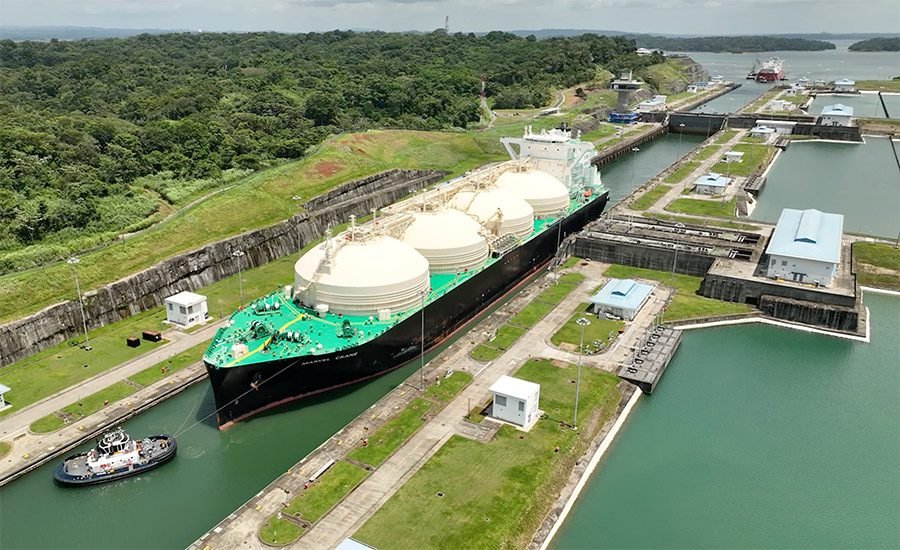
Earlier this month, the Panama Canal Authority (Autoridad del Canal de Panamá, or ACP) lowered the draft limit for ships passing through the waterway, citing “the potential development of an El Niño phenomenon.” The move brought back memories of the canal water crisis three years ago, which affected global shipping.
Canal officials say the situation is very different this time, with water levels in the canal’s reservoirs near record highs. The measure, explained by the sub-administrator of the channel, Ilya Espino de Marotta, is linked to the start of the dry season on the isthmus.
“We are doing this as a preventive measure because we see that the rains are slowing down,” he said. “We want to make sure we’re ready.”
Heavy rains forced the authority to spill water from Lake Gatún in February, an unprecedented event, according to Espino de Marotta. Water saving measures began in December 2025, six months earlier than the same cycle that began in 2023.
Still, anxiety remains because the canal is experiencing unusually high traffic volumes related to the effective closure of the Strait of Hormuz due to the war between the US, Israel and Iran. The shutdown redirected demand for liquefied petroleum gas from the Atlantic Basin and demand for liquefied natural gas to supply from the US Gulf Coast, with Panama providing the shortest route to Asian markets.
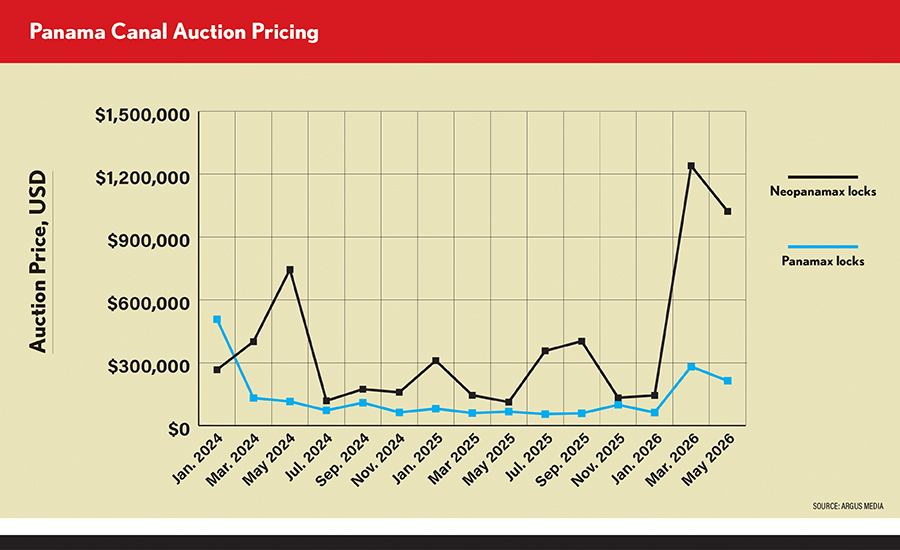
Source: Argus Media
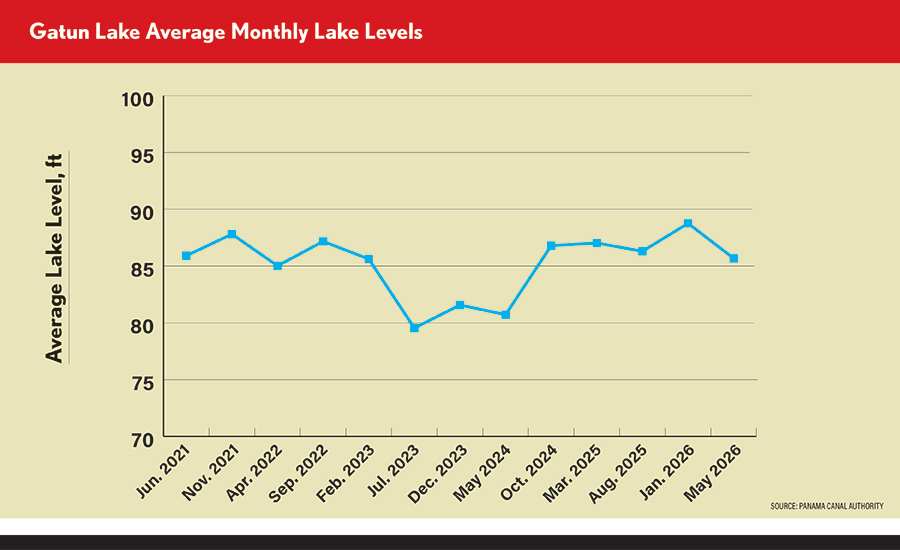
Source: Panama Canal Authority
*Click on the graphics for more details
Nick Watt, head of global commodity pricing at Argus Media, said the result was dramatic but not unexpected.
“In recent years it has been shown that various events can quickly lead to changes in trade flows, and this has affected the Panama Canal,” Watt said.
Looking for quick answers on construction and engineering topics?
Try Ask ENR, our new intelligent AI search tool.
Ask ENR →
While overall traffic has increased, the added demand is most visible in rising auction prices. Each day, the ACP auctions a limited number of passages, while reserved vessels pay regular tolls.
ACP source data cited by the Atlantic Council in May put the average winning bid from March to April at roughly $385,000, nearly triple the pre-conflict average. In April, an LPG carrier paid more than $4 million for traffic through the auction system.
Ongoing talks between the United States and Iran could end with the reopening of the Middle East waterway, but pressure on the Panama Canal will remain. A full return to normal shipping operations will take months, assuming they fully recover.
Maritime historian Sal Mercogliano of Campbell University expects the demand pattern to overcome the immediate disruption, as shippers remain wary of the dangers of Strait of Hormuz traffic.
“I don’t think the Persian Gulf will return to even pre-war levels in the short term,” he said.
Still, it’s hard to rule out the threat of another record drought. NOAA says El Niño conditions are present and expected to strengthen in the Northern Hemisphere winter of 2026-27. Historically, El Niño events have brought drier conditions to the isthmus.
Canal officials have described the amount of water used to operate the canal as 2.5 times the amount used by a city the size of New York. The same freshwater basin that the waterway depends on supplies drinking water to more than 2 million Panamanians, roughly half of the country’s population.
✕
To meet the challenge, canal officials have taken a number of measures to conserve water in the canal over the past few years. Many arose from a US Army Corps of Engineers study of the canal’s water resources completed in 2023.
The verdict was emphatic: “No measure offers a complete solution.” Any viable plan, the Corps found, would require layered measures both inside and outside the canal’s watershed. The ACP’s assessment was equally blunt: “There is no silver bullet to this problem. That’s why we’re leveraging a multitude of action-oriented solutions.”
These measures are starting to take effect. They include:
- Cross Fill: Water movement between adjacent Panamax chambers, saving the equivalent of six daily transits, according to the ACP.
- Tandem closures: Allow two ships to pass through a chamber at the same time, when the sizes of the ships allow it.
- New pipe: In December 2026 it is planned that a new drinking water pipe will be completed from the center of the channel, where the salinity is low, to reduce the pressure on the Miraflores treatment plant.
- AI Integration: The canal has begun experimenting with artificial intelligence for forecasting water quality and modeling ship arrivals, an effort Espino de Marotta described as “baby steps.”
Finally, the channel has the creation of a new Rio Indio reservoir to reinforce the available water supplies. New strategies to maximize canal water flow are also being explored. But most of these measures won’t come until the 2030s at the earliest.
