

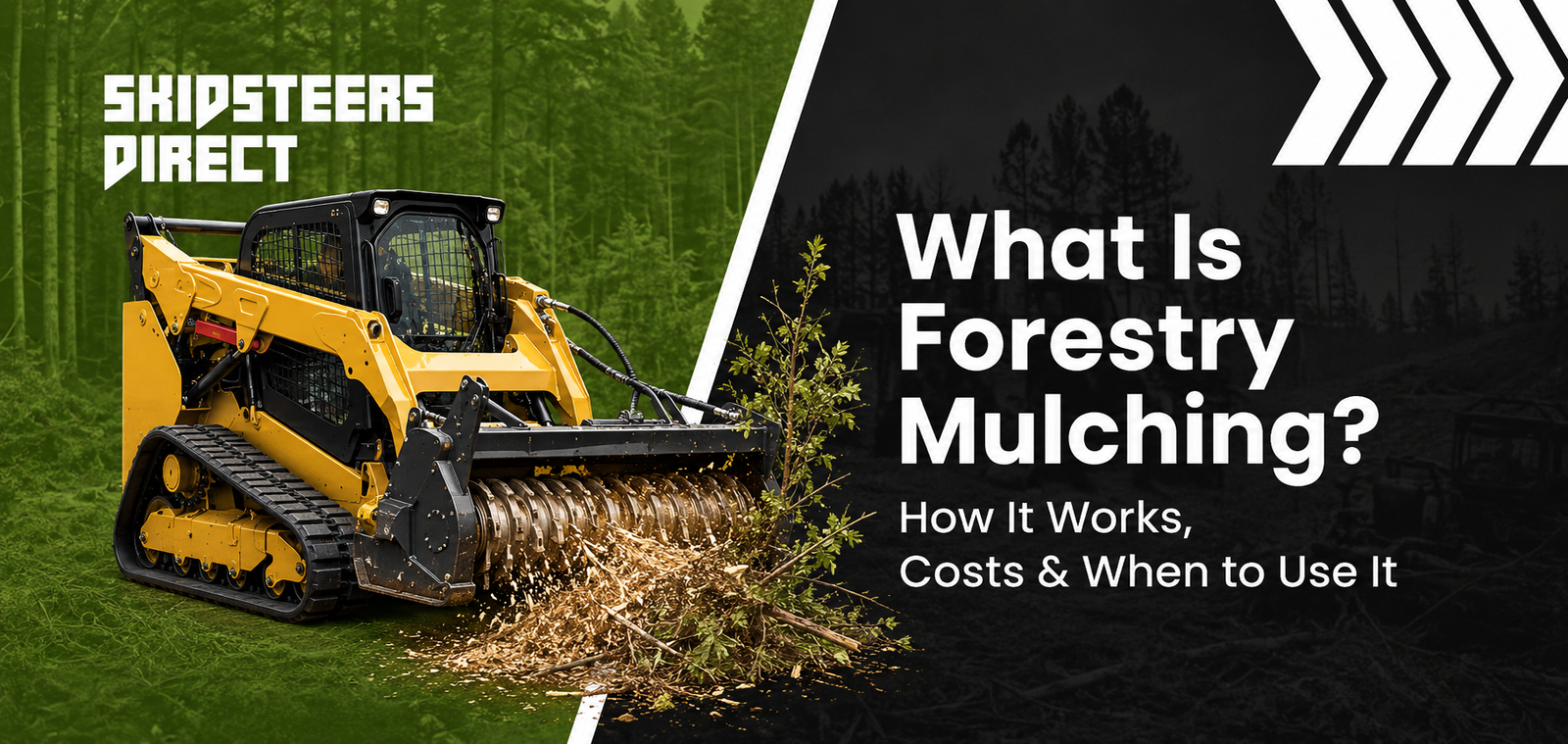
Traditional land clearing goes like this: cut it all down, pile it up, rent a shredder or burn permit, haul the debris off-site, and then treat the exposed, erosion-prone soil you’ve created. Forest mulching skips all these steps.
Forest mulching uses a single machine equipped with a rotating drum of carbide teeth, a mulching head attachment, to cut, shred and deposit vegetation on the ground in one continuous pass. What was a foot brush becomes a layer of mulch. no stack No roll No tracking equipment.
Here’s everything you need to know before deciding if it’s right for your project.
How a mulching head works
A mulching head is a drum attachment equipped with hardened carbide cutting teeth. When spinning at operating speed, typically 1,500 to 2,000 rpm, these tines shred anything they come in contact with: brush, saplings up to 4 to 6 inches in diameter, and in some configurations, trees up to 12 inches.
Shredded material is blown downward, forming a 2- to 4-inch layer of mulch on the ground. This layer does three things simultaneously: it suppresses weed growth, prevents surface layer erosion from the next rain event, and begins to break down to return nutrients to the soil. It is site cleaning and preparation in one operation.
Mulching heads are available for skid steers, skid steers and excavators. Miniature shredder attachments are the most common choice for smaller properties and tighter access. A tracked skid steer can navigate terrain that a full forestry machine can’t.
Forest clearing versus traditional land clearing
The comparison is important because most homeowners default to what their neighbor did, which is usually cut and haul. Here’s where the two methods really differ:
- A pass vs. multicrew: Mulching is done in a single pass. Traditional clearing requires a feller, a shredder, and a haul truck—three separate operations.
- leftovers: Mulching does not produce waste to dispose of. Traditional cleaning requires pulling or burning, adding cost and allowing for complexity.
- Ground disturbance: Mulching leaves root systems largely intact, minimizing erosion. Clearing and clearing removes root structure, leaving bare soil vulnerable to the next storm.
- Selective cleaning: A skilled mulching operator can remove the invasive species and leave the wood. Traditional cleaning is much less precise.
- Access: Crawler mulchers navigate slopes up to 45 degrees and terrain where an excavator would be damaged or stuck.
The trade-off: Traditional clearing is the best call when you need stumps completely removed for a foundation dump or when you’re clearing large-diameter trees that exceed the shredder’s capacity.
When forest mulching is the right choice
Mulching wins in projects where the priorities are minimal disturbance, speed and little cleanup after cleaning. The most common applications:
- Fence line and clearing of the right of way
- Removal of invasive species (brush, mesquite, privet, kudzu)
- Establishing the boundary of the property before a survey or sale
- Creation of firewalls and defensible space around the structures
- Maintenance of pipes and service corridors
- Recovery of pastures from bushes covered with vegetation
It is less suitable for projects where complete stump removal is required, such as preparing a residential lot for a foundation, or where the canopy is predominantly large-diameter hardwood that exceeds the head rating.
How much does forest mulching cost?
Contractor rates for forest gluing typically range from $150 to $400 per hour or $1,200 to $2,500 per acre, depending on vegetation density, terrain and region. Light brush clears faster and costs less per acre. Dense scrub with 3- to 5-inch stems requires more passes and costs more.
For owners who do this work regularly, clearing fences, managing brush on multiple properties, reclaiming pasture, having the attachment and operating it from a machine you already own changes the math completely. A quality miniature mulching header costs between $8,000 and $18,000, depending on size and manufacturer. At contractor rates of $200 an hour, that’s 40 to 90 hours of operation to break even.
Choose the right mulching head for your machine
The right mulching head depends on three variables: the hydraulic flow output (GPM) of your machine, the size of the vegetation you are clearing, and how often you will use it.
- Standard flow (15 to 20 GPM): Handles light brush and grass. Entry level option for occasional use.
- High Flow (25 to 40 GPM): Required for efficient operation on stems longer than 3 inches. More serious floor cleaning applications.
- Drum and Disc Heads: Drum heads (the most common) grind the material finely. Disc heads cut and throw, best for extremely dense, stronger and more spread material.
Check the hydraulic specifications of your machine before selecting a head. Running an undersized hydraulic system on a high demand attachment shortens the life of both the head and the machine’s hydraulic pump. Browse the shredder attachments at Skid Steers Direct to compare flow requirements and find a header that fits your loader.
The bottom line
If you’re clearing anything less than 6 inches in diameter and don’t need the stumps completely removed, forest mulching is almost always the fastest, least expensive, and least disruptive option. One machine, one pass, one layer of mulch left behind and the site is stable the same day you finish. Find the right mulching attachment for your skid steer and check specifications, compatibility and pricing.
